White matter hyperintensity volume

Papers on white matter hyperintensity volume

616 papers17 new in 30 days

Wednesday, November 18

Women's Health Reports

Lifetime hormone exposure linked to brain vessel markers in women

An observational analysis of postmenopausal UK Biobank women linked longer lifetime hormone exposure to a smaller volume of bright spots on brain scans.An observational analysis of postmenopausal UK Biobank women linked longer lifetime hormone exposure to a smaller volume of bright spots on brain scans.

Brain cross-sections beside small upright women show dense white spots around central fluid spaces on one side and sparse spots on the other.
Cross-sectional · 8,826 peoplePopulations

Monday, November 16

medRxiv

Smoking patterns linked to midlife brain differences

A 15-year study of 1,900 Dutch adults linked persistent smoking to double the white-matter hyperintensities, bright areas on brain scans, compared with nonsmoking.A 15-year study of 1,900 Dutch adults linked persistent smoking to double the white-matter hyperintensities, bright areas on brain scans, compared with nonsmoking.

Brain cross-sections show a large section with many white patches beneath smaller sections with fewer patches and distinct folded outer layers.
Preprint: cohort · 1,900 peoplePopulations

Friday, November 13

AJOG Global Reports

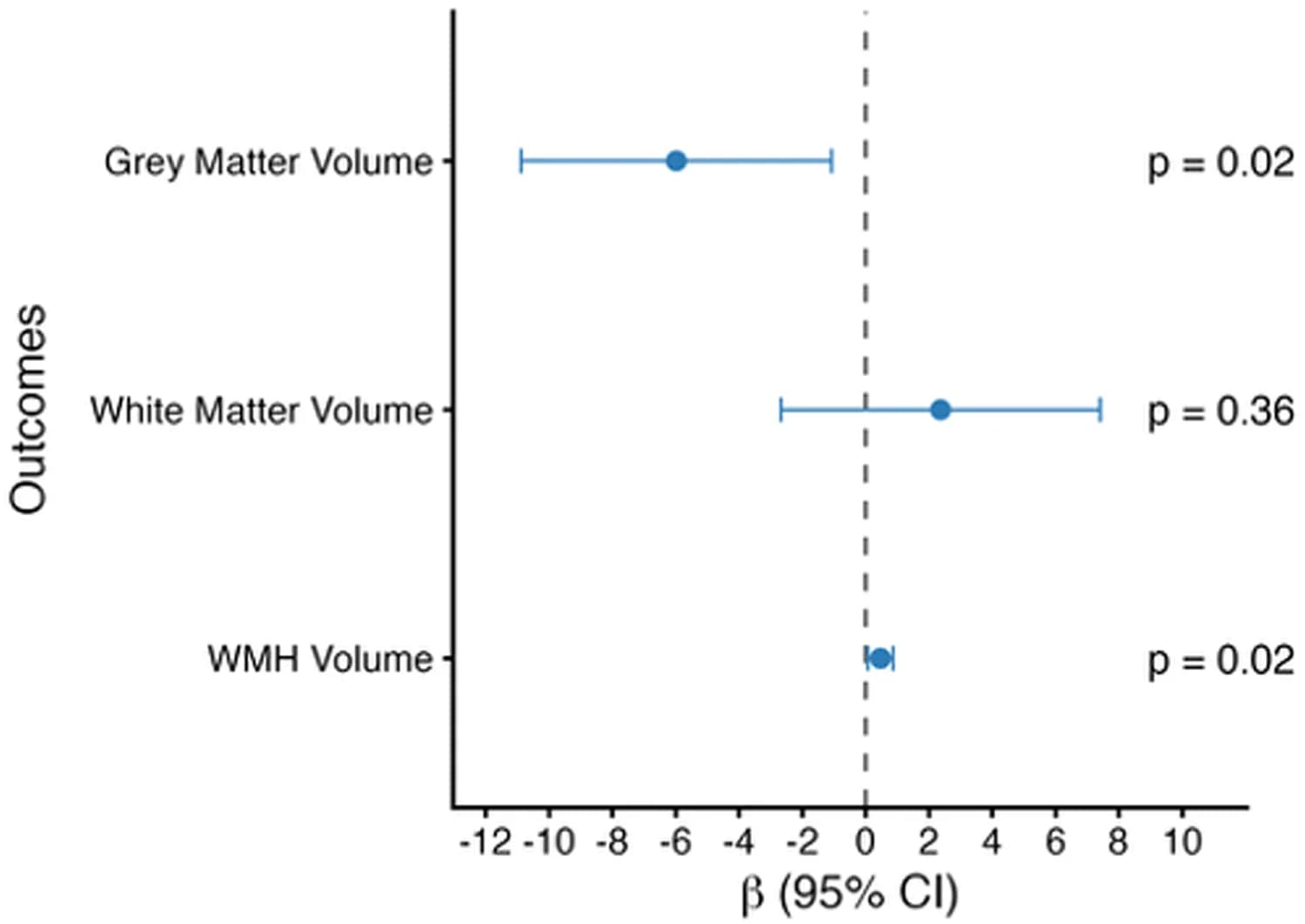
High blood pressure in pregnancy linked to later brain differences

Gray matter volume was 6.0 mL lower in women who developed high blood pressure during pregnancy than in women with normal blood pressure during pregnancy.Gray matter volume was 6.0 mL lower in women who developed high blood pressure during pregnancy than in women with normal blood pressure during pregnancy.

Differences in females with a history of new-onset hypertensive disorders of pregnancy versus females with normotensive pregnancy for morphologic brain structures, (mL)
medRxiv

Model mapped white matter lesions more accurately in brain scans

The model scored 0.73 for overlap with reference lesion maps, compared with 0.50, 0.57 and 0.29 for three existing tools.The model scored 0.73 for overlap with reference lesion maps, compared with 0.50, 0.57 and 0.29 for three existing tools.

Brain cross-section with closely outlined white lesions, surrounded by smaller brain sections with incomplete or oversized lesion outlines.
Preprint: computational studyBiomarkers

Wednesday, November 11

GeroScience

Brain scans improve dementia risk ranking beyond frailty

A simplified score achieved 0.843 on a measure of risk ranking, while a fuller model outperformed frailty alone over 10 years.A simplified score achieved 0.843 on a measure of risk ranking, while a fuller model outperformed frailty alone over 10 years.

Brain sections with many white patches and smaller hippocampi versus unbroken tissue and fuller hippocampi sit beside small upright human figures.
Cohort · 63,509 peopleIncident dementia

Friday, November 6

Research Square

Uneven grip strength linked to later dementia in UK adults

Uneven grip strength was linked to a higher relative rate of dementia than normal grip strength (hazard ratio 1.17), with stronger links for weakness.Uneven grip strength was linked to a higher relative rate of dementia than normal grip strength (hazard ratio 1.17), with stronger links for weakness.

Transition dynamics of handgrip strength (HGS) phenotypes in a multi-state Markov model.
Preprint: cohort · 363,867 peopleAll-cause dementia

Wednesday, November 4

Journal of the American Heart Association

Sleep linked to brain health in diabetes, heart disease or stroke

Adults with diabetes, heart disease or stroke and healthy rather than poor sleep had higher overall cognitive scores, with a model-estimated difference of 0.02.Adults with diabetes, heart disease or stroke and healthy rather than poor sleep had higher overall cognitive scores, with a model-estimated difference of 0.02.

Figure from Journal of the American Heart Association
Cross-sectional · 408,977 peopleHeart disease

Saturday, October 31

Alzheimer's & Dementia Behavior & Socioeconomics of Aging

Social disadvantage linked to poorer thinking skills in Black men

Greater disadvantage was linked to lower memory scores in 331 non-Hispanic Black men; the coefficient, which measures the statistical link, was minus 0.23.Greater disadvantage was linked to lower memory scores in 331 non-Hispanic Black men; the coefficient, which measures the statistical link, was minus 0.23.

Figure from Alzheimer's & Dementia Behavior & Socioeconomics of Aging
Cross-sectional · 331 peoplePopulations

Friday, October 30

Wednesday, October 28

Brain Communications

Strength training showed no clear overall effect on brain lesions

After 12 months, whole-brain lesion volume differed by minus 0.016 log-transformed cubic centimeters versus balance and tone exercises, with no clear group difference.After 12 months, whole-brain lesion volume differed by minus 0.016 log-transformed cubic centimeters versus balance and tone exercises, with no clear group difference.

Figure from Brain Communications
Randomized trial · 73 peopleResistance training

Monday, October 26

Saturday, October 24

Thursday, October 22

Tuesday, October 20

Sunday, October 18

Friday, October 16

Stroke

Blood protein linked to lower brain lesion volume

Higher blood levels of the protein cathepsin B were linked to lower lesion volume, with an association estimate of minus 0.09 in 5,260 people.Higher blood levels of the protein cathepsin B were linked to lower lesion volume, with an association estimate of minus 0.09 in 5,260 people.

Figure from Stroke
Cohort · 5,260 peopleMechanisms
Translational Psychiatry

Longer activity bouts linked to lower dementia risk

Compared with never doing moderate-to-vigorous activity, 13-minute bouts were linked to a 72% lower relative risk of dementia.Compared with never doing moderate-to-vigorous activity, 13-minute bouts were linked to a 72% lower relative risk of dementia.

Study overview. Created in BioRender.
Cohort · 66,483 peopleDementia

Thursday, October 15

Tuesday, October 13

medRxiv

Brain small-vessel disease differed by ethnic and racial group

Black participants’ odds of greater combined disease burden were 1.66 times those of South Asian participants and 2.36 times those of Chinese participants.Black participants’ odds of greater combined disease burden were 1.66 times those of South Asian participants and 2.36 times those of Chinese participants.

All ten pairwise contrasts for the core automated cSVD markers in the full sample.
Preprint: cross-sectional · 1,377 peoplePopulations

Tuesday, October 6

Sunday, October 4

Alzheimer's Research & Therapy

Education links to better cognition independent of brain pathology

Across two aging cohorts spanning normal cognition to mild Alzheimer’s disease, higher education tracked with better cognitive performance even after adjusting for…Across two aging cohorts spanning normal cognition to mild Alzheimer’s disease, higher education tracked with better cognitive performance even after adjusting for multimodal brain pathology.

Figure from Alzheimer's Research & Therapy
Cohort study in peoplePopulations

Friday, October 2

Translational Stroke Research

Plasma CXCL10 links to higher stroke risk in older adults

Each 1-standard deviation higher CXCL10 was linked to 20% greater stroke risk over a median follow-up of 14 years.Each 1-standard deviation higher CXCL10 was linked to 20% greater stroke risk over a median follow-up of 14 years.

Plasma pools with dense and sparse dark proteins sit beside brain sections, the denser pool beside gray tissue with a damaged patch.
Cohort study of 1,175 peopleCXCL10

Thursday, October 1

Neurology Genetics

GLP-1 receptor agonists link to lower stroke and Alzheimer risk

A cross-ancestry Mendelian randomization study of up to 1,812,017 individuals linked genetically proxied GLP-1 receptor agonist exposure to reduced risk of stroke and…A cross-ancestry Mendelian randomization study of up to 1,812,017 individuals linked genetically proxied GLP-1 receptor agonist exposure to reduced risk of stroke and Alzheimer disease.

Summary of Analysis Plan.
Mendelian randomization in peopleGLP-1 receptor agonists

Thursday, September 24

Arteriosclerosis, Thrombosis, and Vascular Biology

AI-estimated blood vessel age linked to poorer brain health

Each standard-deviation increase in estimated blood vessel age was linked to 1.44 times the odds of brain infarcts—areas of dead brain tissue.Each standard-deviation increase in estimated blood vessel age was linked to 1.44 times the odds of brain infarcts—areas of dead brain tissue.

Figure from Arteriosclerosis, Thrombosis, and Vascular Biology
Cross-sectional · 2,313 peopleBiomarkers

Tuesday, September 22

Tuesday, September 15