Social disadvantage linked to poorer thinking skills in Black men
Greater disadvantage was linked to lower memory scores in 331 non-Hispanic Black men; the coefficient, which measures the statistical link, was minus 0.23.
Limit: Self-reported social disadvantage is vulnerable to recall and reporting bias
Edited by Boris Djordjevic · AgingResearch.News
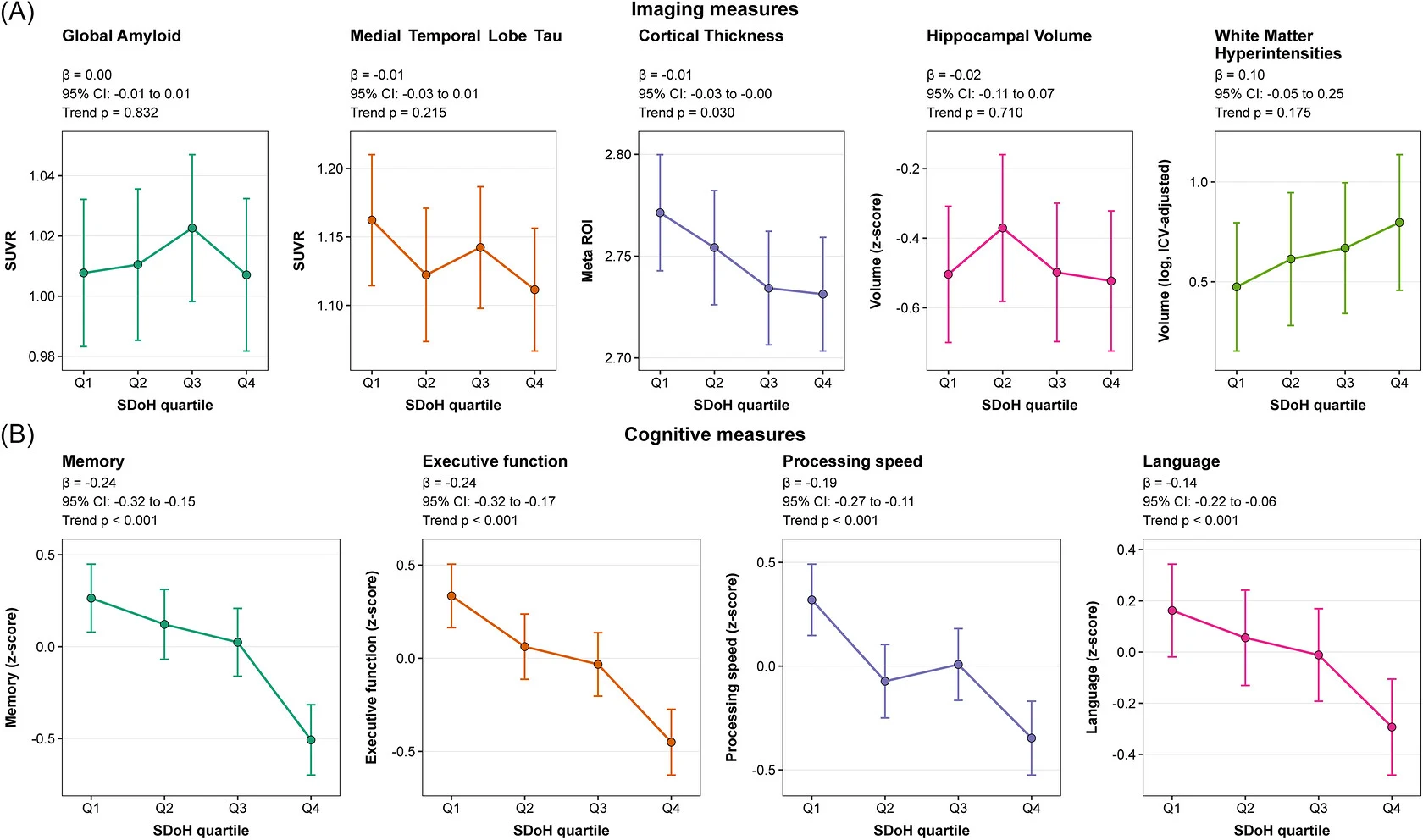
An observational analysis examined data from 331 non-Hispanic Black men in the Health and Aging Brain Study–Health Disparities cohort. Researchers divided participants into four groups based on a combined score of unfavorable social conditions. They assessed thinking skills and brain scans measuring features related to Alzheimer’s disease.
Greater disadvantage was associated with lower scores for memory, executive function, processing speed and language. Executive function covers skills such as planning and managing tasks. Some links between brain measurements and thinking skills were weaker among men facing more unfavorable social conditions. These included measurements of amyloid and tau, proteins associated with Alzheimer’s disease, and the volume of the hippocampus, a brain region important for memory.
Why it matters
The authors suggested that understanding cognitive differences may require considering adverse social conditions beyond what Alzheimer’s-related brain scans capture.
Caveats
This observational analysis cannot establish whether unfavorable social conditions caused cognitive differences. The findings do not establish whether the same patterns apply to women or other racial and ethnic groups.
From the paper
- Participants
Among 331 participants, mean age differed significantly across SDoH quartiles (p < 0.001), with individuals in the most unfavorable quartile (Q4) being younger on average than those in the most favorable quartile (Q1) (60.9 ± 6.1 vs. 65.3 ± 8.0 years).
- Result
Significant interactions were observed between SDoH quartiles and global amyloid burden for memory (β = 1.17, 95% confidence interval [CI]: 0.08 to 2.26).
- Limitation
SDoH indicators were primarily based on participant-reported information and may be subject to recall or reporting bias.
Quoted word for word from the full text on alz-journals.onlinelibrary.wiley.com.
- Cumulative unfavorable social determinants of health
- Memory composite
- Executive function composite
- Processing speed composite
- Language composite
- Humans
The paper
Sanders-Brown Center on Aging University of Kentucky College of Medicine Lexington Kentucky USA
Alzheimer's & Dementia Behavior & Socioeconomics of Aging, Oct 30, 2026, Open access, CC BY-NC-ND