Plasma CXCL10 links to higher stroke risk in older adults
Each 1-standard deviation higher CXCL10 was linked to 20% greater stroke risk over a median follow-up of 14 years.
Our read
Biomarkers- Studied:
- Cohort study of 1,175 people
- In the record:
- The 19th paper on CXCL10 with results in people; 105 on record in all.
Editor of record: Boris Djordjevic · AgingResearch.News
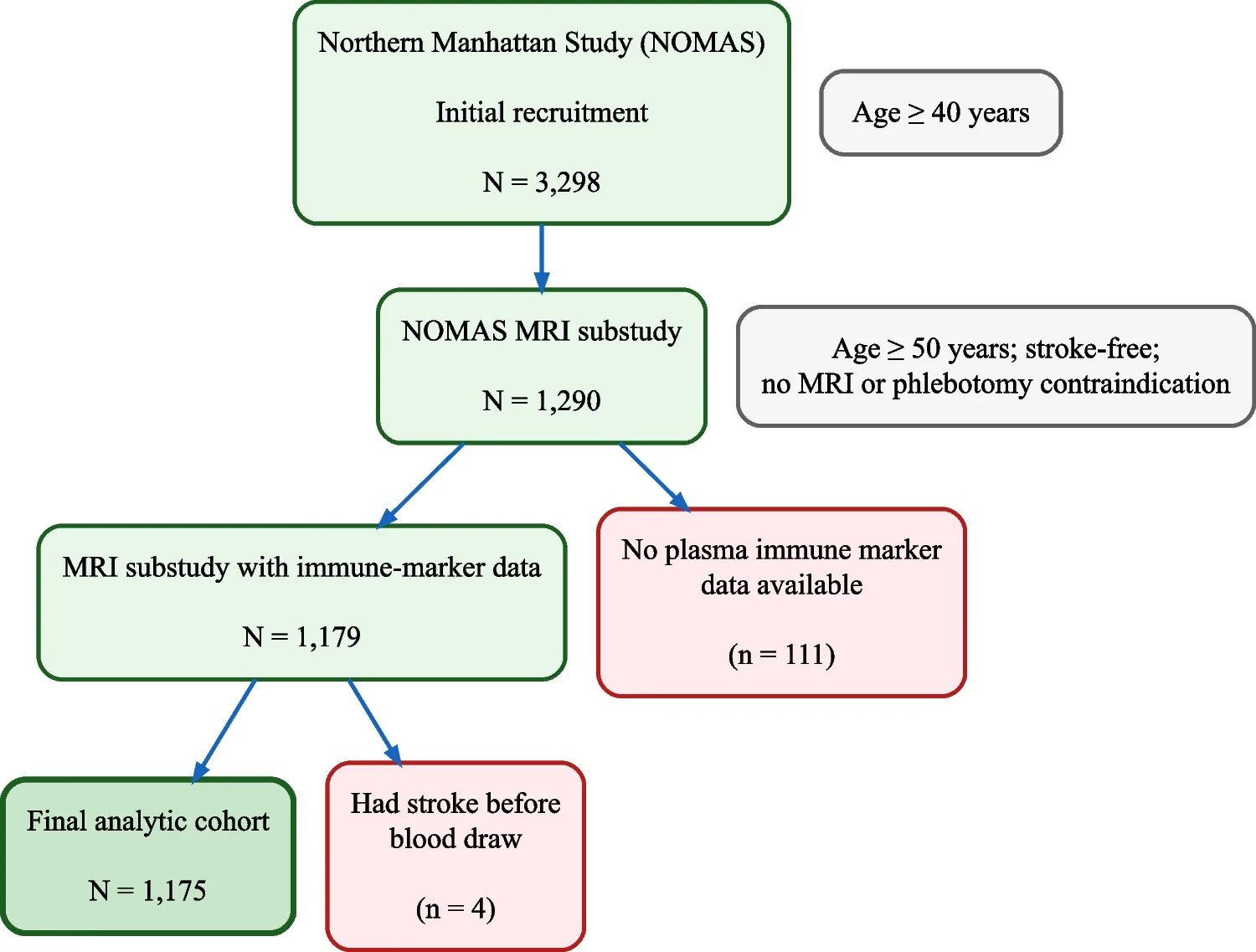
In an observational study of 1,175 stroke-free older adults from the Northern Manhattan Study, researchers analyzed 60 plasma immune-related proteins to identify markers associated with incident stroke. Participants had a mean age of 70 years, were 60% women, and 67% identified as Hispanic. Over a median of 14 years, 130 participants had a stroke, 101 of which were ischemic.
Statistical modeling selected two candidate chemokines, CXCL9 and CXCL10. After adjusting for vascular risk, cardiac conditions, white matter hyperintensity volume, and classical inflammatory cytokines, each 1-standard deviation increase in baseline CXCL10 was associated with 20% higher all-cause stroke risk (HR 1.20; 95% CI 1.04–1.38). CXCL9 was not independently associated with stroke.
Why it matters
The findings suggest that interferon-gamma-responsive immune signaling may play a distinct role in late-life cerebrovascular vulnerability. Pinpointing specific inflammatory proteins like CXCL10 could refine how researchers assess stroke risk driven by chronic inflammation in aging populations.
Caveats
Because this study is observational, the association does not prove that CXCL10 directly causes stroke. The authors note that whether CXCL10 represents a modifiable target for stroke prevention warrants further study.
From the paper
- Participants
Among 1175 stroke-free participants (mean age 70 ± 9 years; 60% women; 67% Hispanic), 130 incident strokes occurred over a median follow-up of 14 (IQR 10–16) years.
- Follow-up
Among 1175 stroke-free participants (mean age 70 ± 9 years; 60% women; 67% Hispanic), 130 incident strokes occurred over a median follow-up of 14 (IQR 10–16) years.
- Result
In multivariable Cox models, each 1-SD greater CXCL10 was associated with 21% greater all-cause stroke risk after adjustment for GVRS and cardiac comorbidities (Model 3; HR 1.21; 95% CI 1.06–1.39).
Quoted word for word from the full text on PubMed Central.
The paper
Chemokine CXCL10 and Incident Stroke Risk in the Northern Manhattan Study
University of Miami
Translational Stroke Research, Oct 2, 2026, Open access


Comments
Be the first to comment.