Hippo–YAP signaling

Papers on hippo–YAP signaling

315 papers22 new in 30 days

Monday, November 16

Thursday, November 12

Tuesday, November 10

Saturday, November 7

AHA Scientific Sessions 2026 Abstract

Vessel-cell enzyme helped drive artery plaque buildup in mice

Mice with high cholesterol developed less artery plaque when researchers deleted an enzyme from blood-vessel lining cells in experiments on disturbed blood flow.Mice with high cholesterol developed less artery plaque when researchers deleted an enzyme from blood-vessel lining cells in experiments on disturbed blood flow.

An opened artery with heavy plaque and a constricting loop sits beside a smaller artery with little plaque and a laboratory mouse.
Mouse studyMechanisms

Friday, November 6

Wednesday, November 4

Tuesday, November 3

Journal of Nanobiotechnology

Immune-cell particles ease bone and muscle decline in aged mice

Experiments in naturally aged mice found benefits from immune-cell particles, with aerobic exercise further improving selected tissue-rebuilding and movement measures.Experiments in naturally aged mice found benefits from immune-cell particles, with aerobic exercise further improving selected tissue-rebuilding and movement measures.

Figure from Journal of Nanobiotechnology
Mouse studyBones and joints

Monday, November 2

Sunday, November 1

Friday, October 30

Bioactive Materials

Engineered stem cell clusters aid blood flow recovery in mice

In a mouse model of restricted blood supply, clusters containing tiny plates took hold better after transplantation and sped blood vessel regeneration.In a mouse model of restricted blood supply, clusters containing tiny plates took hold better after transplantation and sped blood vessel regeneration.

Figure from Bioactive Materials
Mouse studyInterventions

Thursday, October 29

IMetaOmics

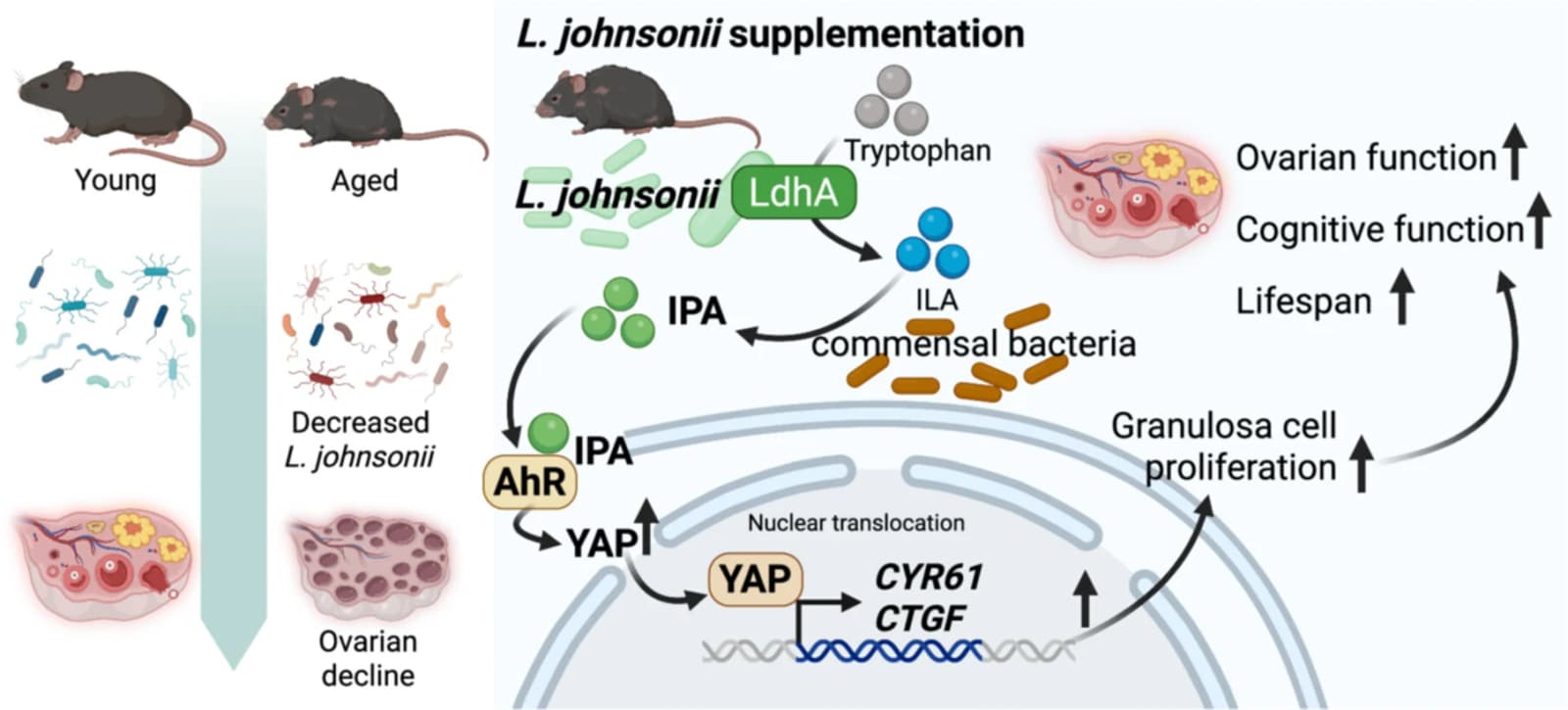
Gut bacterium partly restores hormone levels in aging mice

Experiments in female mice also reported reversed cognitive decline and longer lifespan after researchers restored a bacterium that declined with ovarian failure.Experiments in female mice also reported reversed cognitive decline and longer lifespan after researchers restored a bacterium that declined with ovarian failure.

Figure from IMetaOmics

Saturday, October 24

Friday, October 23

International Journal of Biological Sciences

Young plasma particles increased bone mass in mice

Experiments in female mice with surgically induced osteoporosis found that young plasma exosomes, tiny membrane-enclosed particles, increased bone mass and favored…Experiments in female mice with surgically induced osteoporosis found that young plasma exosomes, tiny membrane-enclosed particles, increased bone mass and favored anti-inflammatory immune cells.

Effects of young and aged plasma and exosome depletion on macrophage polarization and osteogenic and inflammatory markers in OVX mice.
Mouse studyBones and joints

Wednesday, October 21

Tuesday, October 20

Communications Biology

Diabetes drug reduced kidney injury in diabetic rats

An experiment in diabetic rats found that dapagliflozin reduced kidney dysfunction and scarring alongside less iron-dependent cell death.An experiment in diabetic rats found that dapagliflozin reduced kidney dysfunction and scarring alongside less iron-dependent cell death.

Figure from Communications Biology
Rat studyKidney

Saturday, October 17

Biomaterials

Engineered membrane strengthens outer bone in animal models

Experiments in aged animals and animals with reduced weight-bearing found that a membrane targeting inflammation and responses to mechanical forces increased outer bone…Experiments in aged animals and animals with reduced weight-bearing found that a membrane targeting inflammation and responses to mechanical forces increased outer bone thickness.

Figure from Biomaterials
Mouse studyBones and joints

Friday, October 16

Wednesday, October 14

Tuesday, October 13

bioRxiv

Intestinal repair linked to lower gene-based age estimates in mice

In injury experiments, intestinal cells temporarily had lower gene-based age estimates, with the timing differing between young and old mice.In injury experiments, intestinal cells temporarily had lower gene-based age estimates, with the timing differing between young and old mice.

Intestinal transcriptomic clocks capture aging and rejuvenation.
Preprint: mouse studyBiomarkers

Thursday, September 24

Tuesday, September 22