Engineered membrane strengthens outer bone in animal models
Experiments in aged animals and animals with reduced weight-bearing found that a membrane targeting inflammation and responses to mechanical forces increased outer bone thickness.
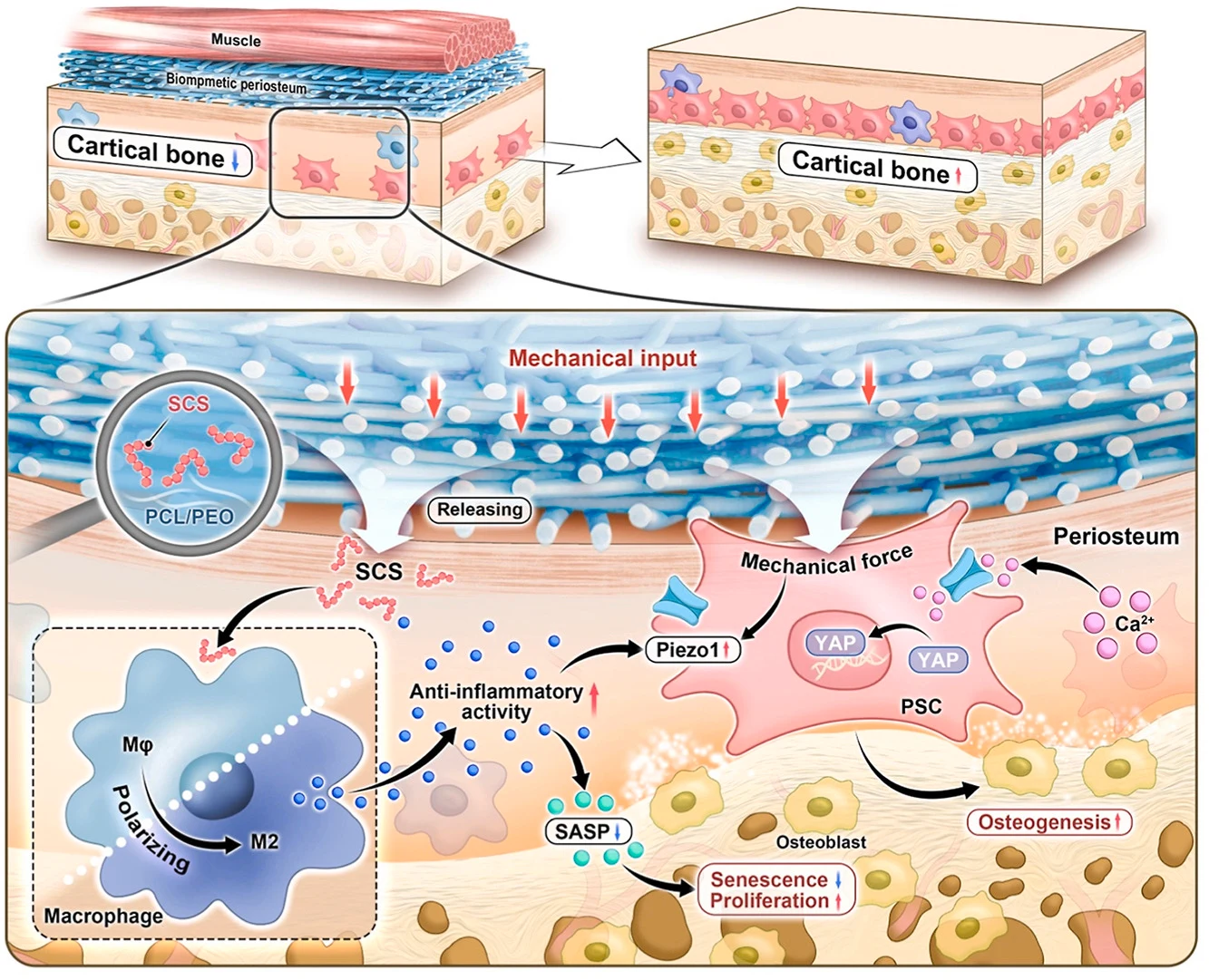
In experiments in aged animal models and models with reduced weight-bearing on the hindlimbs, researchers tested a membrane designed to mimic the periosteum, the tissue covering bone. They designed it to address inflammation and weakened responses to mechanical forces.
One component shifted immune cells away from a pro-inflammatory state. A specially designed fibre structure activated Piezo1, a protein that senses mechanical forces. Together, these components restored the ability of precursor cells in the periosteum to form bone. The membrane also enhanced the thickness and strength of bone’s hard outer layer. The bone-regenerating effect disappeared in mice lacking Piezo1 in a specific group of cells, indicating that sensing mechanical forces through this protein was necessary for the effect.
Why it matters
Age-related bone loss affects the load-bearing outer layer, which current interventions largely neglect. The work points to its surrounding tissue as a target for rebuilding bone during aging and disuse.
Caveats
These were animal experiments, not studies in people. The abstract did not report animal numbers, effect sizes or testing duration.
The paper
Dual immuno-mechanical programming of a biomimetic periosteum for load-bearing bone restoration
East China University of Science and Technology
Biomaterials, 13 Oct 2026