Engineered stem cell clusters aid blood flow recovery in mice
In a mouse model of restricted blood supply, clusters containing tiny plates took hold better after transplantation and sped blood vessel regeneration.
Limit: Follow-up ended after 28 days, leaving longer-term blood flow recovery unmeasured
Edited by Boris Djordjevic · AgingResearch.News
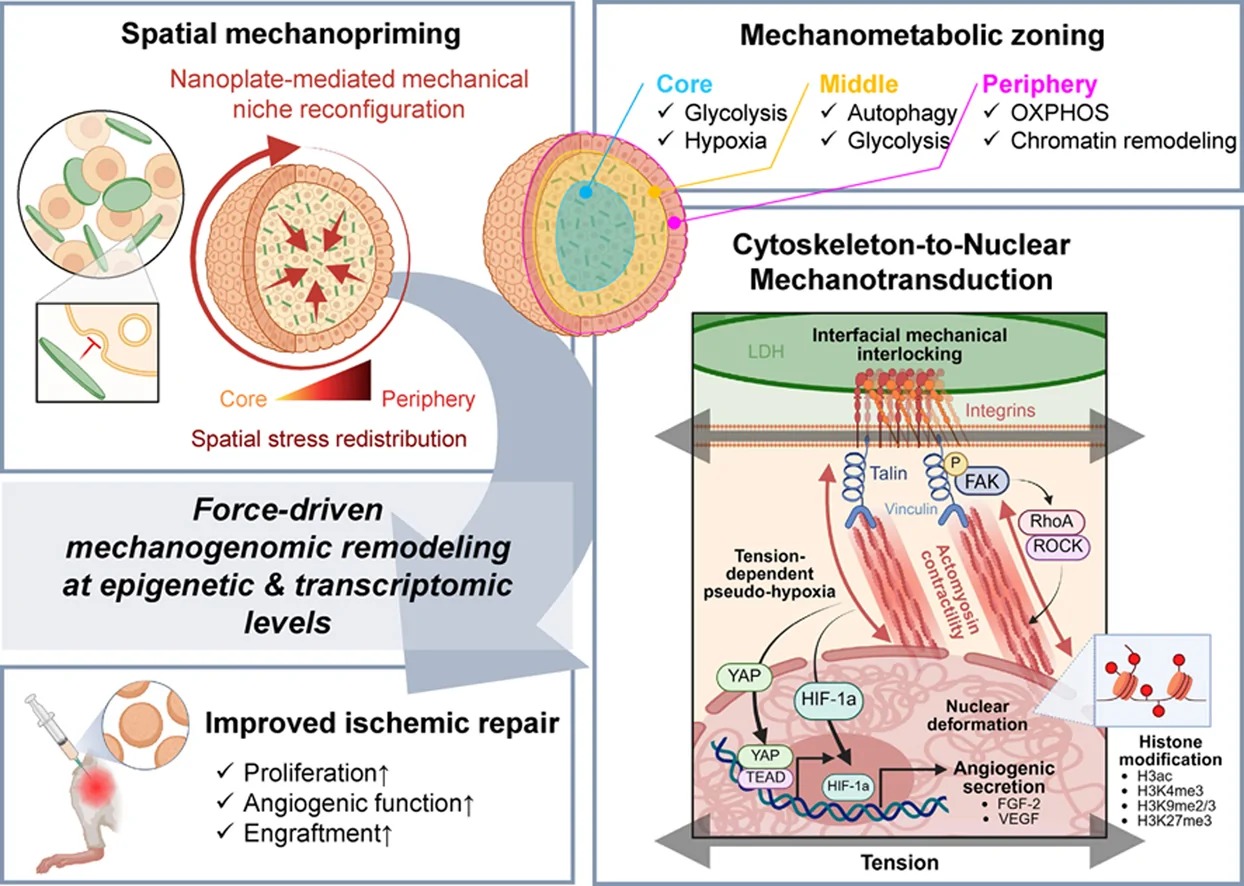
Researchers ran laboratory experiments with mesenchymal stem cell spheroids, three-dimensional clusters of a type of stem cell. They placed tiny plates, about 350 nanometers in size, between the cells. The resulting contact surfaces redistributed mechanical stress and strengthened force transmission through the cells’ supporting fibers to their DNA-containing nuclei. Cells in the clusters showed changes in nuclear shape, gene regulation and the spatial pattern of metabolic activity. The clusters also increased secretion of signals that promote blood vessel growth.
In mice with ischemia, a restricted blood supply, the engineered clusters took hold better after transplantation. They also accelerated blood vessel regeneration and improved blood flow recovery.
Why it matters
The work bears on a question for regenerative approaches to aging: how to organize stem cells to strengthen their tissue-repair potential.
Caveats
The evidence came from cell-cluster experiments and a mouse model, not tests in people. The authors described the link between cell tension and low-oxygen-like signaling as putative.
- Mesenchymal stem cell spheroids
- Spatial mechanopriming
- Angiogenesis
- Epigenetic regulation of gene expression
- Ischemia
- Mice
The paper
Mongolian University of Pharmaceutical Sciences; Dankook University
Bioactive Materials, Oct 22, 2026, Open access