CGAS

Papers on CGAS

372 papers11 new in 30 days

Wednesday, November 11

Cellular & Molecular Biology Letters

Blocking an ion channel reduced cartilage damage in mice

Experiments in mice with osteoarthritis found that inhibiting or removing the channel also reduced bone hardening and senescence, a state in which cartilage cells stop…Experiments in mice with osteoarthritis found that inhibiting or removing the channel also reduced bone hardening and senescence, a state in which cartilage cells stop dividing.

Figure from Cellular & Molecular Biology Letters
Mouse studyBones and joints

Saturday, November 7

AHA Scientific Sessions 2026 Abstract

Excess glucose breakdown hampers blood vessel repair in mice

Mice engineered to increase glucose breakdown in blood vessel–lining cells showed poorer blood-flow recovery and lower capillary density after hindlimb blood supply was…Mice engineered to increase glucose breakdown in blood vessel–lining cells showed poorer blood-flow recovery and lower capillary density after hindlimb blood supply was restricted.

Muscle tissue beside mice contrasts dense capillaries and intact fibers with sparse vessels, torn fibers, and fragmented mitochondria.
Mouse studyMechanisms

Friday, November 6

Biology

Older female mice lacking a DNA sensor had worse liver injury

An experiment comparing 8- and 56-week-old female mice found the worst damage after interrupted liver blood flow in older mice missing a DNA-sensing enzyme.An experiment comparing 8- and 56-week-old female mice found the worst damage after interrupted liver blood flow in older mice missing a DNA-sensing enzyme.

Damaged liver tissue crowded with inflammatory cells contrasts with orderly tissue, beside a laboratory mouse and a gut lining with gaps.
Mouse studyMechanisms

Thursday, November 5

Monday, November 2

Biology Direct

Protein-blocking drug eased intestinal inflammation in mice

A selective protein inhibitor reduced disease severity in two experimental models of colitis, a form of intestinal inflammation.A selective protein inhibitor reduced disease severity in two experimental models of colitis, a form of intestinal inflammation.

Figure from Biology Direct
Mouse studyInflammation
Frontiers in Cell and Developmental Biology

A protein reduced dialysis-related tissue scarring in mice

In a dialysis mouse model, the protein SIRT3 also suppressed immune cell senescence, a state in which cells stop dividing.In a dialysis mouse model, the protein SIRT3 also suppressed immune cell senescence, a state in which cells stop dividing.

Abdominal lining with dense scar fibers beside smoother tissue, surrounded by enlarged damaged immune cells, smaller healthy cells, and a laboratory mouse.
Accepted, not yet published: mouse studyInterventions

Monday, October 26

Advanced Science

In cells, senescent fat stem cells transfer damaged mitochondria

Cell experiments showed that vesicles from senescent fat stem cells carried damaged mitochondria, disrupting mitochondrial balance and activating inflammatory signaling…Cell experiments showed that vesicles from senescent fat stem cells carried damaged mitochondria, disrupting mitochondrial balance and activating inflammatory signaling in spinal disc cells.

Senescent ADSC‐derived MVs lose the protective effects of normal ADSC‐derived MVs and aggravate mitochondrial inflammatory injury in NPCs.
Human cell studyCellular senescence

Friday, October 23

Thursday, October 15

Wednesday, October 14

Tuesday, October 13

Thursday, October 8

Journal of Cellular Physiology

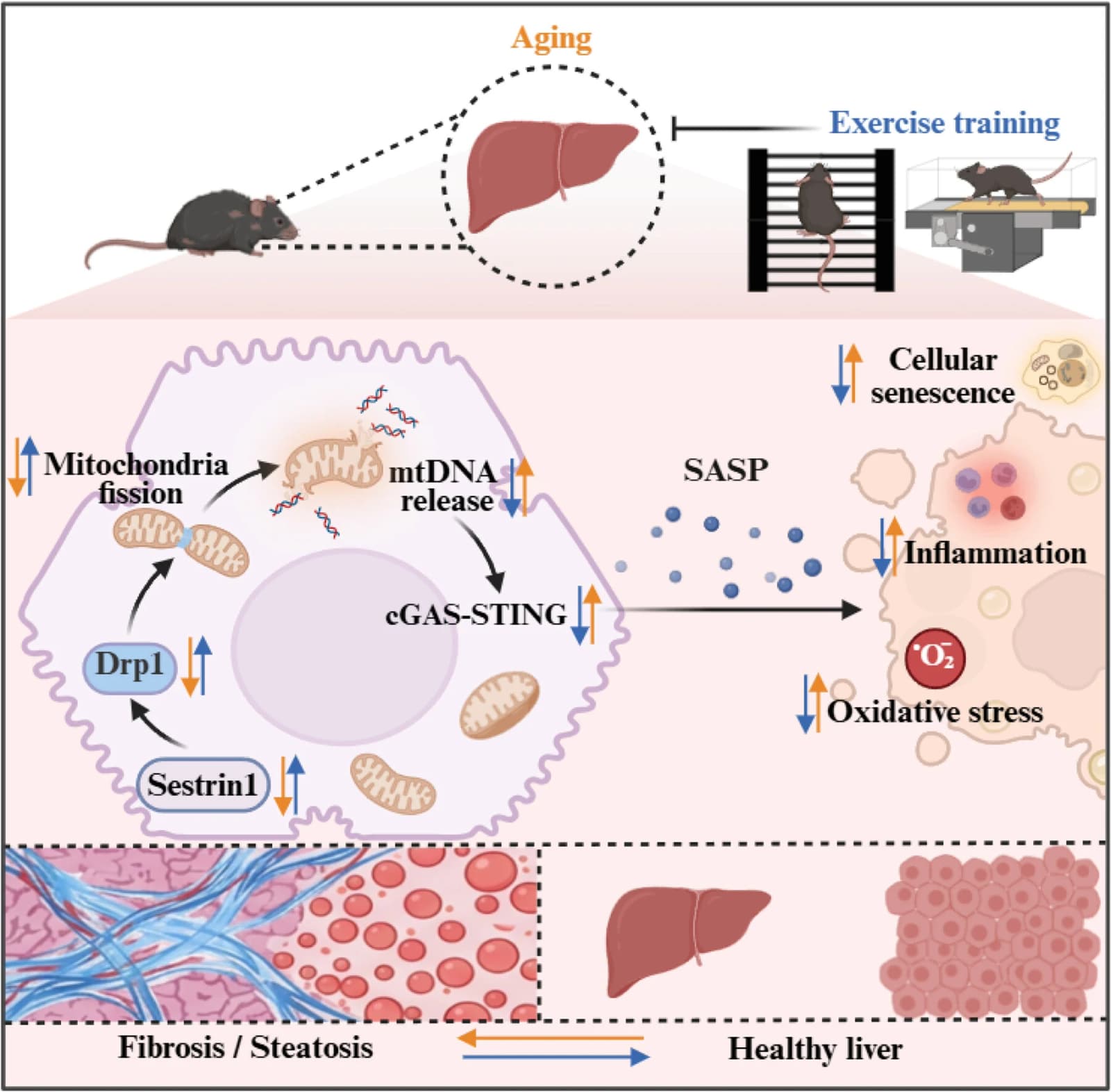
Sestrin1 protects aging livers and aids exercise in mice

In aged mice, lacking Sestrin1 worsened liver cell senescence and fat buildup, and the protein proved indispensable for the liver benefits of exercise.In aged mice, lacking Sestrin1 worsened liver cell senescence and fat buildup, and the protein proved indispensable for the liver benefits of exercise.

Figure from Journal of Cellular Physiology
Experiments in miceInterventions

Sunday, October 4

Wednesday, September 30

Saturday, September 26

Thursday, September 24

Research Square

Compound reduced disease-linked aging-like gene changes in mice

In mice with chemically induced Gaucher disease, MA-5 reduced aging-like gene changes, with particularly prominent effects in brain immune cells.In mice with chemically induced Gaucher disease, MA-5 reduced aging-like gene changes, with particularly prominent effects in brain immune cells.

MA-5 ameliorates disease phenotypes and neuroinflammation in GD mice.
Preprint: mouse studyInterventions

Saturday, September 19

Friday, September 18

Wednesday, September 16

Tuesday, September 15

Monday, September 14

Sunday, September 13

Thursday, September 10

Wednesday, September 9

Tuesday, September 8