Yoda1-Functionalized Nanozymes Coordinate Piezo1 Activation and Mitochondrial Protection to Reprogram the Diabetic Osteoimmune Micromilieu and Promote Vascularized Bone Repair
Abstract
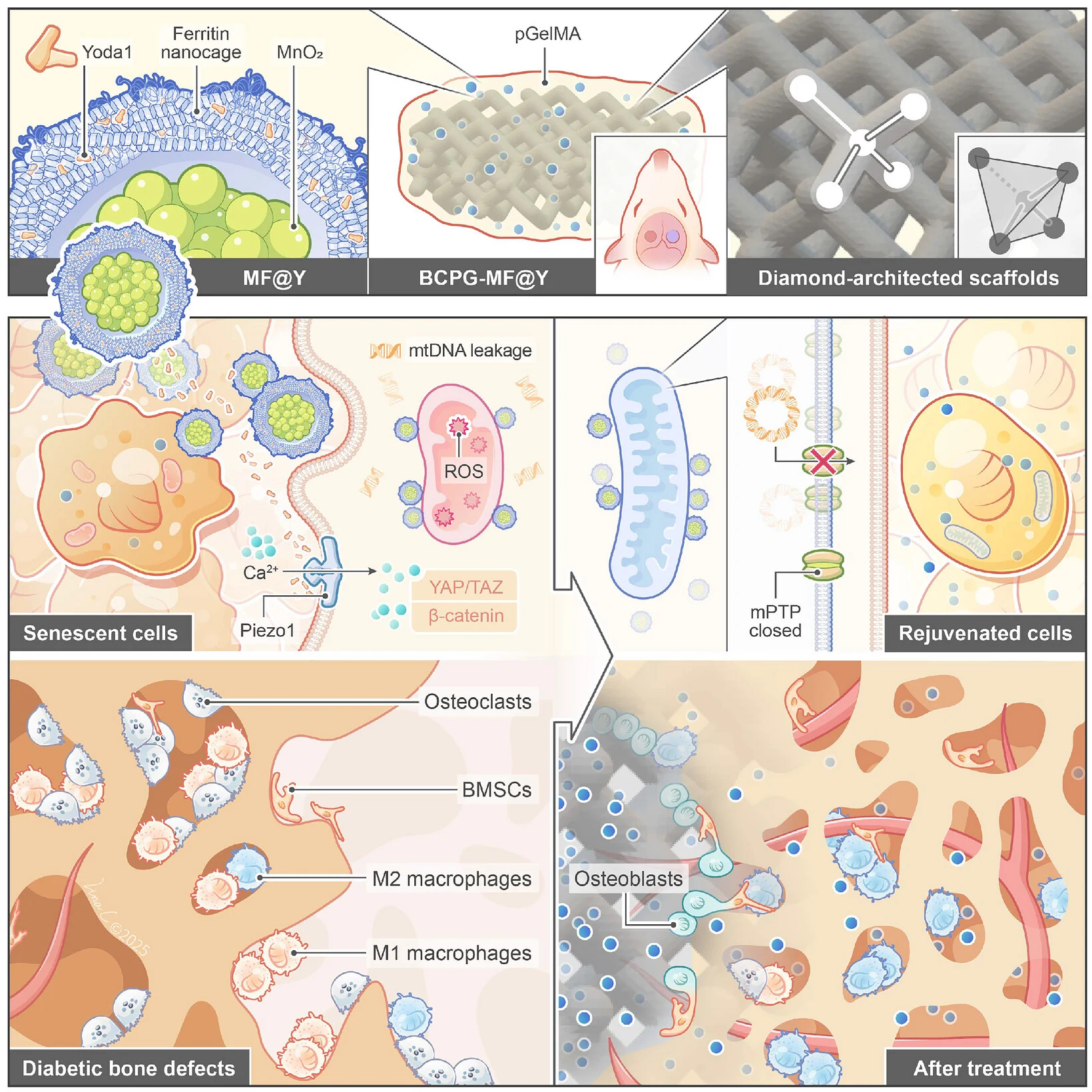
Despite advances in bone tissue engineering, repairing diabetic bone defects remains a formidable challenge. Here, we present an innovative strategy for diabetic bone regeneration, the BCPG-MF@Y scaffold, which features diamond lattices of 3D-printed biphasic calcium phosphate (BCP) integrating porous gelatine methacryloyl (pGelMA) hydrogels embedded with Yoda1-functionalized manganese dioxide-ferritin (MF@Y) biomimetic nanozymes. Our comprehensive analyses revealed that the MF@Y nanozyme orchestrates mitochondrial homeostasis in bone mesenchymal stem cells (BMSCs), effectively scavenges mtROS, maintains mitochondrial membrane potential, modulates mitochondrial permeability transition pore dynamics, and prevents mitochondrial DNA leakage into the cytosol. This leads to inhibition of cGAS‒STING pathway activation, rejuvenation of senescent cells, reduced inflammation, and control of BMSC differentiation. Yoda1-mediated activation of Piezo1 mimics mechanical stimulation, promoting osteogenic differentiation while inhibiting adipogenic and osteoclastic differentiation. The BCPG-MF@Y scaffold synergistically reprograms the osteoimmune micromilieu by protecting mitochondria and activating Piezo1, showing significant promise for vascularized bone repair in diabetic conditions and potential applications in chronic inflammatory disorders.
The paper
Shanghai Jiao Tong University
Advanced Science, 14 Oct 2026, Open access