Redox resilience in skeletal muscle aging: cellular adaptations and exercise-mediated homeostasis
Abstract
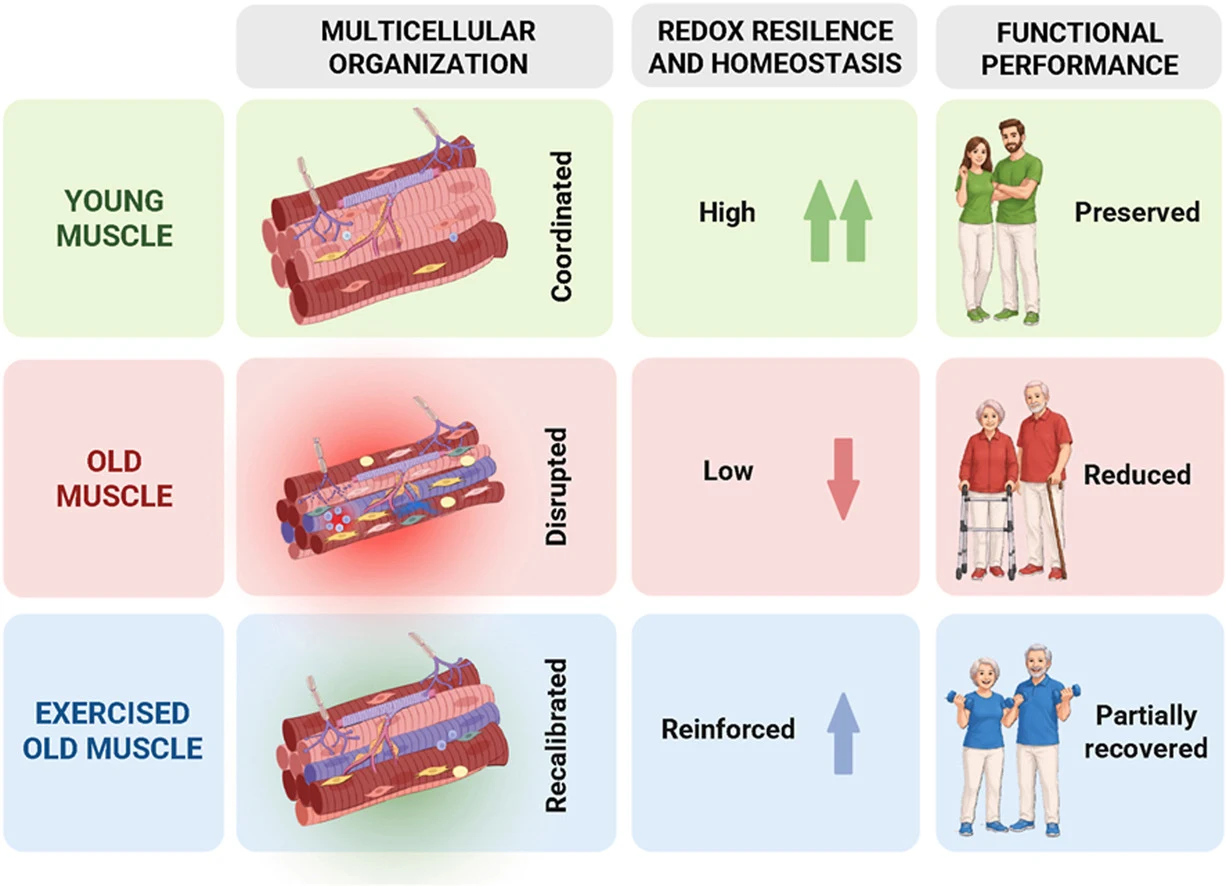
Aging progressively impairs skeletal muscle function, leading to sarcopenia, frailty, and loss of independence. Although oxidative stress has long been considered a central driver of muscle aging, increasing evidence indicates that reactive oxygen species (ROS) also serve essential signaling functions that coordinate mitochondrial remodeling, proteostasis, metabolism, and tissue repair. Consequently, age-related muscle dysfunction is increasingly understood as reflecting impaired adaptive redox signaling rather than excessive oxidant production alone. In this review, we propose the concept of redox resilience as an integrative framework describing the capacity of skeletal muscle to preserve structural integrity and functional performance through the dynamic regulation of oxidant production, antioxidant defenses, and redox-sensitive signaling in response to physiological challenges. We discuss how aging disrupts this resilience through impaired redox-sensitive signaling, including the attenuation of exercise-induced Nrf-2 activation, together with alterations in the multicellular organization of skeletal muscle. Recent advances in single-cell and single-nucleus transcriptomics have revealed that muscle aging involves profound remodeling of specialized myonuclear populations, stromal cells, immune cells, and intercellular communication networks, highlighting the multicellular complexity of skeletal muscle aging and providing a framework to investigate how redox-dependent processes may interact with tissue-wide signaling networks. We further examine how regular physical exercise reinforces redox resilience by promoting transient ROS-mediated signaling through NADPH oxidases, activation of Nrf-2 and PGC-1α-dependent pathways, mitochondrial quality control, and metabolic remodeling. These adaptations enhance the capacity of skeletal muscle to respond to physiological stress while preserving tissue homeostasis. Finally, we discuss future perspectives for targeting adaptive redox networks to promote healthy muscle aging and propose that restoring redox resilience may preserve physiological ROS signaling while strengthening endogenous antioxidant responses and limiting excessive oxidative damage, thereby contributing to the maintenance of muscle function and health span.
- Exercise
- Modelling and theory
- Cellular homeostasis
- NRF2–KEAP1 antioxidant response
- Oxidative stress and ROS signalling
- Mitochondrion
The paper
University of Valencia
Free Radical Biology & Medicine, 15 Oct 2026