A protease-resistant D-amino acid αA-crystallin mini-chaperone with enhanced chaperone and antioxidant activities protects against amyloid-β proteotoxicity
Abstract
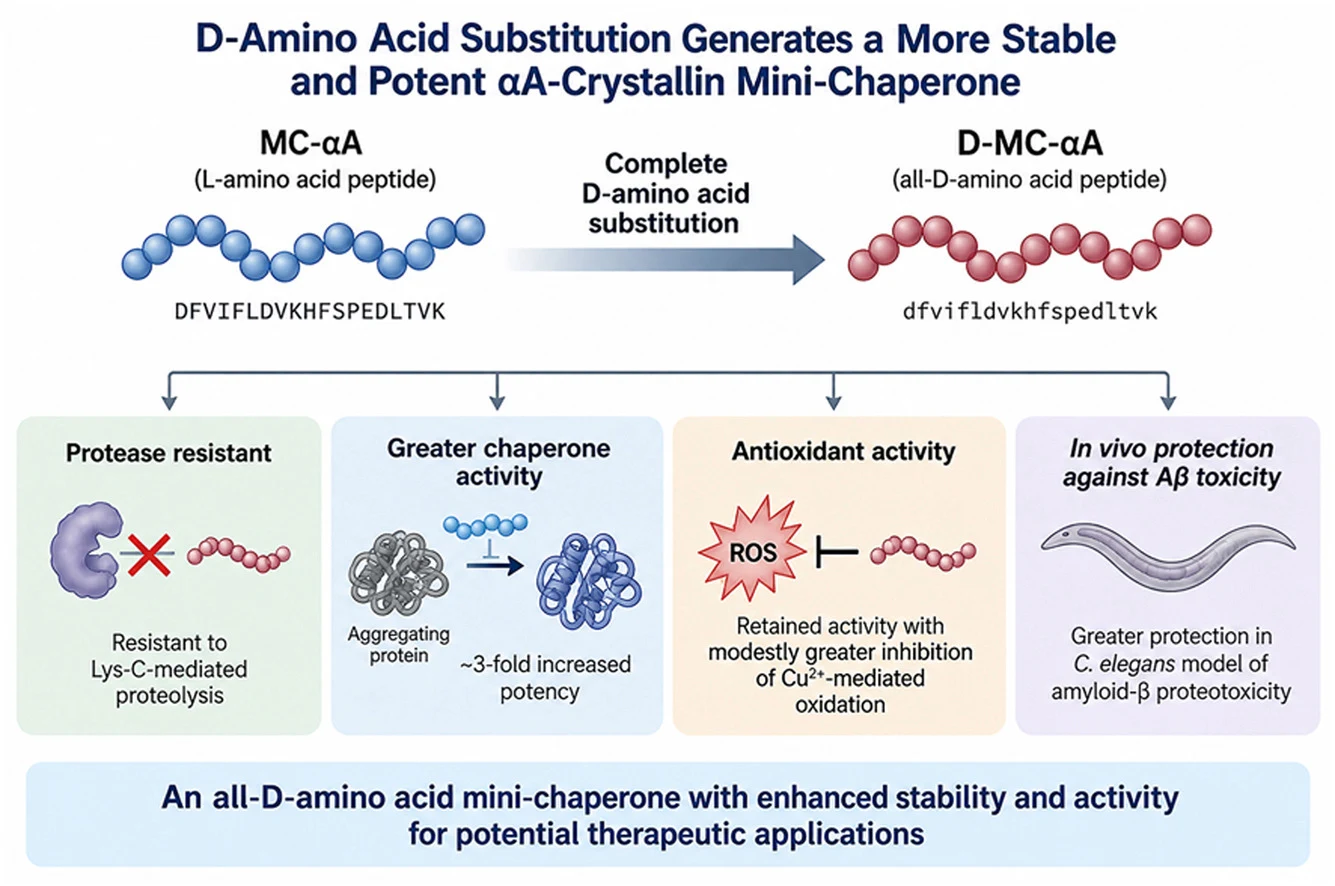
Protein misfolding, aggregation, and oxidative stress contribute to aging and numerous neurodegenerative diseases, including Alzheimer's disease. Although the αA-crystallin-derived mini-chaperone peptide suppresses protein aggregation, its therapeutic potential is limited by susceptibility to proteolytic degradation. Here, we synthesized a protease-resistant analog composed entirely of D-amino acids (D-MC-αA) and compared its biochemical and biological properties with those of the parent peptide (MC-αA). Chaperone activity was assessed using two aggregation-prone model proteins, antioxidant activity by inhibition of Cu²⁺-mediated oxidation of ascorbic acid, and proteolytic stability by enzymatic digestion followed by reverse-phase HPLC. Cytoprotective and membrane-protective activities were evaluated using melittin-induced cytotoxicity in retinal pigment epithelial cells and hemolysis of human red blood cells. Peptide uptake, lifespan, thermotolerance, and protection against amyloid-β toxicity were evaluated in Caenorhabditis elegans (C. elegans). D-MC-αA exhibited approximately threefold greater chaperone activity than MC-αA, completely resisted enzymatic degradation, and more effectively inhibited Cu²⁺-mediated ascorbic acid oxidation. Both peptides protected retinal cells against melittin-induced injury and reduced red blood cell hemolysis. The mini-chaperone was efficiently taken up by C. elegans, and both peptides significantly extended lifespan, enhanced thermotolerance, delayed amyloid-β-induced paralysis, and prolonged survival without adversely affecting feeding behavior or reproduction. D-MC-αA provided greater protection than MC-αA against amyloid-β-induced paralysis and mortality. Collectively, these findings demonstrate that all-D-amino acid substitution confers proteolytic resistance, enhances chaperone and antioxidant activities, and preserves cytoprotective function, supporting further development of D-MC-αA for disorders associated with protein misfolding, oxidative stress, and amyloid toxicity.
The paper
University of Missouri
Free Radical Biology & Medicine, 13 Oct 2026