Body fat and inflammation link ultraprocessed food to heart risk
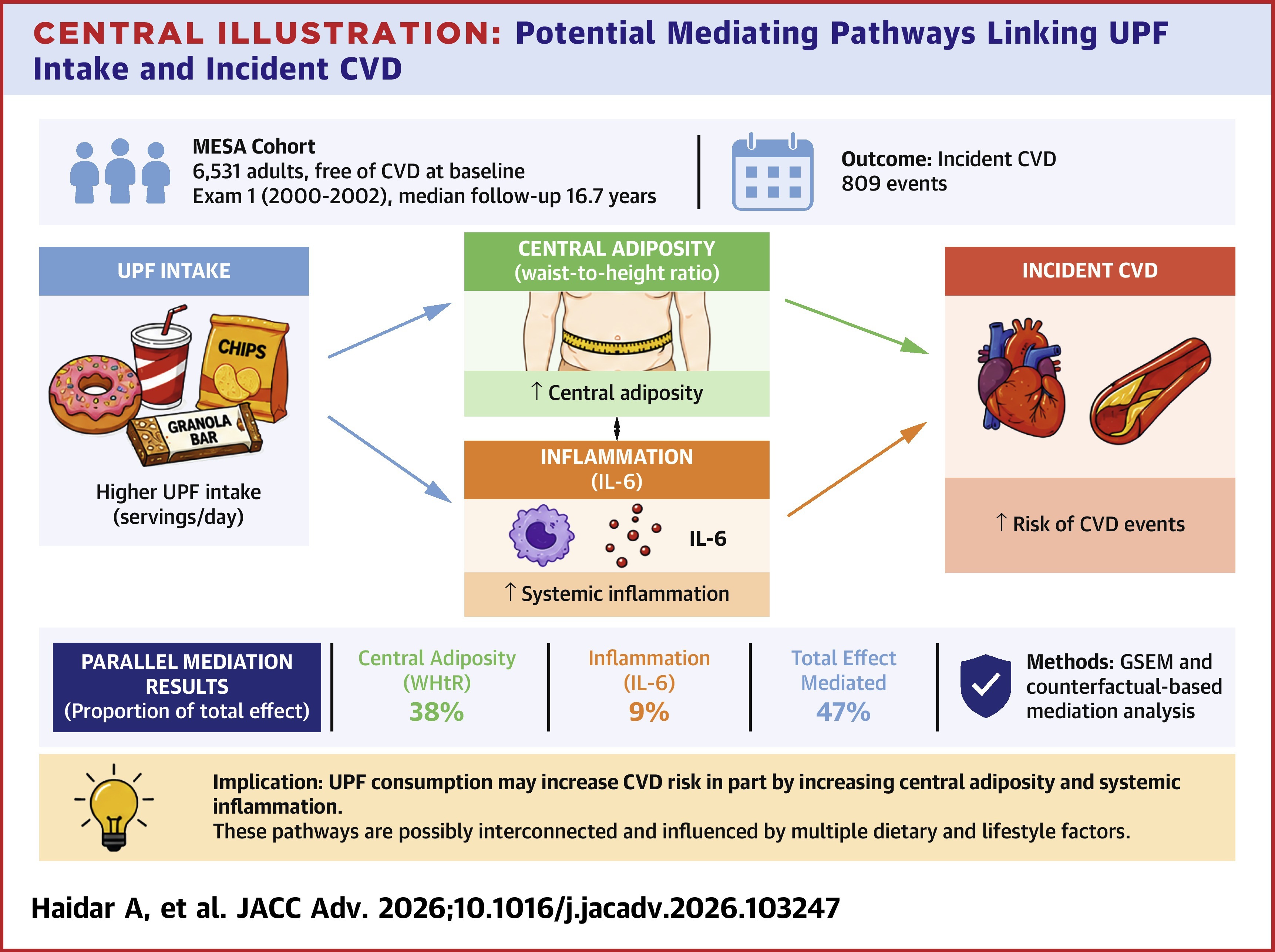
In 6,531 adults, waist-to-height ratio mediated 44% and interleukin-6 mediated 13% of the association between ultraprocessed food intake and incident cardiovascular disease.
JACC Advances
In a prospective cohort of 6,531 men and women aged 45 to 84 years from the Multi-Ethnic Study of Atherosclerosis, researchers examined how ultraprocessed food intake relates to incident cardiovascular disease. Participants were free of clinically apparent cardiovascular disease at baseline, and diets were categorized using the Nova classification system. Higher consumption of ultraprocessed foods was associated with adverse cardiometabolic profiles. In single-mediator models, central adiposity measured by waist-to-height ratio mediated 44% of the total association with incident cardiovascular disease, while systemic inflammation measured by interleukin-6 mediated 13%. In parallel models including both factors, waist-to-height ratio accounted for 38% and interleukin-6 accounted for 9% of the mediated proportion.
Why it matters
The findings provide mechanistic insight into how ultraprocessed food consumption contributes to cardiovascular disease risk via central adiposity and systemic inflammation. Clarifying these pathways helps support targeted dietary approaches to reduce long-term cardiometabolic risk.
Caveats
The findings stem from an observational prospective cohort, which establishes associations rather than definitive cause and effect. In addition, the measured adiposity and inflammatory markers only partially mediated the association, indicating other biological mechanisms remain to be identified.
The paper
The University of Texas Health Science Center · Wake Forest University Health Sciences
JACC Advances · 18 Sep 2026