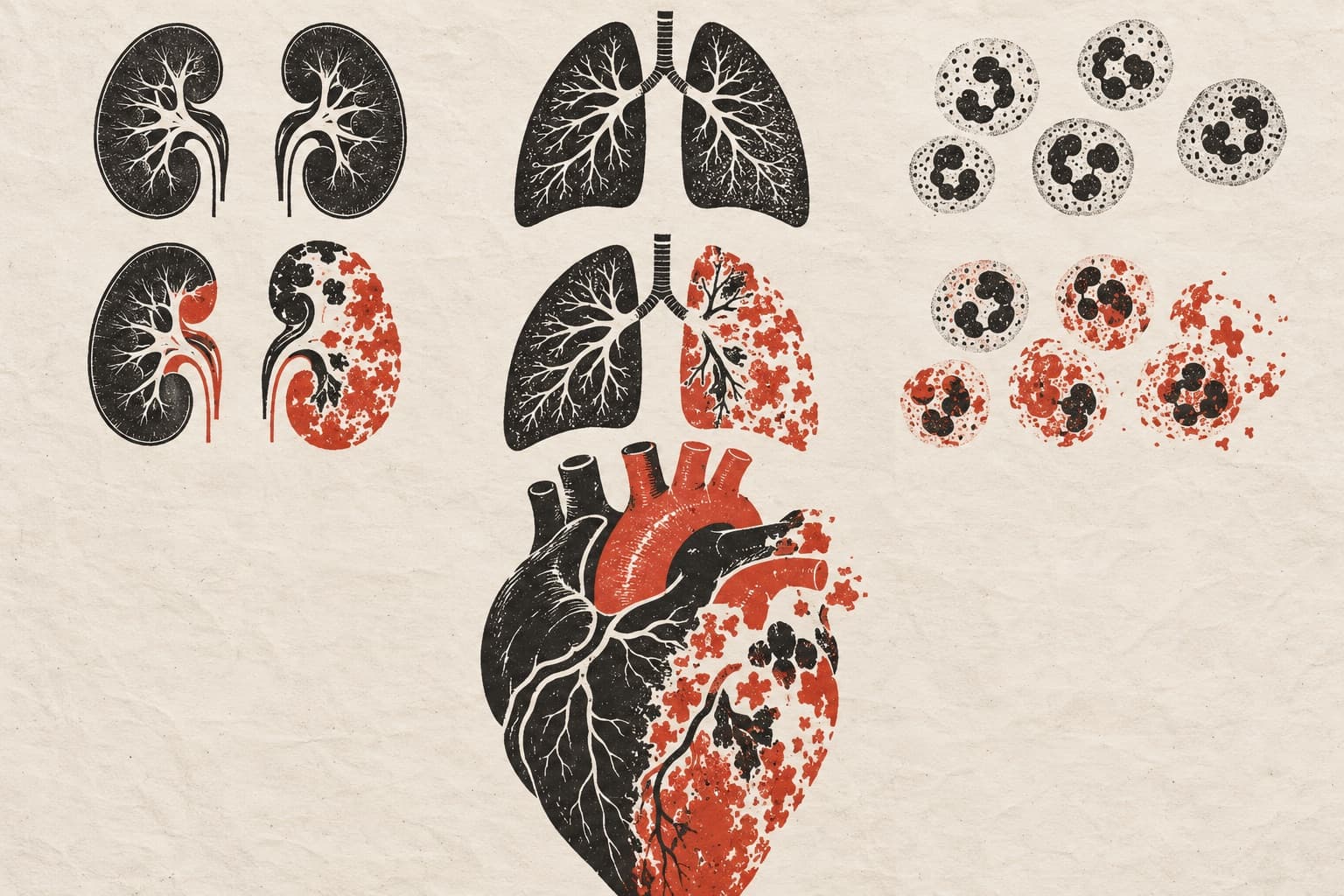
Inflammatory burden links to racial disparities in heart failure
In a 16-year study of 6,785 adults, baseline inflammatory markers accounted for 57.5% of the Black-White log-hazard difference in incident heart failure.
medRxiv
In a preprint analyzing 6,785 human participants followed for approximately 16 years in the Multi-Ethnic Study of Atherosclerosis, researchers tracked how baseline systemic inflammation relates to incident heart failure. The authors examined four circulating biomarkers: interleukin-6, C-reactive protein, fibrinogen, and D-dimer. Over the follow-up period, 485 participants developed heart failure.
Each biomarker independently associated with incident heart failure per standard-deviation increment, led by interleukin-6 (hazard ratio 1.20) and D-dimer (hazard ratio 1.18). A composite inflammatory index yielded a hazard ratio of 1.25. Race did not modify these risks. Adding the biomarkers to clinical models reduced the Black-White log-hazard difference by 57.5%, and results held after adjusting for ambient air pollution.
Why it matters
Chronic, low-grade systemic inflammation is a key hallmark of cardiovascular aging. These findings suggest that differences in cumulative inflammatory exposure, rather than intrinsic biological susceptibility, contribute substantially to racial disparities in age-related cardiovascular decline.
Caveats
The observational design means sequential biomarker adjustment is consistent with, but not sufficient to prove, an inflammatory mechanism. In addition, the paper is a preprint that has not yet been peer-reviewed.
The paper
Lynn University · RIPLRT Institute
medRxiv · 1 Oct 2026 · Preprint, not peer-reviewed