Dapagliflozin did not improve heart relaxation in small trial
A heart-relaxation measure stayed at 6.2 with dapagliflozin, versus 6.6 to 6.7 with placebo, in a 32-person randomised trial.
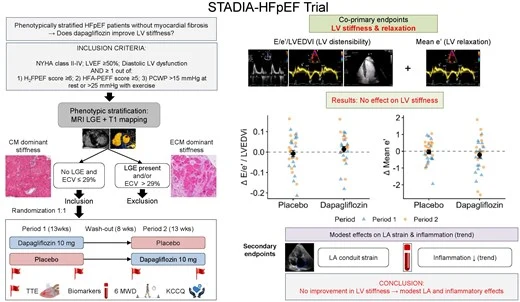
34 weeks, double-blind, placebo-controlled
A randomised crossover trial tested dapagliflozin in 32 people with heart failure with preserved ejection fraction, in which the heart pumps out a normal proportion of the blood it holds. Their median age was 73, and 28 were women. Heart scans excluded people with significant heart-muscle scarring or structural heart-muscle diseases.
Participants received dapagliflozin at 10 mg and placebo, each for 13 weeks, separated by eight weeks without either. Neither participants nor researchers knew which they received. Twenty-nine people completed the protocol. Compared with placebo, dapagliflozin did not significantly improve measures of the left lower heart chamber’s ability to stretch or relax. Most secondary outcomes also showed no clear benefit. The researchers said exploratory findings involving the upper left heart chamber and inflammation needed confirmation in larger studies.
Why it matters
For older people with heart failure, the trial addressed whether the absence of substantial heart-muscle scarring might help identify those whose hearts could respond to dapagliflozin.
Caveats
This small trial mostly included women and excluded significant heart-muscle scarring and structural heart-muscle diseases, limiting its applicability to other patients. The abstract did not report adverse-event results.
- Dapagliflozin
- Inflammation
- Extracellular matrix
- Heart failure with preserved ejection fraction
- Myocardial fibrosis
- Humans
The paper
Department of Cardiology
European Heart Journal Cardiovascular Pharmacotherapy, 17 Oct 2026