The associations between dynapenic obesity and cognitive disorder in older hypertension patients: a multicenter cross-sectional study
Multicentre
Abstract
BACKGROUND: Evidence regarding the associations between dynapenic obesity and cognitive disorder in older adults is limited. This study aimed to investigate the prevalence of cognitive disorder among the older patients with hypertension (HTN), explore the association between dynapenic obesity and cognitive disorder, and explore a hypothesized path structure. METHODS: We conducted a multicenter cross-sectional study from July 2023 to March 2024 among the older HTN patients aged 65 years and older. Data were collected using a structured questionnaire and standardized measurement. Logistic regression models were used to test the association between dynapenic obesity and cognitive disorder. Multiple imputation by chained equations under a missing-at-random assumption was conducted. Structural equation modeling was employed to explore the hypothesized path analysis. Subgroup and sensitivity analyses were performed to validate the robustness of the findings. RESULTS: The study included 9,568 older HTN patients. The prevalence of cognitive disorder in this population was 15.67% (95% confidence interval [CI]: 14.94-16.40%). After adjusting for potential confounders, a significant positive association was observed between dynapenic obesity and cognitive disorder (adjusted odds ratio [aOR] = 1.418, 95% CI: 1.263-1.591). In the path model, dynapenic obesity was associated with lower odds of adequate physical activity (PA) (aOR = 0.708, 95% CI: 0.640-0.783). Adequate physical activity was associated with lower odds of depressive disorders (aOR = 0.441, 95% CI: 0.367-0.529) and cognitive disorder (aOR = 0.521, 95% CI: 0.452-0.601). Participants with depressive disorders had higher odds of cognitive disorder than those without depressive disorders (aOR = 1.312, 95% CI: 1.031-1.669). This association remained consistent across different age groups (all p < 0.05). Almost all results of sensitivity analysis were consistent with the main findings. CONCLUSION: Dynapenic obesity was positively associated with cognitive disorder. PA and depressive disorders were regarded as variables within a hypothesized cross-sectional path structure.
From the paper
- Participants
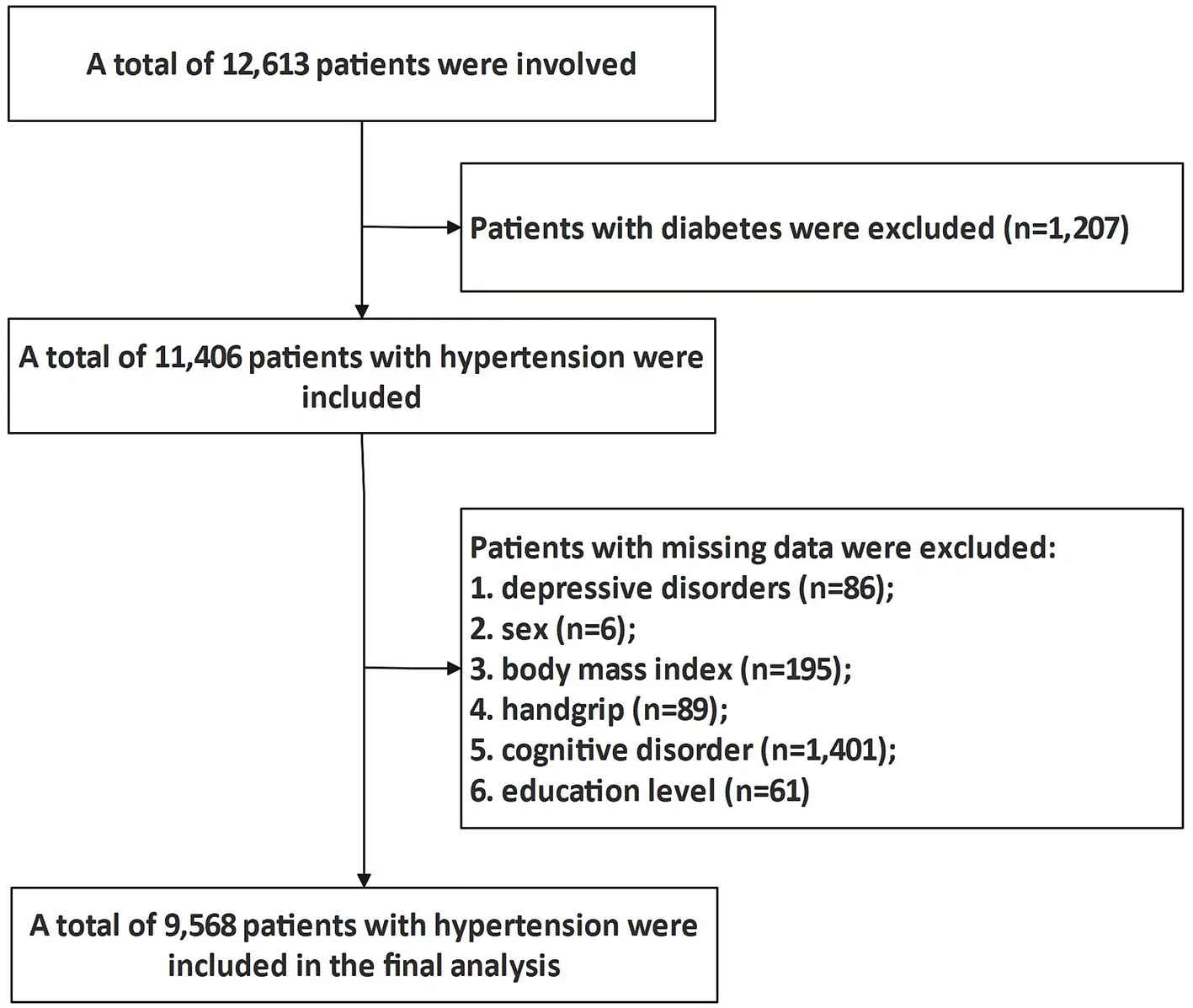
A total of 9,568 participants were included in this study, with 42.79% being men and a median age of 72 years.
- Result
The aOR = 1.085 (95% CI: 1.075–1.096) per one-unit increase, 1.505 (95% CI: 1.435–1.579) per five-unit increase, and 1.626 (95% CI: 1.536–1.720) per one-SD increase.
Results, The association between dynapenic obesity and cognitive disorder
Quoted word for word from the full text on frontiersin.org.
The paper
Zhengzhou University
Frontiers in Public Health, 29 Sep 2026, Open access