Physical activity is linked to lower dementia risk in hypertension
The highest quartile of moderate activity was tied to a hazard ratio of 0.41 compared with the lowest quartile in 47,861 hypertensive adults.
Frontiers in Aging Neuroscience
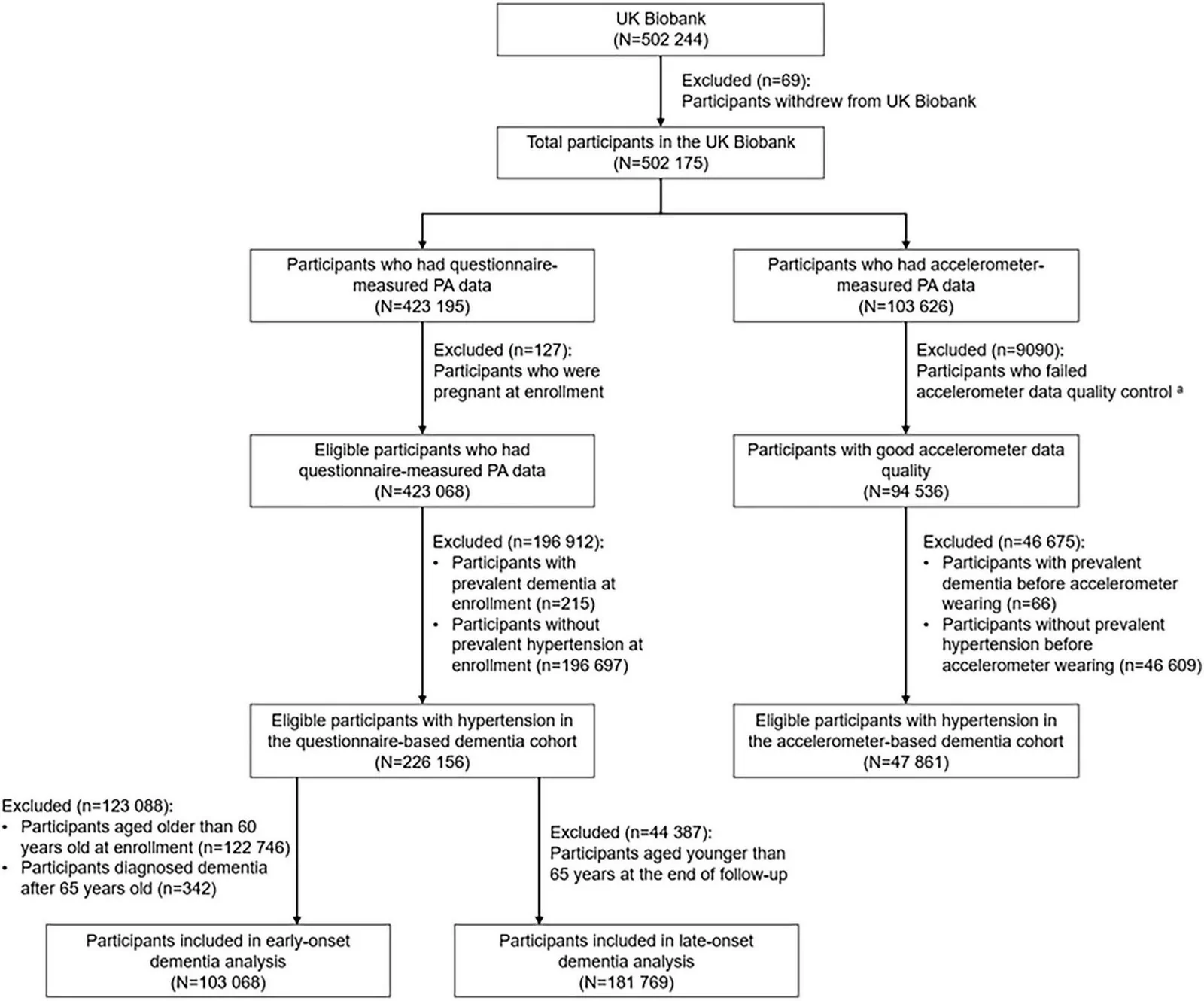
Among 47,861 UK Biobank participants with hypertension who wore wrist accelerometers, 574 developed dementia over a median follow-up of 8.1 years. Researchers assessed physical activity across intensity quartiles and daily domains. Compared with the lowest quartile, participants in the highest quartile of moderate activity had a lower risk of dementia (HR 0.41), as did those in the highest quartiles of vigorous (HR 0.34), moderate-to-vigorous (HR 0.43), and total activity (HR 0.63). In a parallel questionnaire-based cohort of 226,156 hypertensive adults followed for a median of 13.7 years, 5,647 cases occurred. Higher self-reported activity, particularly leisure-time exercise and housework, was consistently tied to lower risk estimates. Moderate activity showed a more pronounced relative risk reduction for early-onset than late-onset dementia.
Why it matters
Hypertension is a major vascular contributor to cognitive decline and pathological brain aging. These findings suggest that engaging in moderate-to-vigorous daily movement may help offset dementia risk among adults managing high blood pressure.
Caveats
The observational design cannot establish causality and may be subject to residual confounding. Furthermore, relying on hospital inpatient and death records to identify dementia likely undercounts total incidence by missing milder cases.
- Physical activity
- Light-intensity physical activity
- Moderate-intensity physical activity
- Dementia
- Hypertension
- Humans
The paper
Association between physical activity and incident dementia among individuals with hypertension
Chinese Academy of Medical Sciences & Peking Union Medical College
Frontiers in Aging Neuroscience · 15 Sep 2026