Higher body roundness trajectories linked to hypertension risk
In non-diabetic older adults, an increasing body roundness trajectory had an odds ratio of 1.76 for incident hypertension compared with a low-level pattern.
Global Heart
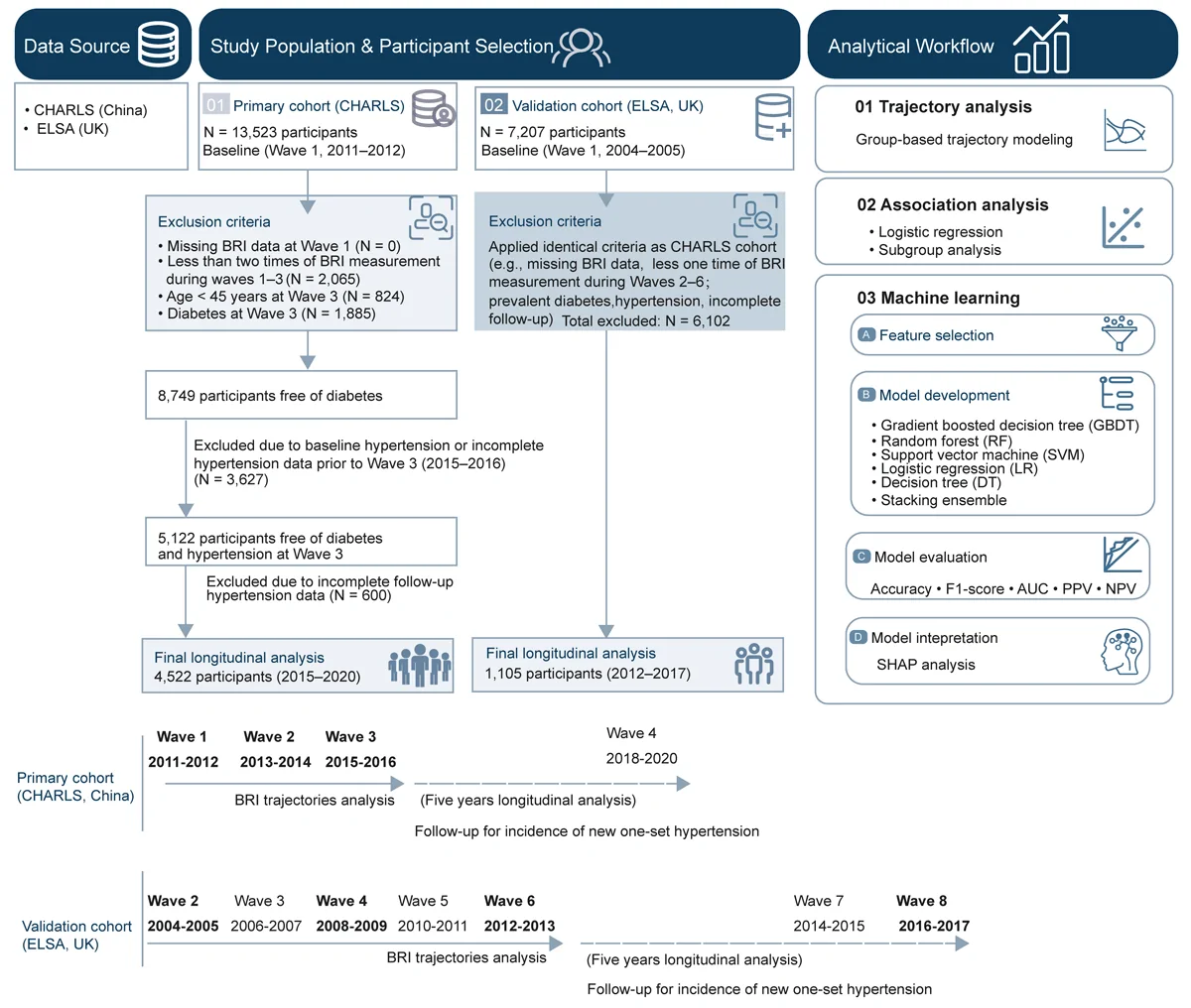
In 4,522 non-diabetic Chinese adults aged 45 and older from the CHARLS cohort, researchers modeled body roundness index trajectories over three survey waves between 2011 and 2016. They tracked incident hypertension through 2020. The team identified three distinct patterns: low-level inverted U-shaped, moderate-level inverted U-shaped, and high-level increasing trajectories.
Compared with the low-level trajectory, adjusted odds ratios for incident hypertension were 1.40 (95% CI, 1.13–1.73) for the moderate pattern and 1.76 (95% CI, 1.21–2.56) for the high-level increasing pattern. In an external validation cohort of 1,105 adults aged 50 and older from the English Longitudinal Study of Ageing, the high-level increasing trajectory was also associated with higher odds of hypertension (odds ratio 1.67, 95% CI, 1.01–2.75). Machine learning models indicated that trajectory groups offered complementary predictive information alongside age and circulating biomarkers.
Why it matters
Central adiposity tends to shift across the lifespan and is a key driver of cardiovascular risk. Tracking longitudinal changes in body roundness may help clinicians spot older adults at risk for arterial disease even in the absence of diabetes.
Caveats
The observational design cannot determine whether changes in body roundness directly cause hypertension. In addition, the outcome relied in part on self-reported physician diagnoses, and the high-trajectory group in the English validation cohort contained only 106 participants.
The paper
Second Affiliated Hospital of Chongqing Medical University
Global Heart · 25 Sep 2026 · CC BY