Aerobic Exercise Ameliorates Osteoarthritic Chondrocyte Degradation in Osteoarthritis via Regulating E2F8/NLRP14 Signaling Pathway
Abstract
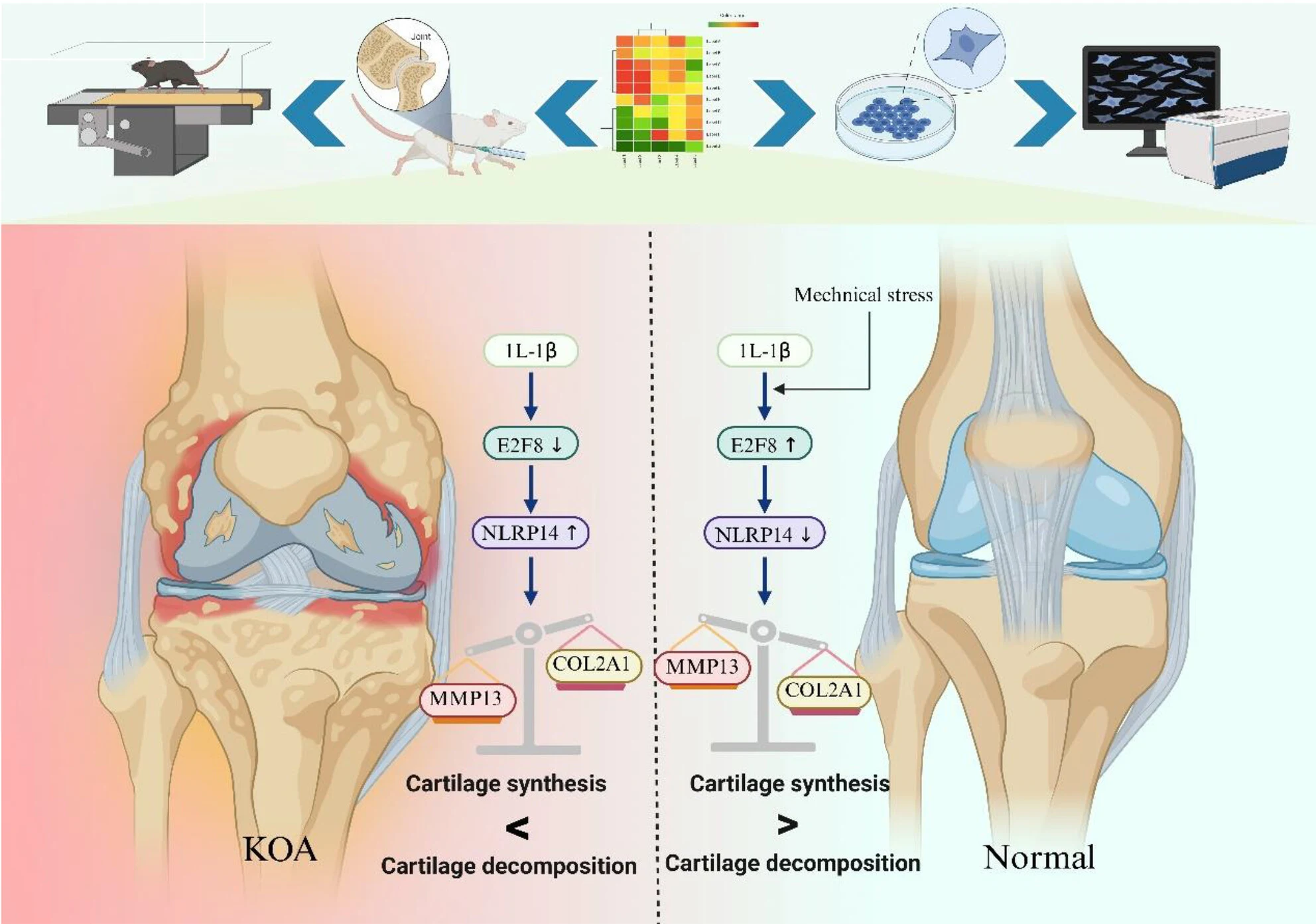
Although physical activity is known to mitigate disease risks, its protective molecular mechanisms remain poorly understood. E2F8, a regulator of cell cycle and metabolism, showed significant differential expression between osteoarthritis (OA) and exercise models, suggesting it may link mechanical activity to OA alleviation. In vitro, Interleukin-1 Beta (IL-1β) simulated inflammation. In vivo, OA was induced in rats via Monosodium iodoacetate (MIA) injection. The effects of E2F8 and mechanical stress were assessed using moderate treadmill exercise, histology, and joint observation. Bioinformatic analysis, cyclic tensile strain, Western blot, immunofluorescence, and gene knockdown were used to investigate mechanisms. In OA rats, E2F8 was downregulated in cartilage while NLRP14 increased. Exercise reversed E2F8 downregulation, alleviated cartilage degeneration, restored anabolic activity, and reduced inflammatory catabolism linked to senescence. In vitro, mechanical stress reversed the IL-1β-induced anabolic/catabolic imbalance by regulating the E2F8/NLRP14, mitigating OA progression. Mechanical stress enhances E2F8 expression in osteoarthritic chondrocytes, which in turn protects cartilage by suppressing the expression of NLRP14. These findings underscore the role of E2F8 as a mechano-sensitive mediator and highlight the potential of exercise or exercise-mimetic therapies as effective strategies for preventing and treating OA.
The paper
College of Exercise and Health
FASEB Journal, 14 Oct 2026