Self-renewing nanoparticles reduce friction and joint wear
The engineered particles cut friction over 90% compared with commercial hyaluronic acid and reversed chondrocyte senescence in lab models of osteoarthritis.
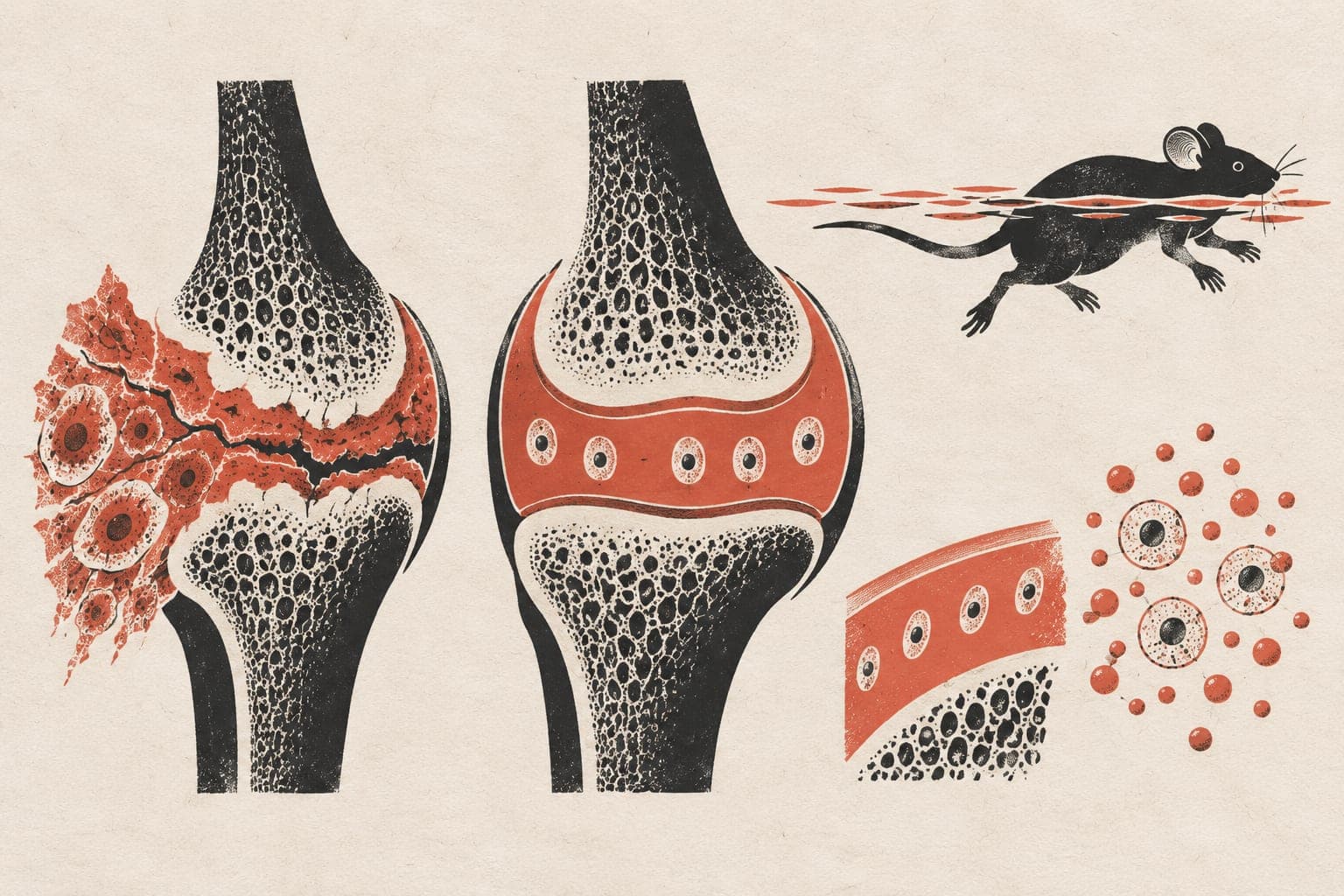
In an experiment using models of knee and jaw osteoarthritis, researchers tested a multifunctional nanoparticle system designed to treat mechanically aggravated joint degeneration. Friction and oxidative inflammation together advance age-related cartilage loss. Under physical movement, the nanoparticles partially dissociate to spread a lubricated layer, then spontaneously reassemble when movement stops. This cycle maintained ultralow friction under repeated loading, achieving a greater than 90% lower coefficient of friction than commercial hyaluronic acid. In inflammatory joints, oxidative molecules triggered targeted drug release. The treatment reduced the inflammatory proteins IL-6 and IL-1β, reversed chondrocyte senescence—a state where cartilage cells stop dividing—and protected the extracellular matrix. In a load-driven knee model and a frequency-driven jaw joint model, the nanoparticles preserved cartilage, suppressed inflammation, and improved joint shape.
Why it matters
Age-related joint degeneration is driven by both physical wear and oxidative inflammation. Developing materials that restore lasting joint lubrication while reversing cellular senescence could address key mechanisms of osteoarthritis.
Caveats
The results come from lab-based joint models rather than clinical studies in patients. The abstract also does not state how long the joint protection lasts over time.
The paper
Tsinghua University
Advanced Materials, 9 Oct 2026