A Chemokine Profile Linked to Both Triglyceride-Rich Lipoproteins and Lipoprotein(a), But Not LDL, Is Associated With Cardiovascular Disease
Abstract
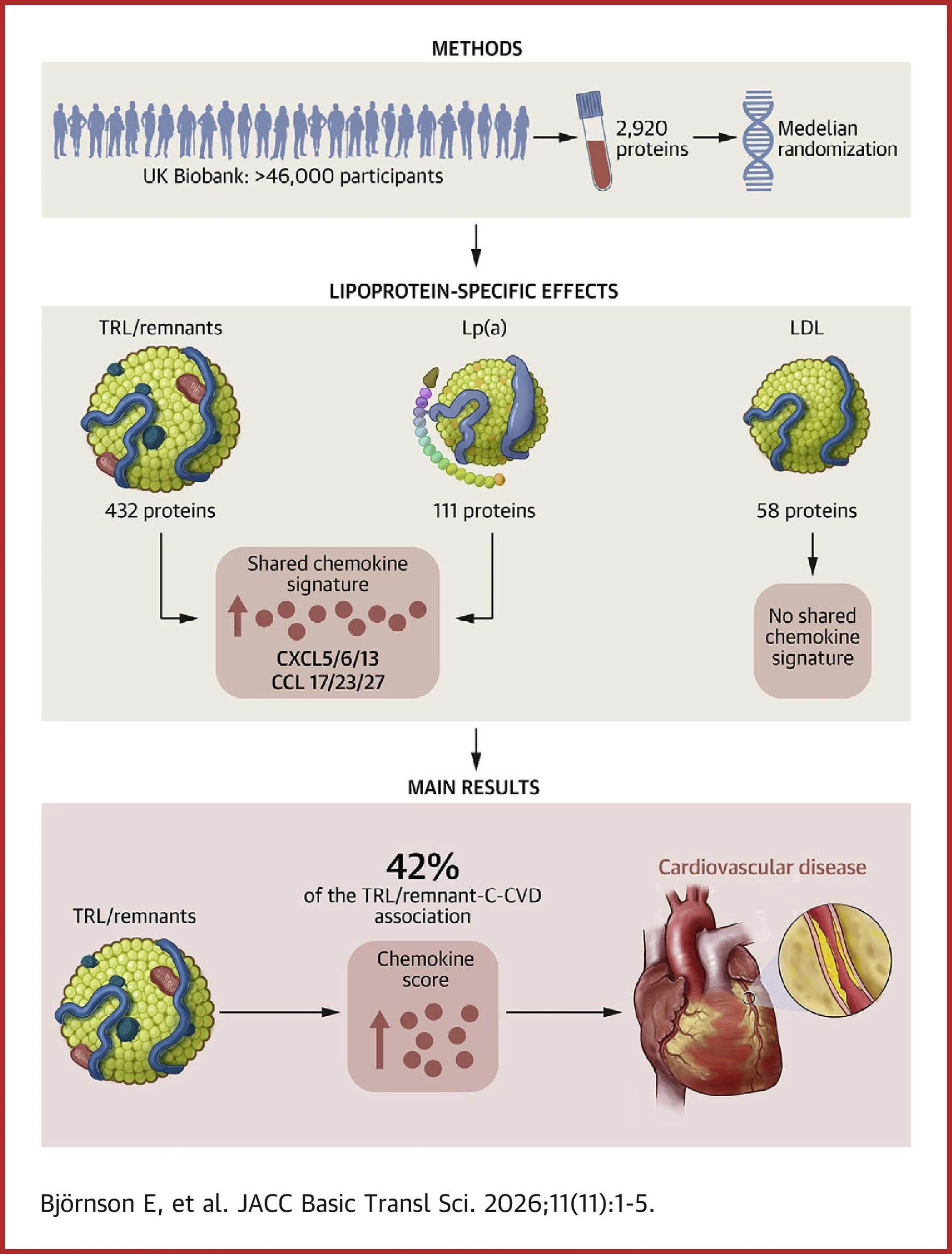
Triglyceride-rich lipoproteins (TRL) and lipoprotein(a) [Lp(a)] demonstrate heightened per-particle atherogenicity compared with low-density lipoproteins (LDL), yet mechanistic underpinnings remain unclear. Using Mendelian randomization in >46,000 UK Biobank participants, we linked genetically determined variation in TRL/remnants, LDL, and Lp(a) to 2,920 plasma proteins and found causal associations with 432, 58, and 111 proteins, respectively. Notably, TRL/remnants and Lp(a) both impacted chemokine-signaling and leukocyte-chemotaxis pathways, distinct from LDL's effect on lipid metabolism. A specific chemokine signature linked to both TRL and Lp(a) accounted for around 40% (with wide confidence limits) of the TRL/remnant cholesterol: cardiovascular disease (CVD) association. However, a more general causal relationship between plasma chemokine concentrations and CVD risk independent of a TRL/Lp(a) effect was not supported by quantitative trait loci analysis. These results are compatible with a model in which TRL/Lp(a)-driven chemokine activation contributes meaningfully to CVD risk.
- Lipid and ceramide metabolism
- Lipoprotein
- Cardiovascular disease
- Chemokines
- Low-density lipoprotein
- Humans
The paper
University of Gothenburg
JACC Basic to Translational Science, 13 Oct 2026