HDL particle sizes show contrasting links to dementia risk
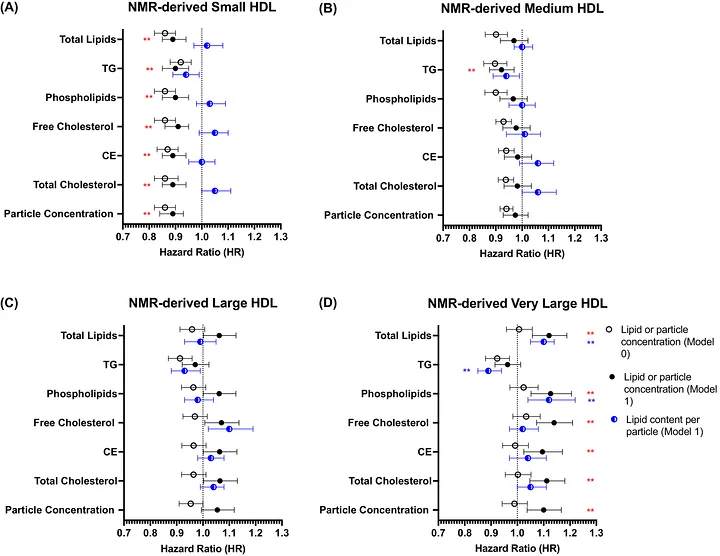
In 23,790 older adults, higher small HDL levels tracked lower dementia risk (hazard ratios 0.89 to 0.91), while very large HDL tracked higher risk (1.10 to 1.14).
Alzheimer's & Dementia
In older human adults from the UK Biobank and the Atherosclerosis Risk in Communities study, researchers evaluated whether high-density lipoprotein subclasses relate to dementia risk. The team analyzed blood samples from 23,790 dementia-free UK Biobank participants aged 67 or older using nuclear magnetic resonance spectroscopy. Over an average 12.6-year follow-up, 1,626 participants developed dementia. Higher concentrations of small HDL particles and their lipid components were associated with lower dementia risk, with hazard ratios between 0.89 and 0.91. In contrast, very large HDL particle and lipid concentrations were linked to higher dementia risk, with hazard ratios between 1.10 and 1.14. Total plasma HDL cholesterol showed no significant association. In 147 ARIC participants analyzed via mass spectrometry, triglycerides and specific phospholipids carried on isolated HDL subfractions were also associated with lower dementia risk.
Why it matters
Total HDL cholesterol is commonly monitored in cardiovascular and brain health, but it conceals the functional diversity of circulating lipoproteins. Showing that small and very large HDL particles hold opposing associations with dementia indicates that particle size and lipid cargo are critical factors in brain aging.
Caveats
The observational design cannot establish causality between HDL subclasses and cognitive decline. In addition, the ARIC cohort had only 147 participants and 38 dementia cases due to sample loss, and the two cohorts used different profiling methods that precluded direct comparison.
The paper
Associations of plasma HDL subclasses with incident dementia risk in older adults
Show 10 more authors
Samantha Roemhild, Lindsey Neumann, Dwight R. Stoll, Ling Li, Pamela L. Lutsey, Michelle M Mielke, Yu Fang, Ron C. Hoogeveen, Lin Zhang, Alvaro Alonso,University of Minnesota
Alzheimer's & Dementia · 1 Oct 2026