Drug may target lab-grown human cells with reduced TET2 gene function
A 48-hour screen of 489 compounds identified lanatoside C as a candidate for preferentially killing human immune cells with reduced TET2 gene function.
Our read
Interventions- Studied:
- Experiments in patient-derived human macrophages, 48 h, against TET2-WT patient-derived macrophages (Dose-response)
- What changed:
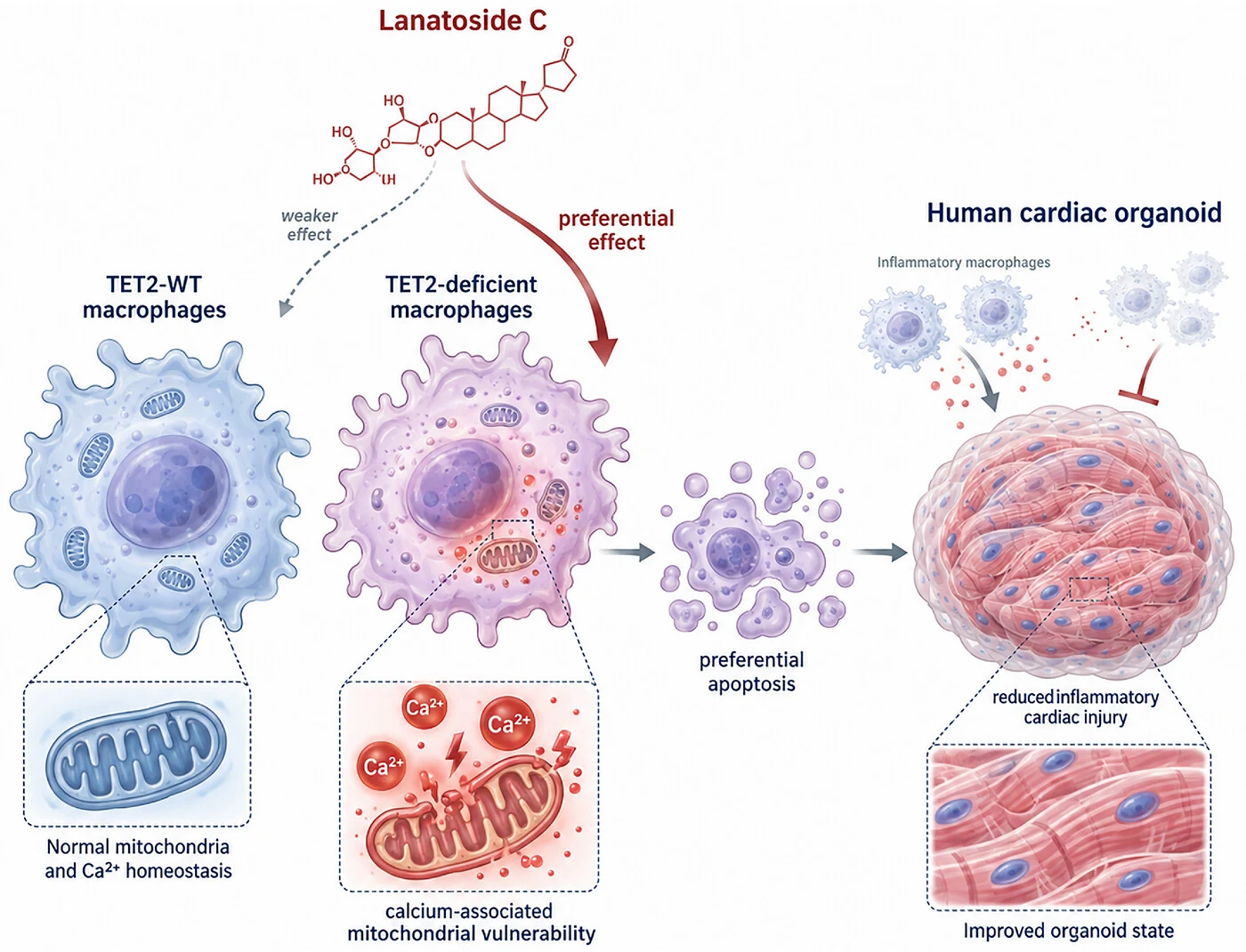
- Lanatoside C halved macrophage viability at 0.138 µM for TET2-mutant cells versus 3.048 µM for controls
- The catch:
- The control-cell drug-sensitivity estimate lacked an upper confidence bound, weakening the apparent selectivity
- In the record:
- One of 3 papers on Lanatoside C on record: 1 with results in people, 1 in animals.
Editor of record: Boris Djordjevic · AgingResearch.News
Human macrophages, a type of immune cell, grown from the THP-1 cell line were tested in laboratory experiments after researchers reduced the function of the TET2 gene. The team screened 489 compounds over 48 hours. Lanatoside C preferentially triggered programmed cell death in TET2-deficient macrophages, with substantially smaller effects in control cells. It also disrupted the electrical charge across membranes of mitochondria, the cells’ energy-producing structures.
Macrophages grown from four human donors likewise showed greater drug sensitivity after TET2 function was reduced. In human heart organoids, three-dimensional models grown in the lab, lanatoside C preferentially reduced macrophages with reduced TET2 function. This reduced inflammatory changes, heart-muscle cell death and scarring.
Why it matters
TET2-linked clonal hematopoiesis—the expansion of blood cells carrying a shared mutation—is associated with increased cardiovascular risk. These experiments suggest a candidate strategy for targeting the harmful immune cells implicated in that link.
Caveats
The authors note that the heart-organoid model used temporary TET2 reduction rather than stable mutations. It addressed downstream immune cells, not whether targeting them changes the long-term expansion of mutant blood-forming stem cells.
Where the evidence stands
Lanatoside C
- 2 independent labs in 1 country
- Funders: Ministry of Science and ICT, South Korea and 2 more
TET2
- 56 independent labs in 15 countries
- 3 findings against
- Funders: National Heart, Lung, and Blood Institute and others
- 15 of 98 findings with company ties
From the paper
- Result
The TET2-mutant estimate was well bounded within the concentration range tested (95% CI, 0.106-0.177 µM), whereas the upper confidence limit for the TET2-WT estimate could not be determined.
Results, 2.6 Reduced TET2 Function Sensitizes Human Macrophages to Lanatoside C
- Harms
All 32 recipient mice completed the study without mortality or overt treatment-related adverse events.
- Limitation
First, the human co-culture system models acute TET2 loss-of-function through siRNA-mediated knockdown in THP-1-derived macrophages and therefore does not reproduce the stable somatic mutation, hematopoietic stem-cell origin …
Quoted word for word from the full text on advanced.onlinelibrary.wiley.com.
The paper
Targeting a Calcium‐Associated Mitochondrial Vulnerability in TET2‐Deficient Myeloid Cells
Cardiology/Angiology/ Nephrology Goethe University Hospital Frankfurt am Main Germany
Advanced Science, Nov 9, 2026, Open access, CC BY


Comments
Be the first to comment.