Mobile DNA activity differs by mutation in human blood cells
An observational study of 68 otherwise healthy adults over 50 found contrasting mobile DNA activity patterns associated with mutations in two genes.
Our read
Mechanisms- Studied:
- Cross-sectional study of 68 adults with or without clonal hematopoiesis, against TET2-mutant clones (Independent replication)
- What changed:
- Several mobile DNA families had higher expression in large DNMT3A-mutant blood-cell clones than in TET2-mutant clones
- The catch:
- Differences in blood-cell composition could account for some mutation-linked differences in mobile DNA expression
- In the record:
- The 44th paper on TET2 with results in people; 268 on record in all.
- Why it’s aging research:
- It studies something that builds up in the body with age.
Editor of record: Boris Djordjevic · AgingResearch.News
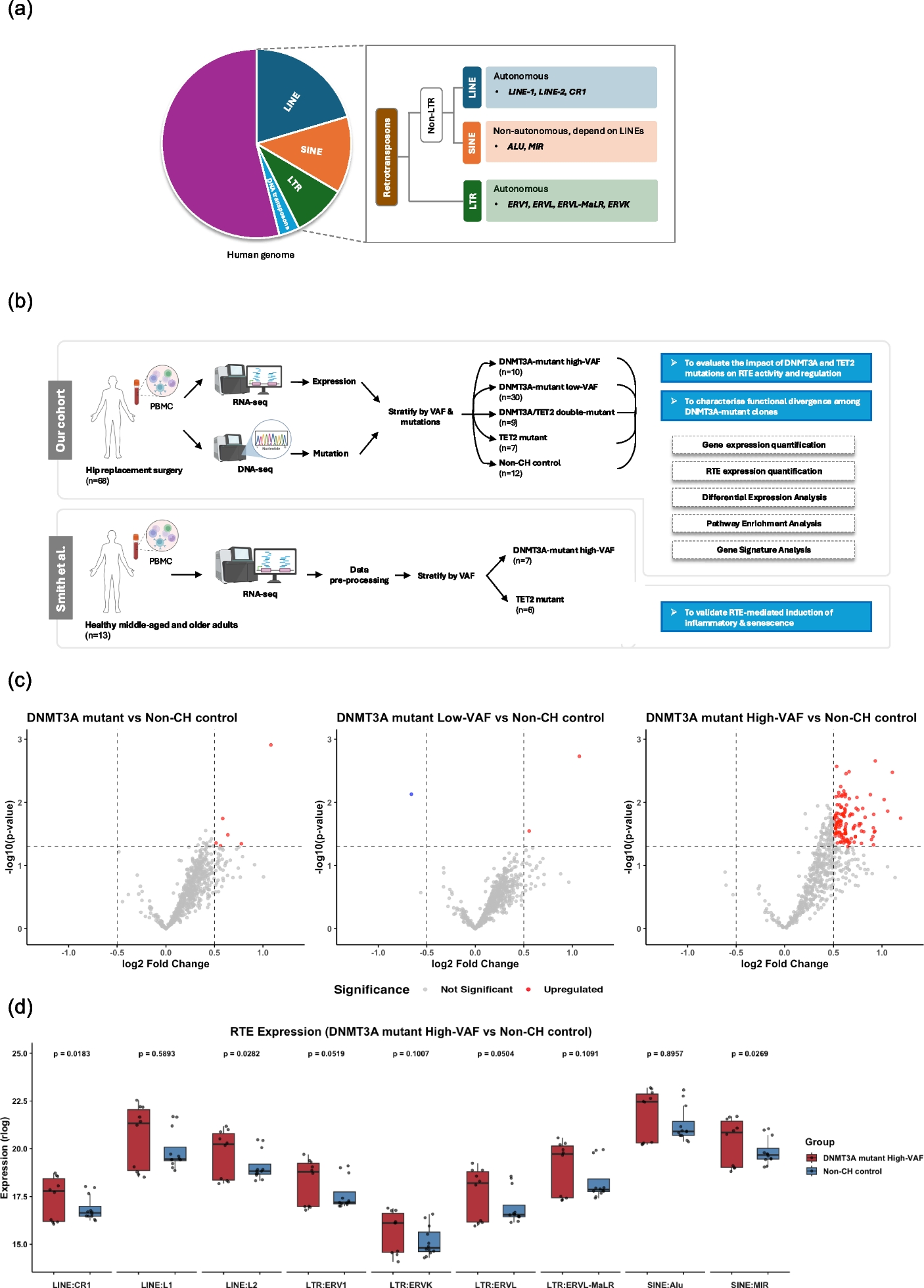
An observational study analyzed blood samples from 68 otherwise healthy adults over 50 undergoing elective hip replacement. Of these, 56 had clonal hematopoiesis, in which mutated blood-forming cells generate expanding groups of related cells; 12 did not.
Researchers compared mutations in two genes, DNMT3A and TET2. Retrotransposable elements—DNA sequences that can copy themselves—produced more RNA than in controls in DNMT3A-mutant samples where more than 10% of measured gene copies carried a mutation. Activity varied within this group. TET2-mutant samples showed a trend toward lower retroelement activity than controls. In the high-burden DNMT3A group, higher retroelement activity was linked to inflammatory gene activity and signatures of senescence, a state in which cells stop dividing. These links were reproduced in an independent cohort.
Why it matters
Clonal hematopoiesis is common in older adults and has been linked to blood disorders and cardiovascular disease. The authors propose testing whether altering retroelement activity could change inflammation associated with DNMT3A-mutant clonal hematopoiesis.
Caveats
This observational analysis measured RNA patterns, not whether retroelement activity caused inflammation. The high-burden DNMT3A group included only 10 people; the main cohort covered adults over 50 undergoing elective hip replacement and excluded people with known blood cancers.
From the paper
- Limitation
First, the use of bulk PBMC RNA sequencing may be influenced by differences in cellular composition.
Quoted word for word from the full text on link.springer.com.
- Cellular senescence
- Inflammation
- mTOR signaling
- Clonal burden
- Clonal hematopoiesis of indeterminate potential
- Humans
The paper
Bristol-Myers Squibb (United States); King's College London
GeroScience, Sep 16, 2026, Open access

Comments
Be the first to comment.