Hyperventilation-Induced Heart Rate Response as a Marker of Cardiovascular Risk - Large-Scale Validation from the Courtois Cardiovascular Signature Program
Abstract
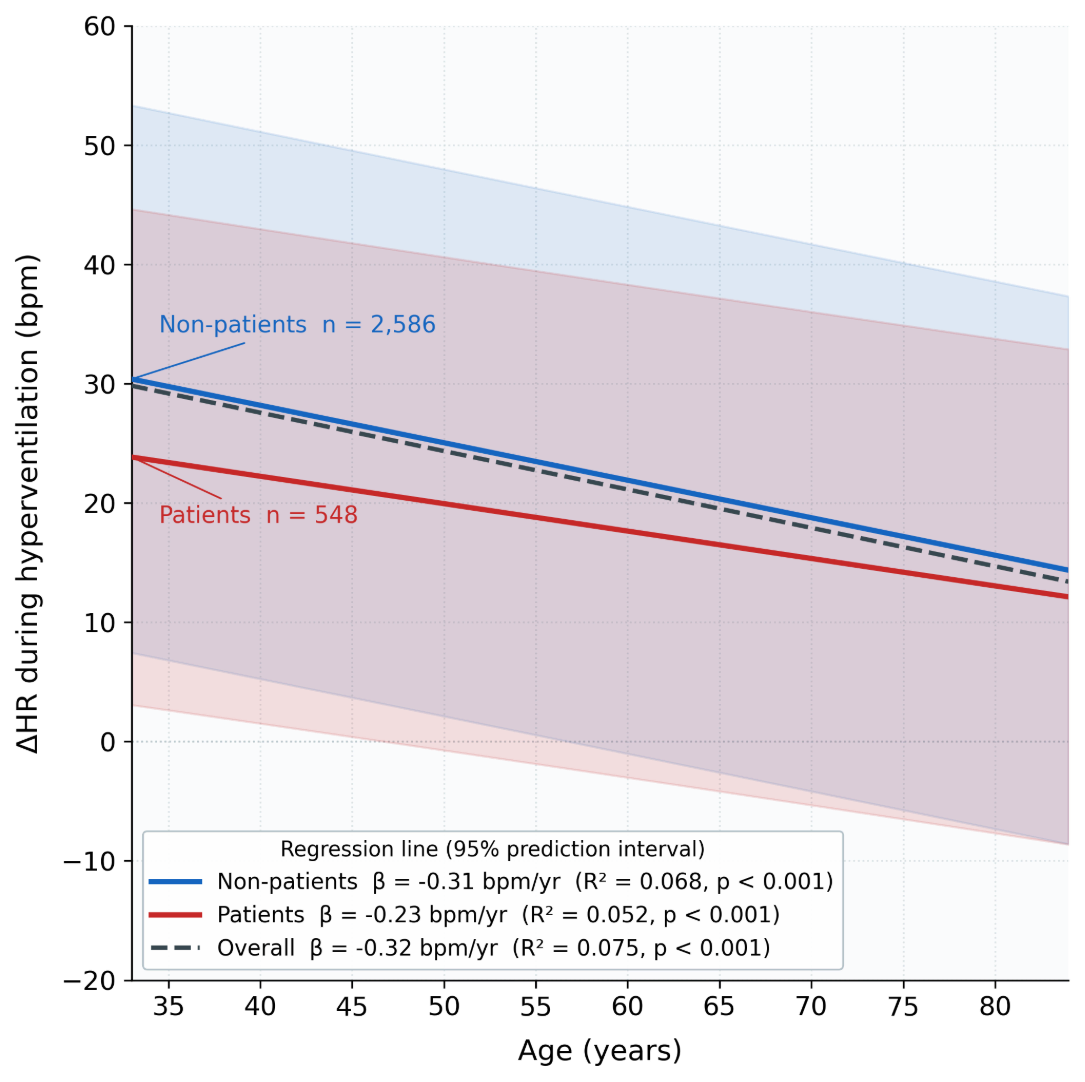
Hyperventilation-induced change in heart rate (ΔHR) is attenuated in cardiovascular patients, but validation in a large cohort was lacking. We analysed 3,134 participants from the Courtois Cardiovascular Signature Program (CCVSP), spanning five pre-specified cardiovascular risk categories from zero-risk healthy individuals to established atherosclerotic cardiac disease. ΔHR was defined as heart rate at end of 60-second paced hyperventilation minus resting baseline. ΔHR decreased monotonically across risk groups (Kruskal-Wallis H = 145.2, p < 0.001), from a median of 24.0 bpm [IQR 16.0–33.0] in Zero-Risk participants to 15.0 bpm [9.2–22.0] in those with atherosclerotic cardiac disease. After age adjustment, only the established cardiovascular and atherosclerotic disease groups remained significantly attenuated; intermediate risk groups did not. A logistic model incorporating age and ΔHR achieved an AUC of 0.659 [95% CI: 0.633–0.684], with LR + 2.17 and LR − 0.49, yielding a negative predictive value of 97.5% at 5% prevalence. An enhanced model adding history-based variables (sex, smoking, diabetes, hypertension, family history) achieved an AUC of 0.710 [95% CI: 0.686–0.735]. This study validates, in the largest prospective cohort to date, that hyperventilation-induced ΔHR is attenuated in cardiovascular disease. Age-adjusted ΔHR provides a clinically meaningful rule-out performance in low-prevalence settings, supporting its use as a simple, equipment-light pre-screening marker.
From the paper
- Participants
The final analytic sample comprised 3,134 participants (Table 1).
- Result
The logistic model achieved AUC = 0.659 [95% CI: 0.633–0.684], significantly outperforming ΔHR alone (AUC = 0.642) and exceeding the ΔHR-only Youden J statistic by 8.1%.
Results, log-odds(Patient) = − 2.480 + 0.029 × Age − 0.037 × ΔHR
- Events by group
… 77.1% in the 1–2 Risk Factors group, 42.3% in the High-Risk group, 49.6% in the Cardiovascular Disease group, and 79.8% in the Atherosclerotic Cardiac Disease group.
Results, Enhanced Risk Model Combining ΔHR with History-Based and Anthropometric Predictors
Quoted word for word from the full text on researchsquare.com.
- Paced hyperventilation
- Smoking
- Cardiovascular disease
- Coronary artery disease
- Atherosclerotic cardiovascular disease
- Humans
The paper
McGill University Health Centre; McGill University
Research Square, 14 Oct 2026, Open access, Preprint, not peer-reviewed


