Globally trained model predicts age in new heart recordings
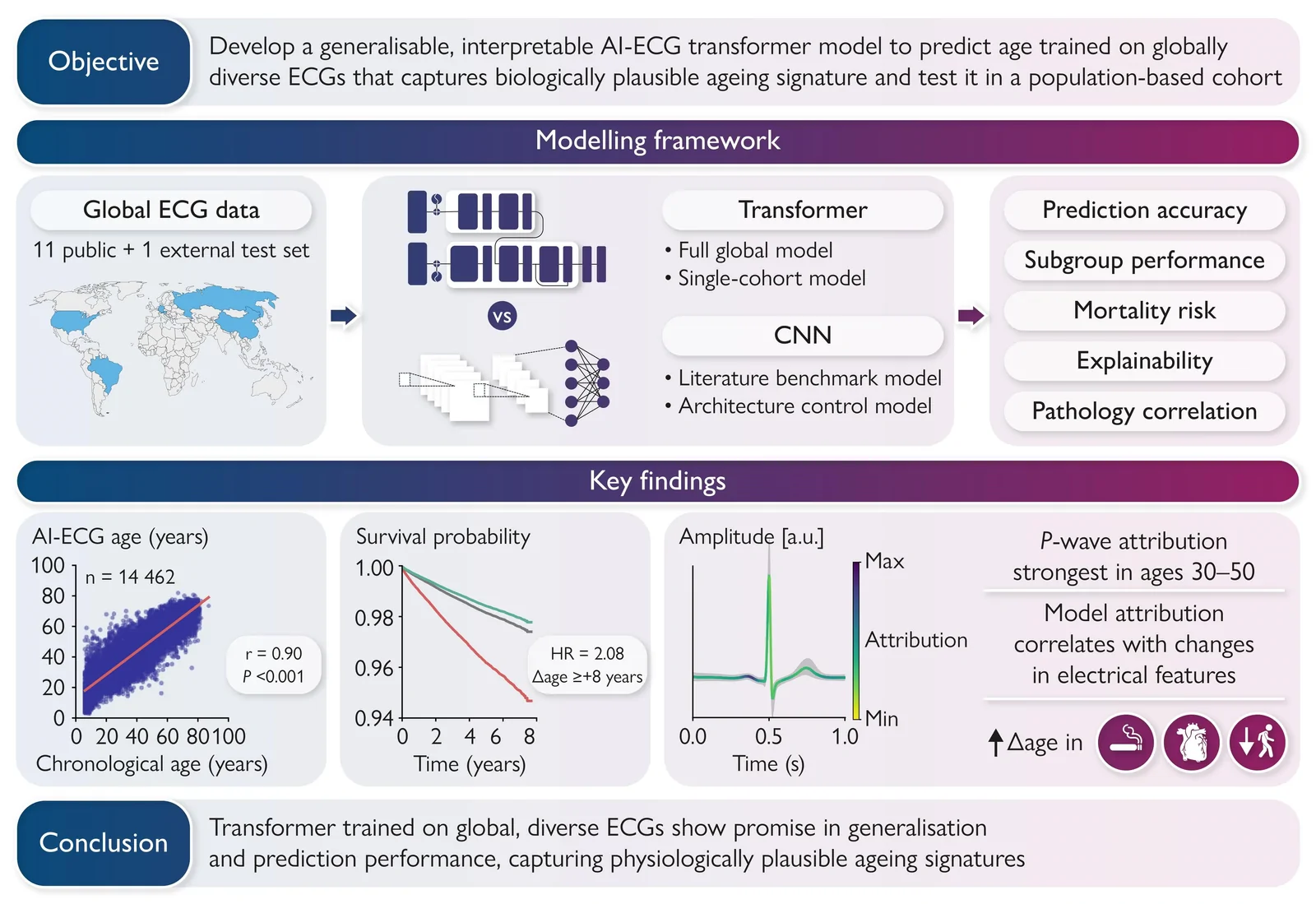
In 14,462 independent recordings, predicted and actual ages had a correlation of 0.90, outperforming another model design and a model trained on a more uniform population.
435,203 participants, cohort study, independent replication
In a modelling study, researchers trained and validated age-prediction models using 435,203 recordings of people’s heart electrical activity from 11 public datasets across four continents. They tested the models on a separate set of 14,462 recordings. The best-performing globally trained artificial intelligence model maintained a correlation of 0.90 between predicted and actual age, meaning the two closely tracked each other. It outperformed another model design trained on global data and a model trained on a single, more uniform population.
A predicted age at least eight years above actual age was associated with twice the risk of death. An analysis of how the model made predictions identified the electrical signal from the heart’s upper chambers as the strongest contributor to its age estimates.
Why it matters
The work addresses whether the heart’s electrical signals can offer insight into cardiovascular aging and related risk beyond a person’s age in years.
Caveats
The mortality analysis was observational, so the age gap was associated with risk rather than shown to cause it. Further validation is needed before using the model to assess clinical risk.
The paper
Explainable age prediction using a transformer trained on diverse global electrocardiograms
Medical University of Vienna
European Heart Journal Digital Health, 23 Sep 2026