Spinal cord charts map age patterns and disease differences
Different upper spinal cord measurements peaked at ages 29.7–44.1 years in reference charts based on scans of 10,159 healthy people aged 8–85.
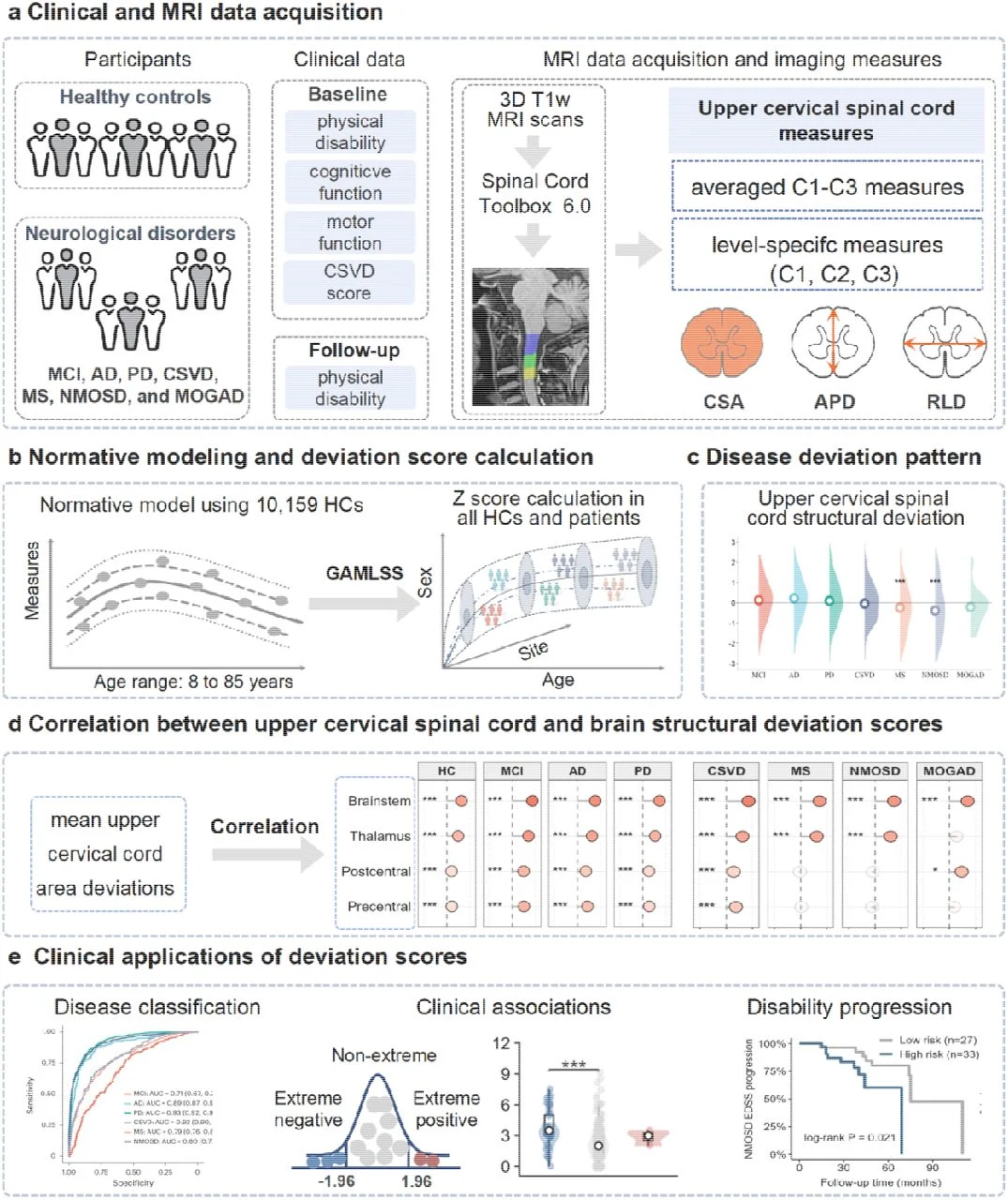
Researchers analysed three-dimensional scans from 10,159 healthy people aged 8–85 in an observational study of the spinal cord in the upper neck. They built reference charts for its size and shape. Different measurements peaked at ages ranging from 29.7 to 44.1 years.
The researchers applied the charts to 2,394 patients with seven neurological disorders, including Alzheimer’s disease, Parkinson’s disease and multiple sclerosis. They calculated scores showing how far each patient’s measurements differed from the healthy reference. These scores captured disease-specific abnormalities and helped classify neurological disorders. They were also associated with thinking abilities, physical disability and disease progression. The researchers developed a personalised spinal cord report to support interpretation of individual scans.
Why it matters
Understanding expected age-related variation is important when assessing neurological disorders that occur with aging, including Alzheimer’s and Parkinson’s diseases.
Caveats
The observational analysis could not establish cause and effect or show that using the charts improved clinical care. The paper is a preprint and has not yet been peer-reviewed.
From the paper
- Result
… the spinal cord model (Model 2) showed moderate-to-good discriminatory ability in three tasks: NMOSD versus MOGAD (AUC = 0.858, 95% CI: 0.807-0.908), NMOSD versus HCs (AUC = 0.837, 95% CI: 0.795-0.879), and MS versus MOGAD (AUC = 0.827, 95% CI: 0.768-0.886) …
Results, Disease classification using upper cervical spinal cord deviations
- Limitation
Moreover, the absence of children younger than 8 years and sparse sampling in some age ranges may limit the generalizability and precision of the reference models.
Quoted word for word from the full text on medRxiv.
The paper
Beijing Tian Tan Hospital
medRxiv, 12 Oct 2026, Open access, Preprint, not peer-reviewed
