Retinal vascular changes track mortality risk in humans
Increased retinal fractal dimension carried a mortality hazard ratio of 0.92 per standard deviation, whereas arteriolar widening carried a hazard ratio of 1.09.
medRxiv
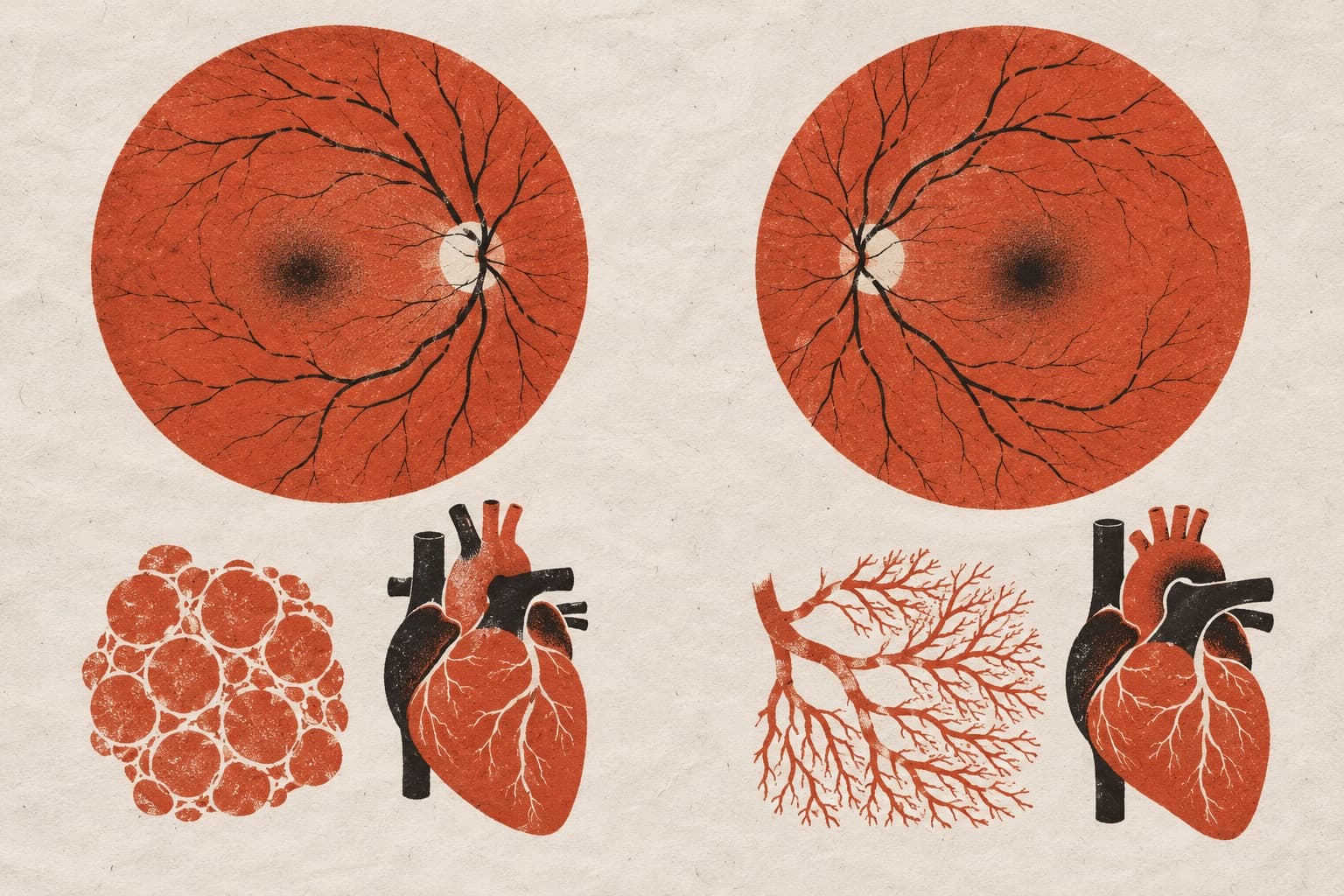
In a preprint analyzing 21,562 participants from the Canadian Longitudinal Study on Aging, researchers quantified retinal vascular morphology across a mean interval of 5.7 years. Over time, average vascular complexity and density declined, while vessel tortuosity, arteriolar widths, and venular widths increased. Altered trajectories were tied primarily to older age and higher low-density lipoprotein cholesterol, and within-person rises in mean arterial pressure covaried with lower complexity, density, and vessel widths. Independently of baseline vascular features, each standard deviation increase in fractal dimension was associated with lower all-cause mortality (hazard ratio = 0.92), whereas arteriolar widening was associated with higher mortality (hazard ratio = 1.09). Retinal changes were not associated with major adverse cardiovascular events after false-discovery-rate correction.
Why it matters
The findings show that retinal microvascular remodeling is a dynamic phenotype that tracks systemic physiological health. Serial retinal imaging may therefore provide non-invasive biomarkers of vascular aging and survival.
Caveats
The study is observational, cannot establish causality, and is reported in a preprint that has not yet undergone peer review.
The paper
Show 5 more authors
Tom MacGillivray, Yitian Zhao, Bernard Keavney, Matthew Sperrin, Alejandro Federico Frangi,University of Manchester
medRxiv · 2 Oct 2026 · CC BY · Preprint, not peer-reviewed