Chemical changes mark aging in animal cell recycling centers
Experiments across species and tissues identified a chemical signature that could predict chronological age but was largely hidden when researchers analyzed whole tissues.
Limit: The chemical signature predicts chronological age rather than directly measuring declining lysosome function
Edited by Boris Djordjevic · AgingResearch.News
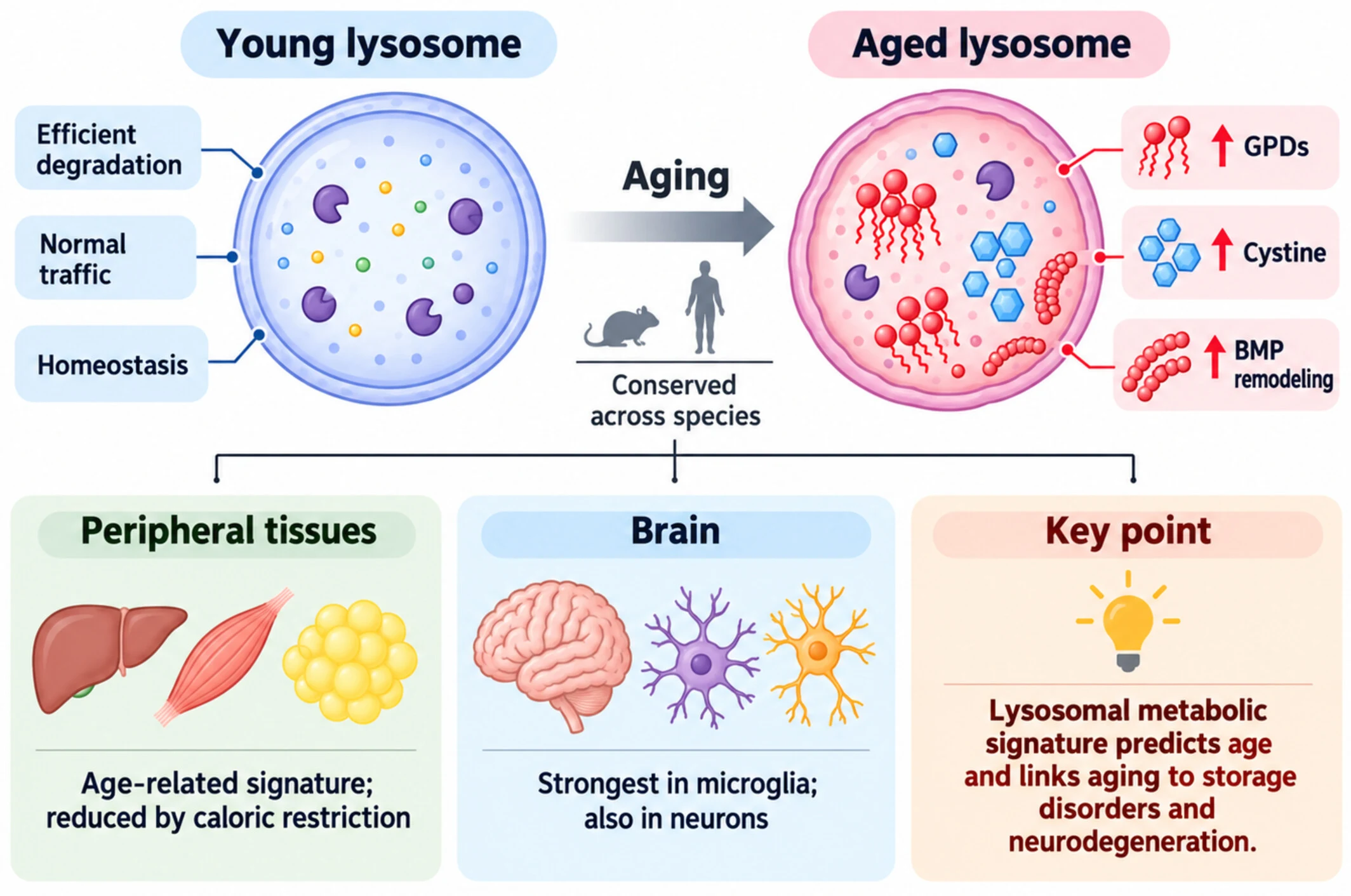
The article described experiments in animals across species, tissues and ages. Puszynska and colleagues isolated lysosomes, cell compartments that break down and recycle material, and analyzed their chemicals and fats.
Several chemicals accumulated with age, and the composition of a lysosomal fat changed. This pattern developed progressively and could predict chronological age. It was largely hidden when researchers analyzed whole tissues. The pattern resembled chemical abnormalities associated with lysosomal storage disorders, diseases in which material builds up inside lysosomes. Restricting calorie intake weakened the signature in tissues outside the brain, but not in the brain. Within the brain, age-related chemical accumulation was especially prominent in microglia, the brain’s immune cells. It also appeared in neurons, the cells that carry nerve signals.
Why it matters
Lysosomes help cells dispose of material and coordinate metabolism. Studying their chemistry may help researchers investigate connections between normal aging, lysosomal storage disorders and vulnerability to late-life diseases that damage nerve cells.
Caveats
The findings do not establish whether these chemical changes contribute to declining lysosome function or merely mark age. The supplied abstract does not identify the animal species or sample sizes.
- Caloric restriction
- Lipid and ceramide metabolism
- Lysosome
- Bis(monoacylglycero)phosphate
- Cystine
- Glycerophosphodiesters
Caloric restriction is part of Bryan Johnson's Blueprint
The paper
The Lysosomal Clock: Are We Only as Old as Our Lysosomes?
The University of Sydney; Université Paris Cité
Traffic, Oct 21, 2026


