Retinal Arterial Wall Reflectivity and Incident Cardiovascular Disease
Abstract
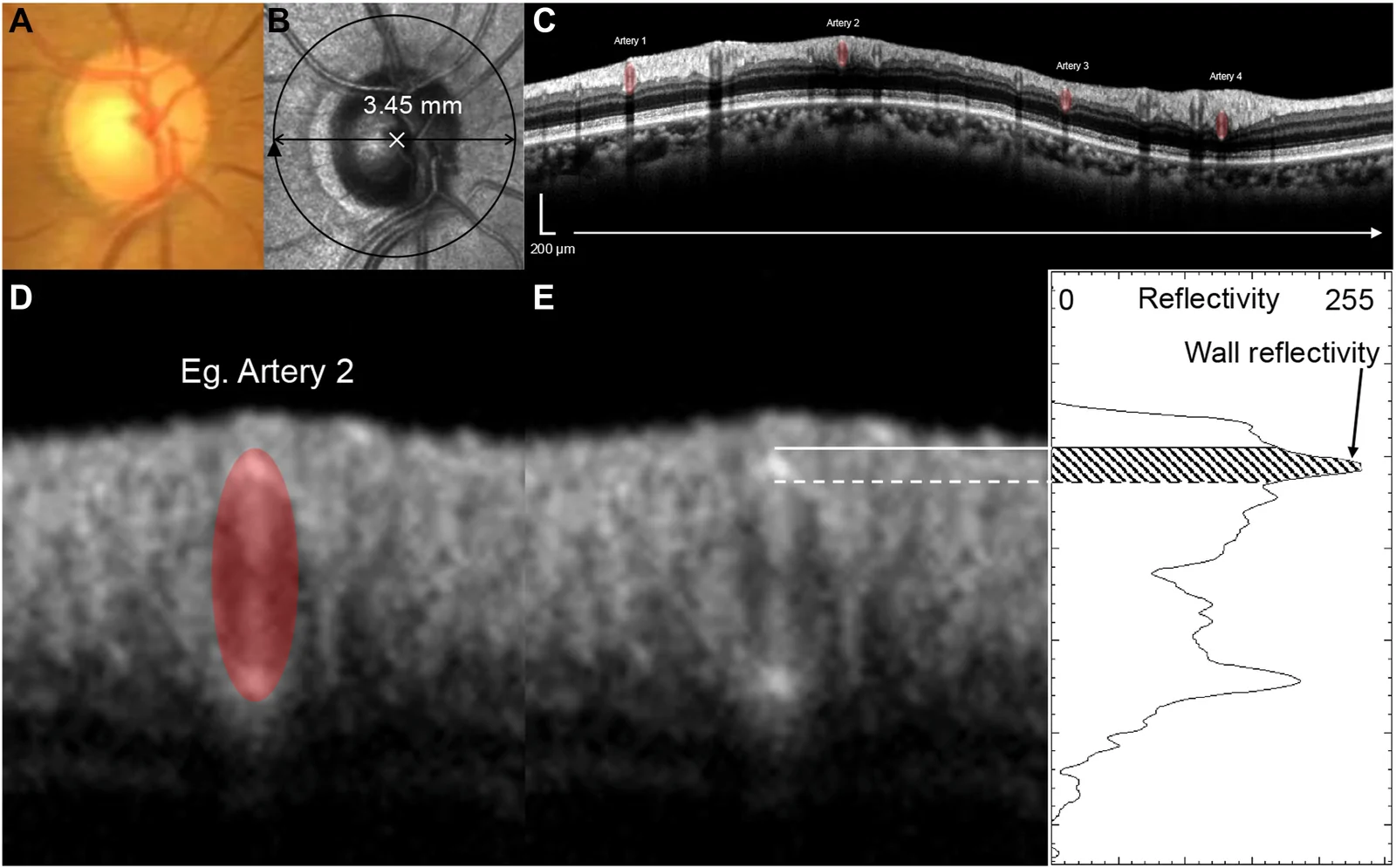
OBJECTIVE: To determine whether retinal arterial wall reflectivity is associated with future cardiovascular disease (CVD) in a large community-based Japanese cohort. DESIGN: Community-based cohort study. PARTICIPANTS: A total of 6264 adults from the Nagahama Study (baseline 2012-2016) without a history of CVD. METHODS: Retinal arterial wall reflectivity was measured on peripapillary OCT images at baseline. Participants were followed for approximately 7 years, and incident CVD events, including stroke and coronary artery disease (CAD), were identified through medical records. Associations were evaluated using Fine-Gray competing risk models and expressed as subdistribution hazard ratios (SHRs). Retinal arterial caliber was included in multivariable analyses. MAIN OUTCOME MEASURES: Incident CVD events, including stroke and CAD. RESULTS: During a mean follow-up of 6.7 years, 125 incident CVD events occurred. In the full cohort, retinal arterial wall reflectivity was not independently associated with CVD (SHR per 10 arbitrary units, 1.026; 95% confidence interval [CI], 0.920-1.145). A continuous age-by-reflectivity interaction was observed (P = 0.029). In post hoc exploratory analyses among participants younger than 70 years, parsimonious models suggested possible associations with CVD (SHR, 1.173; 95% CI, 1.031-1.334) and stroke (SHR, 1.280; 95% CI, 1.088-1.506). CONCLUSIONS: Retinal arterial wall reflectivity was not independently associated with incident CVD in the full cohort. Post hoc exploratory analyses among participants younger than 70 years suggested possible modest associations with CVD, particularly stroke-related outcomes. These findings suggest that retinal arterial wall reflectivity may reflect subclinical vascular alterations, but require external validation. FINANCIAL DISCLOSURES: Proprietary or commercial disclosure may be found in the Footnotes and Disclosures at the end of this article.
- Retinal arterial wall reflectivity
- Incident cardiovascular disease
- Cardiovascular disease
- Coronary artery disease
- Incident stroke
- Humans
The paper
Kyoto University
Ophthalmology Science, Sep 4, 2026, Open access
