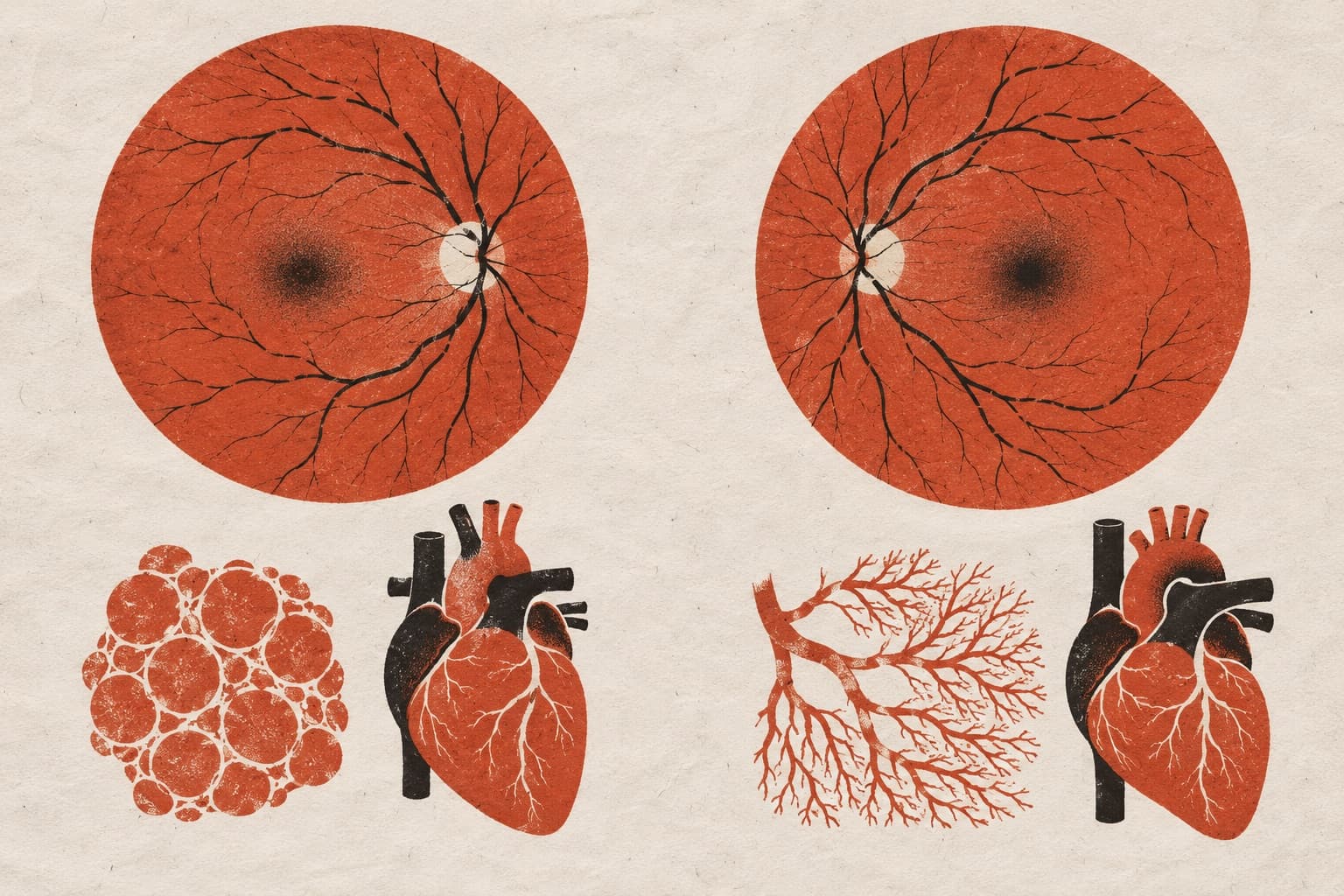
Retinal asymmetry between eyes is linked to cardiovascular risk
Across 46,836 adults, each standard deviation increase in retinal nerve fiber layer asymmetry was linked to hazard ratios from ~1.07 for atrial fibrillation to 1.15 for heart failure.
Journal of the American Heart Association
In a prospective cohort of 46,836 UK Biobank participants with bilateral optical coherence tomography imaging, researchers evaluated whether intereye asymmetry across retinal layers associates with cardiovascular risk. Across median follow-up periods ranging from 9.22 to 9.38 years, with a maximum follow-up of 12.86 years, investigators tracked incident coronary heart disease, myocardial infarction, atrial fibrillation, and heart failure. Greater retinal asymmetry was consistently observed in participants who developed cardiovascular disease. Retinal nerve fiber layer asymmetry displayed the most consistent links, with hazard ratios per standard deviation increase spanning from ~1.07 for atrial fibrillation to 1.15 for heart failure. Adding this asymmetry to prediction models modestly improved risk stratification compared with mean thickness alone. Exploratory proteomic analyses suggested associations between retinal nerve fiber layer asymmetry and circulating signatures tied to inflammation, extracellular matrix remodeling, and insulin-like growth factor signaling.
Why it matters
The findings suggest that structural asymmetry between eyes may offer a noninvasive window into systemic microvascular health and biological pathways relevant to cardiovascular aging. Retinal nerve fiber layer asymmetry may serve as a candidate imaging marker to aid future risk assessment.
Caveats
As an observational study, the design cannot establish causality between retinal asymmetry and cardiovascular outcomes. Furthermore, the molecular findings rely on exploratory proteomic analyses that require validation.
- Inflammation
- Extracellular matrix remodelling
- Insulin/IGF-1 signalling
- Retinal nerve fiber layer asymmetry
- Atrial fibrillation
- Humans
The paper
Intereye Retinal Asymmetry, Incident Cardiovascular Disease, and Circulating Proteomic Signatures
Shanghai Jiao Tong University
Journal of the American Heart Association · 29 Sep 2026