The Triad of Vascular Ageing: Cellular Senescence, Inflammaging, and Epigenetic Remodelling in Atherosclerosis
Abstract
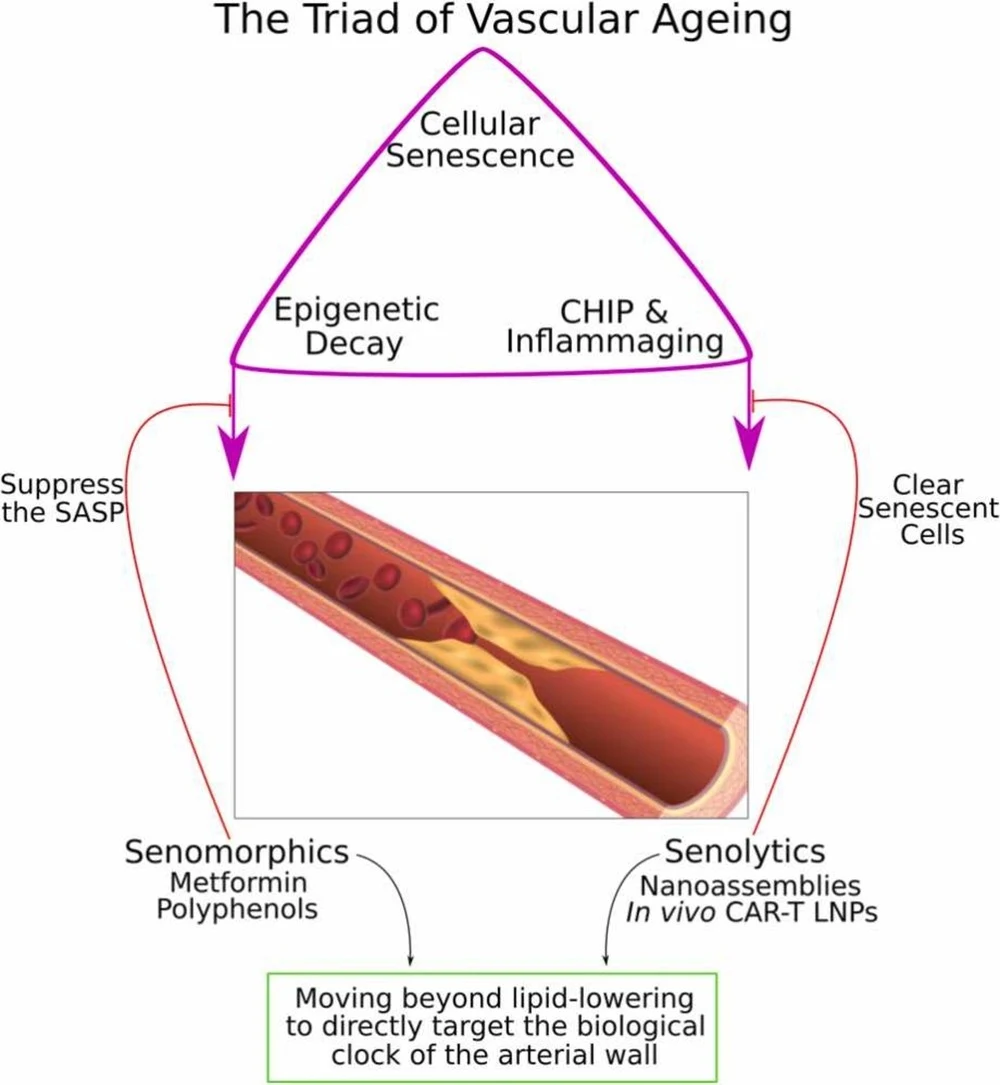
Atherosclerotic cardiovascular disease remains a leading global cause of the cardiovascular mortality burden, yet traditional lipid-centric models fail to explain the residual cardiovascular risk observed in older populations. This review, synthesising contemporary literature from 2020 onwards alongside foundational studies, explores the paradigm shift towards the 'geroscience hypothesis', positing that intrinsic biological ageing of the vascular wall is a potent amplifier and primary driver of atherogenesis acting in synergy with circulating lipids. We delineate a pathogenic triad: cellular senescence, systemic inflammaging, and epigenetic dysregulation. At the cellular level, mechanical and metabolic stressors force endothelial and vascular smooth muscle cells into a usually stable senescent state, triggering the Senescence-Associated Secretory Phenotype. Immunologically, ASCVD in the elderly is driven by metabolically exhausted macrophages, the emergence of clonal haematopoiesis of indeterminate potential, and cytotoxic memory T cells. Crucially, metabolic stressors such as hyperglycaemia induce long-lasting alterations to the chromatin landscape of haematopoietic stem cells, establishing 'trained immunity' and a persistent pro-inflammatory metabolic memory. These processes are deeply governed by an altered epigenetic landscape, including the loss of protective sirtuins and aberrant RNA methylation, which dynamically accelerate biological clocks like GrimAge. Clinically, vascular ageing trajectories are highly sexually dimorphic and heavily influenced by midlife metabolic clustering and endocrine shifts and murine models suggest highly sexually dimorphic plaque immunophenotypes. Finally, we evaluate the translational frontier of precision senotherapeutics. We contrast senomorphics, such as repurposed metformin and natural polyphenols that suppress the SASP, with targeted senolytics. Emerging nanotechnology-including in vivo CAR-T lipid nanoparticles and responsive peptide nanoassemblies-offers preclinical proof-of-concept strategies to selectively clear senescent cells without systemic toxicity. Ultimately, mitigating ASCVD requires moving beyond lipid management to integratively target the biological clock of the artery.
- CAR-T lipid nanoparticles
- Metformin
- Cellular senescence
- Chromatin and 3D genome organisation
- Atherosclerosis
- Atherosclerotic cardiovascular disease
The paper
Braude Academic College of Engineering; Institute of General Pathology and Pathophysiology
Mechanisms of Ageing and Development, 16 Oct 2026

