Mutation detection tools largely disagree in cell mixtures
Detection rates and the share of correct calls approached 80% for single-letter changes present in over 2% of DNA copies at sequencing depths of at least 300-fold.
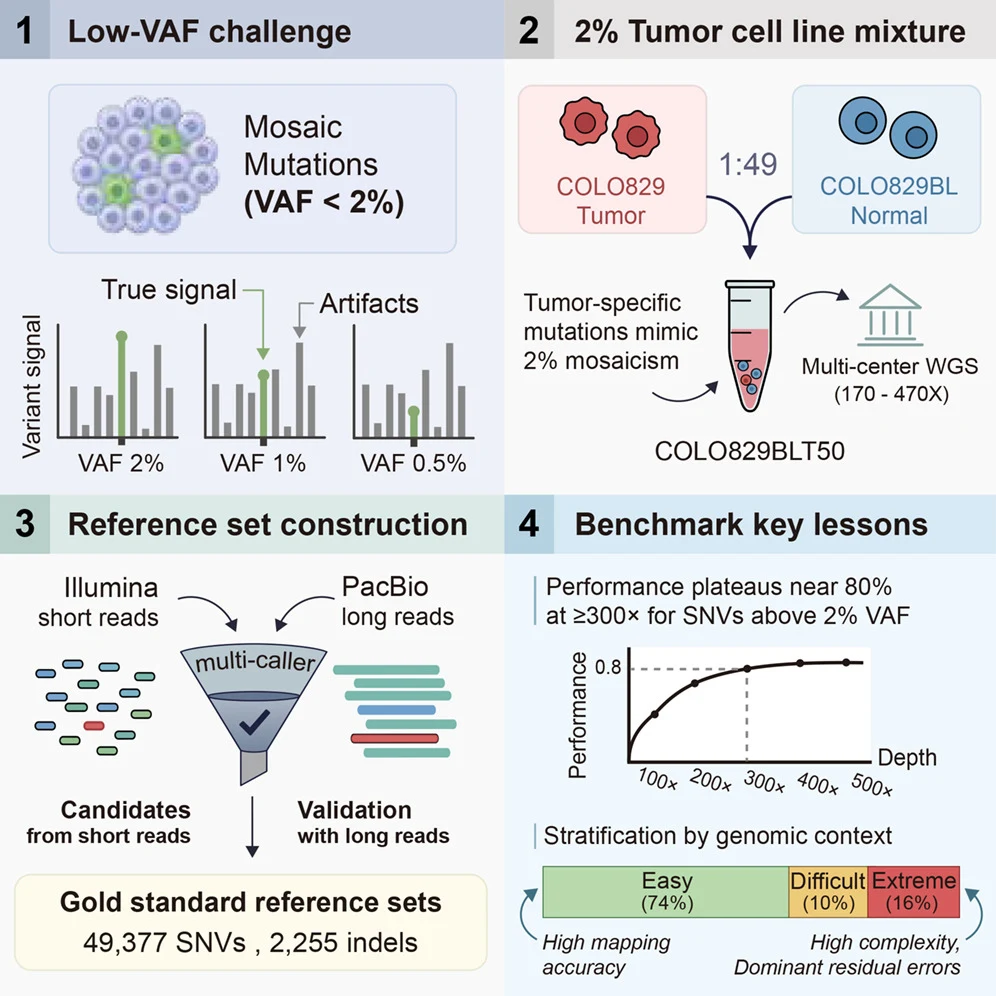
In an experiment using mixtures of cells grown in the lab, researchers compared methods for detecting rare DNA mutations. They mixed cell lines at a ratio of 1:49 and collected whole-genome sequencing data at five centres. Seven institutions tested 12 analysis pipelines against a reference set of mutations.
The methods largely disagreed on which mutations they detected, both across tools and across replicate samples. This partly reflected chance sampling of rare mutations in separately prepared samples. For single-letter DNA changes present in more than 2% of DNA copies, detection rates approached 80%, as did the share of reported mutations that were correct. This required sequencing depths averaging at least 300 reads per DNA position. Additional sequencing brought little improvement.
Why it matters
Reliable detection of rare mutations in non-cancer tissues provides a basis for investigating how these genetic changes relate to aging.
Caveats
This benchmark used laboratory cell mixtures, not intact tissues or people. The reported performance figures concerned single-letter changes above 2% of DNA copies, not necessarily rarer mutations or DNA insertions and deletions.
- Resources: datasets, atlases and tools
- Culture-derived mutations
- Mosaic insertions and deletions
- Mosaic single-nucleotide variants
- Variant allele fraction
The paper
College of Natural Sciences; Harvard Medical School
Cell Genomics, 15 Oct 2026