Prediction of dementia-related mortality in metabolic dysfunction-associated steatotic liver disease using survival machine-learning models
Abstract
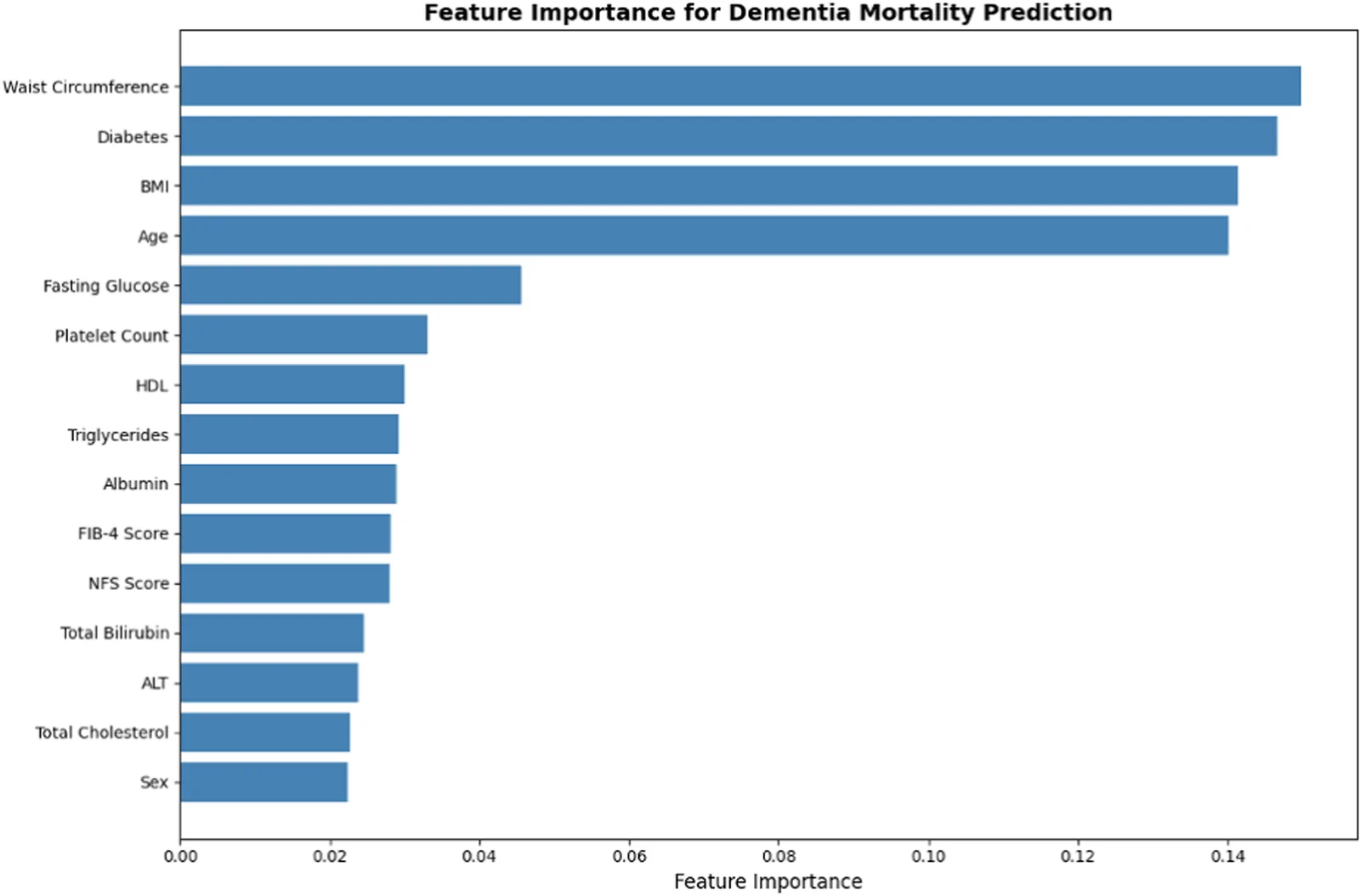
BACKGROUND: Metabolic dysfunction-associated steatotic liver disease (MASLD) is increasingly recognized as a multisystem condition with extrahepatic complications, including cognitive decline, Alzheimer's disease, and related dementias. However, conventional clinical tools have limited ability to predict dementia-related mortality in this population. OBJECTIVE: To develop and internally validate survival-based machine-learning models for predicting dementia-related mortality among adults with MASLD and identify key clinical predictors. METHODS: Adults with MASLD were identified from NHANES III with linked mortality data. Dementia-related mortality was defined using National Death Index codes for Alzheimer's disease and other dementias. Cox proportional hazards models, random survival forests, gradient-boosted survival models, and logistic regression were developed and compared with exploratory comparator model. Performance was evaluated using concordance indices, area under the receiver-operating-characteristic curve, Brier scores, and reclassification metrics relative to the FIB-4 score. RESULTS: Among 1774 adults with MASLD, 115 dementia-related deaths occurred during a median follow-up of 193 months. Overall discrimination was modest. Logistic regression showed the highest discrimination in 5-fold cross-validation, whereas the penalized Cox model achieved the highest bootstrap C-index. The gradient-boosted survival model demonstrated the greatest improvement in reclassification compared with FIB-4. Exploratory risk stratification classified all dementia-related deaths within the high-risk cohort, although these findings warrant cautious interpretation due to possible overfitting. Waist circumference, diabetes, body mass index, and age were the most influential predictors. CONCLUSIONS: Survival-based models may improve identification of MASLD patients at elevated risk of dementia-related mortality. Metabolic and anthropometric factors appeared more informative than liver fibrosis scores, and warrant external validation in contemporary cohorts.
- Machine learning
- Dementia
- Metabolic dysfunction-associated steatotic liver disease
- Alzheimer's disease
- Body mass index
- Humans
The paper
Euclid University; Research Department
Journal of Alzheimer's Disease Reports, 30 Jun 2026, Open access