Muscle quality and blood markers linked to dementia after stroke
In 7,047 UK stroke survivors, lower muscle quality and higher blood metabolite risk scores were linked to higher risks of all-cause, Alzheimer's and vascular dementia.
Dose-response
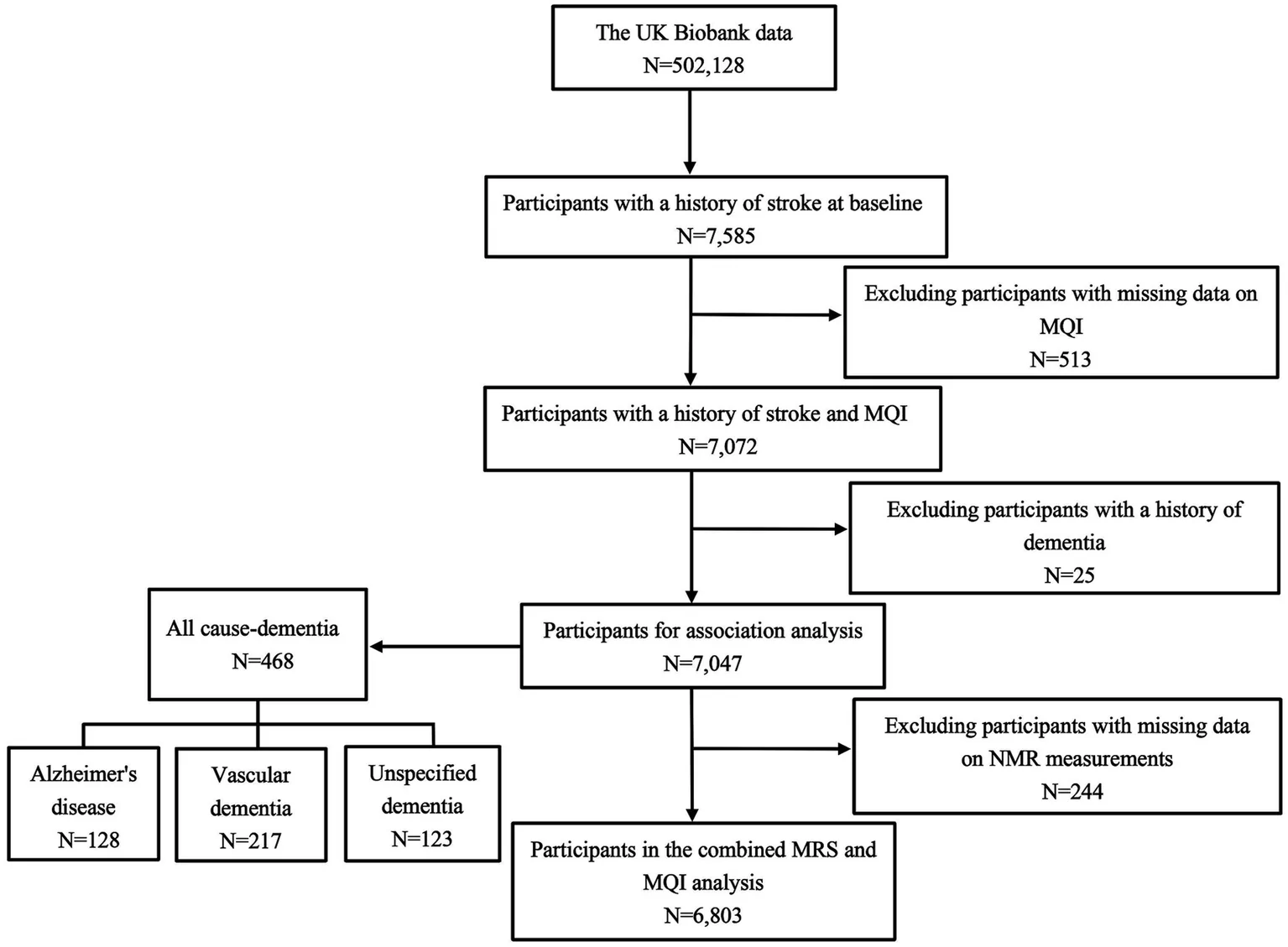
Researchers examined 7,047 UK Biobank participants with a history of stroke and no dementia at baseline in an observational cohort study. They assessed muscle quality by dividing dominant-hand grip strength by the same arm's fat-free mass. They used blood metabolites, small molecules in blood, to build risk scores.
Higher muscle quality was associated with lower risks of all-cause dementia, Alzheimer's disease and vascular dementia. Participants with high metabolic risk scores and the lowest muscle quality had the greatest risks. Hazard ratios, measures of relative risk, were 3.29 for all-cause dementia, 5.83 for Alzheimer's and 4.57 for vascular dementia. A separate Mendelian randomisation analysis using genetic differences provided suggestive evidence linking higher genetically predicted lean mass, the body's non-fat mass, to lower Alzheimer's risk, and stronger genetically predicted grip to lower vascular dementia risk after accounting for lean mass.
Why it matters
Dementia is a severe long-term complication of stroke. Combining muscle quality and blood metabolite measures may assist early risk screening in stroke survivors.
Caveats
The cohort associations do not establish cause and effect; the genetic analysis provided suggestive evidence, not proof. The cohort results concern stroke survivors without dementia at baseline and may not extend to people without a history of stroke.
From the paper
- Participants
A total of 7,047 participants (mean age, 60.45 ± 6.91 years) were included in the primary analysis, in which 4,068 (57.73%) were men, 6,663 (94.55%) were White, and 1,457 (20.80%) had a college degree or above.
- Follow-up
During a median follow-up of 15.09 years, 468 participants developed incident ACD.
Results, 3.2 The association between the MQI and dementia among stroke survivors
- Result
Compared with the low MQI group, the high MQI group was associated with significantly lower risks of ACD (HR = 0.51, 95% CI: 0.39–0.67), AD (HR = 0.47, 95% CI: 0.29–0.76), and VaD (HR = 0.59, 95% CI: 0.40–0.88), respectively.
Results, 3.2 The association between the MQI and dementia among stroke survivors
- Limitation
Firstly, the UK Biobank cohort is mainly composed of White individuals, and the research results may not be directly applicable to other ethnic groups.
Quoted word for word from the full text on frontiersin.org.
The paper
Suining Central Hospital
Frontiers in Aging Neuroscience, 29 Sep 2026