Speech age gaps track dementia phenotypes and biological aging
In 2,928 individuals across five Latin American countries, speech age gaps tracked dementia diagnoses, brain age, social exposome, and epigenetic aging clocks.
Science Advances
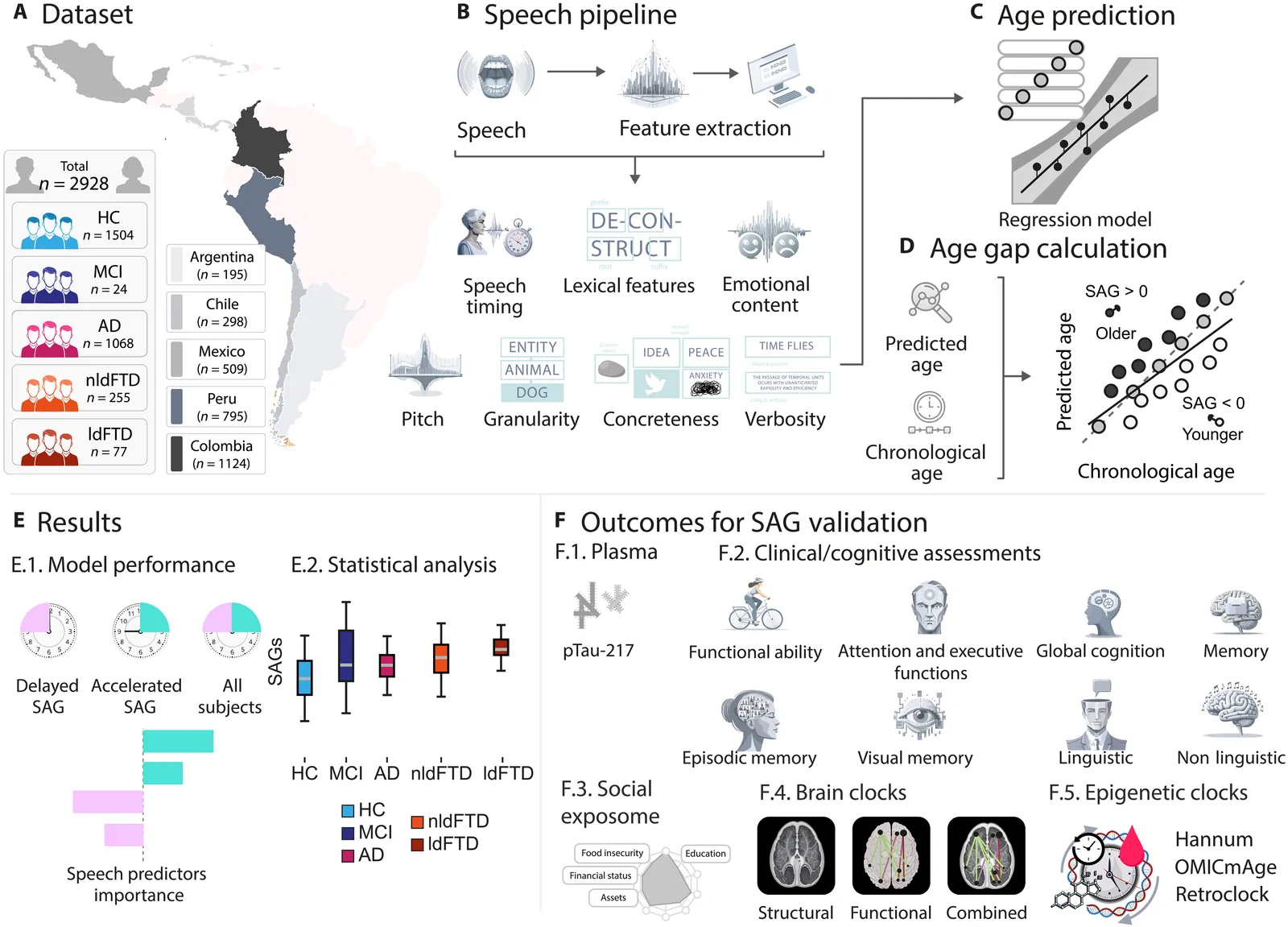
In a cross-sectional study of 2,928 human participants across five Latin American countries, researchers developed a speech-based biological aging clock. The cohort included healthy controls alongside individuals with mild cognitive impairment, Alzheimer's disease, and non-language or language-dominant frontotemporal dementia. Supervised models trained on multimodal acoustic and linguistic features estimated chronological age, yielding speech age gaps where positive values reflect older-appearing speech. Speech age gaps differentiated diagnostic groups, with healthy controls scoring lower than patient groups, and Alzheimer's disease scoring lower than frontotemporal dementia variants. These gaps associated with clinical and cognitive domains, structural and functional brain clocks, and social exposome. In Alzheimer's disease, speech age gaps correlated with phosphorylated tau (p-Tau217). The metric also correlated with epigenetic age clocks, including Retroclock and OMICmAge.
Why it matters
The results indicate that speech features capture cross-sectional, multilevel variation associated with biological aging and neurodegeneration. This approach may provide a scalable, low-cost biomarker candidate for aging studies in underrepresented global populations.
Caveats
The findings rely on cross-sectional data, which cannot capture dynamic, longitudinal changes in speech or disease progression. In addition, associations between speech age gaps and specific epigenetic clocks varied across diagnostic subgroups.
The paper
Speech clocks decode dementia phenotypes, social exposome, and biological aging
Show 48 more authors
Sebastián Moguilner, Agustina Legaz, Pavel Prado, Jhosmary Cuadros, Lucía Amoruso, Liset Gonzalez, Damián Dellavale, Juan Pablo Espinoza‐Puelles, Javier Palma-Espinosa, C. Jarne, Fabio Mattiussi, Matías Caccia, Alejandro Sosa Welford, Nicolás Pelella, Jeremías Inchauspe, Franco Javier Ferrante, Gonzalo Nicolás Pérez, Marcelo Adrián Maito, Guido Rocatti, Maria Eugenia Godoy, Joaquin Migeot, Paulina Orellana, Ariel Caviedes, Martín Bruno, Leonel Tadao Takada, Slachevsky Andrea, María Isabel Behrens, Bárbara Bruna, David Fernando Aguillon, Lina Maria Zapata‐Restrepo, José Alberto Ávila‐Funes, Nilton Custodio, Bruce L. Miller, Maria Luisa Gorno‐Tempini, Stefanie Danielle Piña‐Escudero, Pablo A Reyes, Kun Hu, Maira Okada de Oliveira, Carlos Coronel‐Oliveros, Josephine Cruzat, Juan F. Cardona, Michael Corley, Irene B. Meier, Vaibhav A. Narayan, Enzo Tagliazucchi, Sandra Báez, Claudia A. Duran-Aniotz, Adolfo M. García,Adolfo Ibáñez University · Trinity College Dublin
Science Advances · 30 Sep 2026