Putative Butyrate-Producing Gut Bacteria Profile and Muscle Health in Older Post-Stroke Patients
Abstract
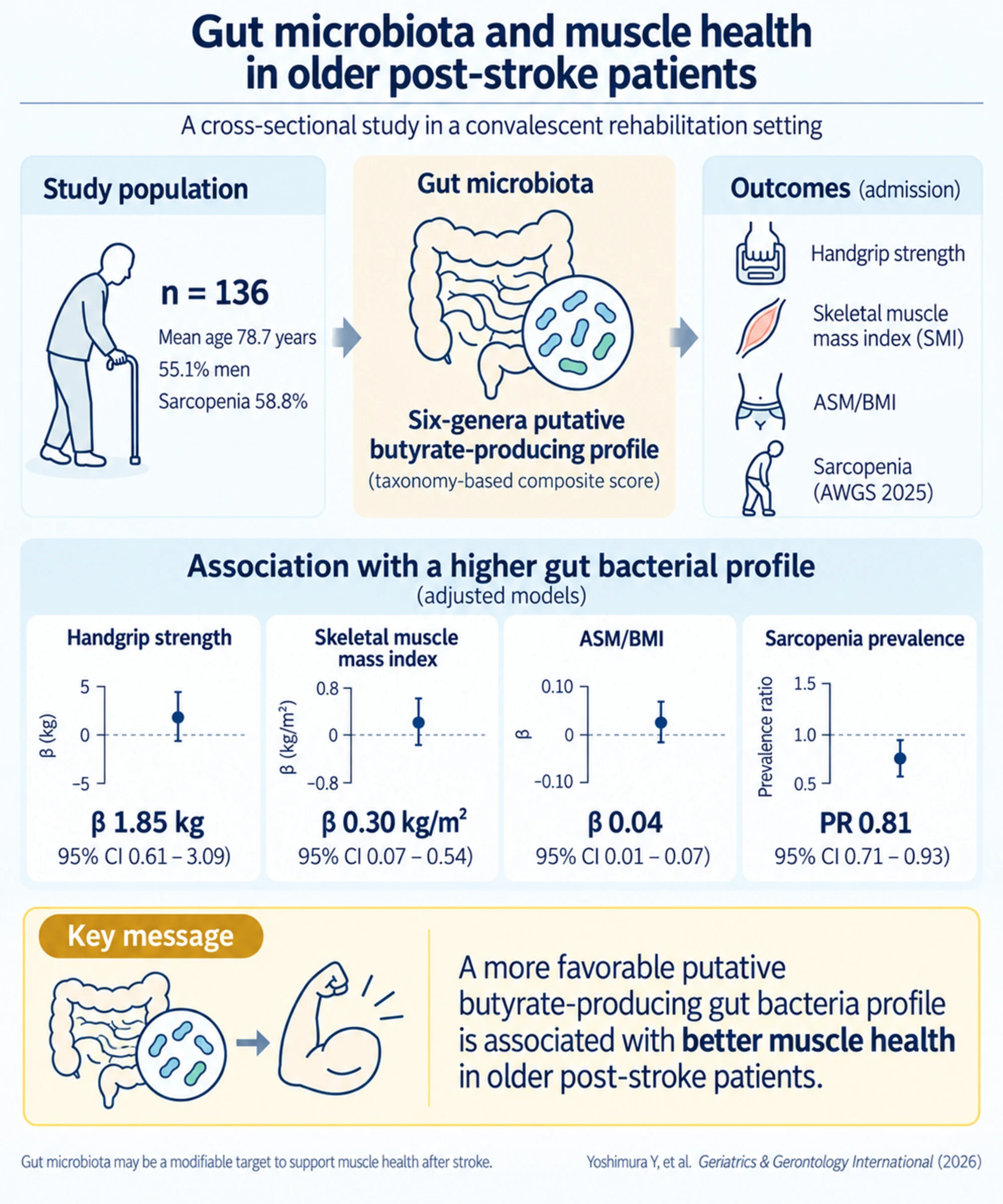
AIM: Muscle health is a clinically relevant dimension of vulnerability in older post-stroke patients, but its gut microbial correlates remain unclear. We examined whether a taxonomy-based putative butyrate-producing gut bacteria profile was associated with admission muscle health. METHODS: This registry-based cross-sectional study included patients aged 65 years or older with 16S rRNA gut microbiota data and no systemic antibiotic exposure within 4 weeks before stool sampling. A six-genera profile was constructed from genus-level relative abundance using centered log-ratio transformation, standardization, and averaging. Outcomes were handgrip strength, skeletal muscle mass index (SMI), body mass index-indexed appendicular skeletal muscle mass (ASM/BMI), and sarcopenia by Asian Working Group for Sarcopenia 2025 criteria. Models adjusted for age, sex, comorbidity, premorbid function, nutritional risk, and inflammation. RESULTS: Among 136 patients (mean age 78.7 years; 55.1% men), 80 (58.8%) had sarcopenia. After adjustment, a higher profile was associated with higher handgrip strength (β 1.85 kg, 95% CI 0.61-3.09), SMI (β 0.30 kg/m², 95% CI 0.07-0.54), and ASM/BMI (β 0.04, 95% CI 0.01-0.07), and lower sarcopenia prevalence (prevalence ratio 0.81 per standard deviation, 95% CI 0.71-0.93). Exploratory genus-level signals were most apparent for Agathobacter and Butyricicoccus. CONCLUSION: A taxonomy-based putative butyrate-producing gut bacteria profile was associated with better admission muscle health in older post-stroke rehabilitation patients. These findings support a gut-muscle phenotype association, not microbial function or causality.
- Microbiome composition
- Putative butyrate-producing gut bacteria profile
- Stroke
- Sarcopenia
- Body mass index-indexed appendicular skeletal muscle mass
- Humans
The paper
Kumamoto Rehabilitation Hospital; Aichi Medical University Hospital
Geriatrics & Gerontology International, 1 Oct 2026