Depressive symptoms linked to disability in older Chinese adults
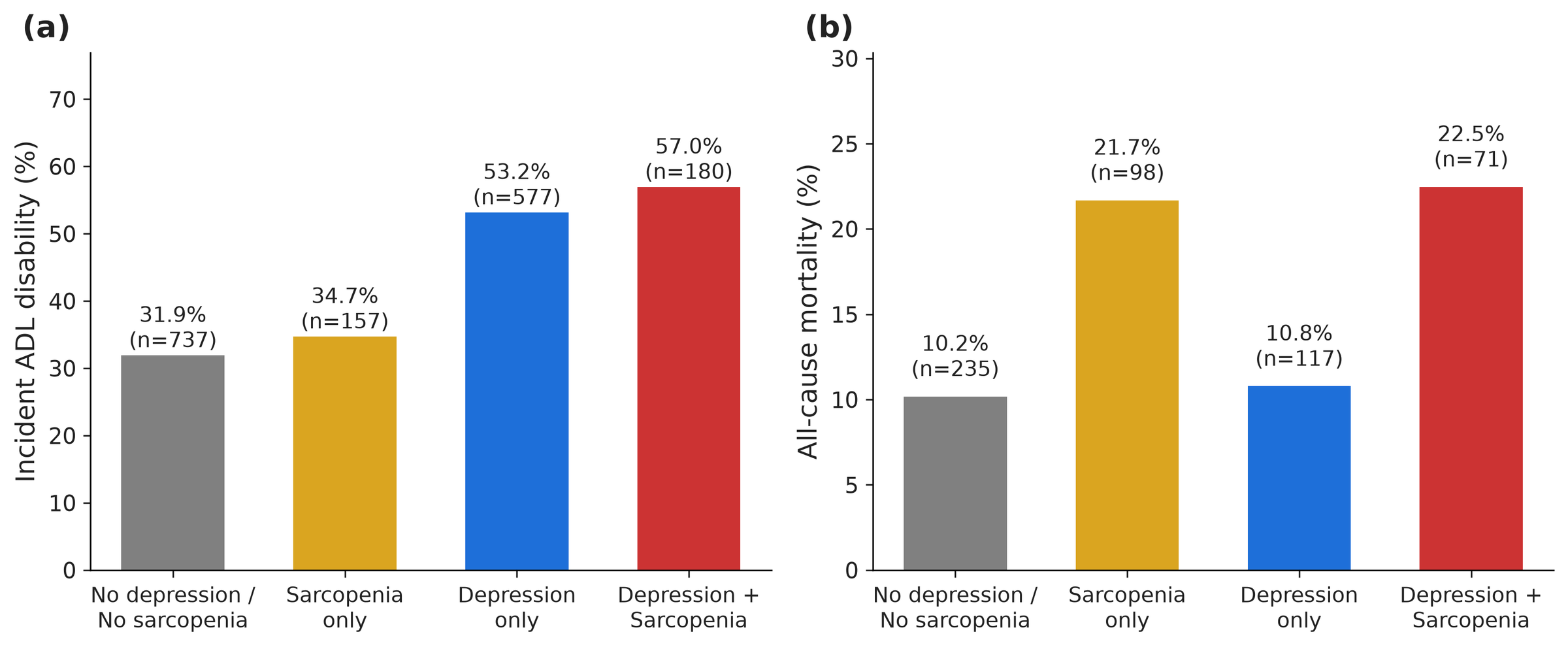
Adults with depressive symptoms and low muscle strength and mass had a disability hazard ratio—comparing rates over time—of 1.40 versus those with neither.
7 years
An observational cohort study followed 4,161 community-dwelling Chinese adults aged 60 or older who initially had no disability in basic daily activities. Researchers identified depressive symptoms using a questionnaire. They assessed sarcopenia, a condition involving low muscle strength and mass, using grip strength, walking speed and estimated limb muscle mass.
Over a median seven years, 1,651 participants developed disability in daily activities. Compared with neither condition, adjusted disability hazard ratios were 1.37 for depressive symptoms alone and 1.40 for both conditions. The association for both conditions was strongest among adults aged 60–69. Sarcopenia alone showed no clear association with disability. For mortality, the ranges of likely effects for all three groups included no difference. Low grip strength was independently linked to higher mortality, unlike the overall sarcopenia diagnosis.
Why it matters
Losing independence is a concern in later life. The authors suggested that adults aged 60–69 with both conditions may benefit from combined screening and early intervention.
Caveats
This observational study cannot establish cause and effect; depressive symptoms came from a questionnaire and muscle mass was estimated. The paper is a preprint and has not been peer-reviewed.
From the paper
- Participants
We included 4,161 community-dwelling adults aged ≥ 60 years from the China Health and Retirement Longitudinal Study (CHARLS, 2011–2018) who were free of activities of daily living (ADL) disability at baseline.
- Follow-up
Over a median follow-up of 7.0 years, 1,651 (39.7%) participants developed ADL disability and 521 (12.5%) died.
- Result
Compared with the no depression/no sarcopenia group, the fully adjusted HRs for ADL disability were 1.01 (95% CI 0.87–1.18) for sarcopenia only, 1.37 (1.23–1.53) for depression only, and 1.40 (1.15–1.70) for depression plus sarcopenia.
Quoted word for word from the full text on researchsquare.com.
- Sarcopenia
- Grip strength
- Depression
- Activities of daily living disability
- Appendicular skeletal muscle mass
- Humans
The paper
The General Hospital of Western Theater Command
Research Square, 11 Oct 2026, Preprint, not peer-reviewed