The Intergenerational Clock: How Advanced Parental Age Shapes Offspring Biological Aging, Longevity and Neurodegenerative Risk
Abstract
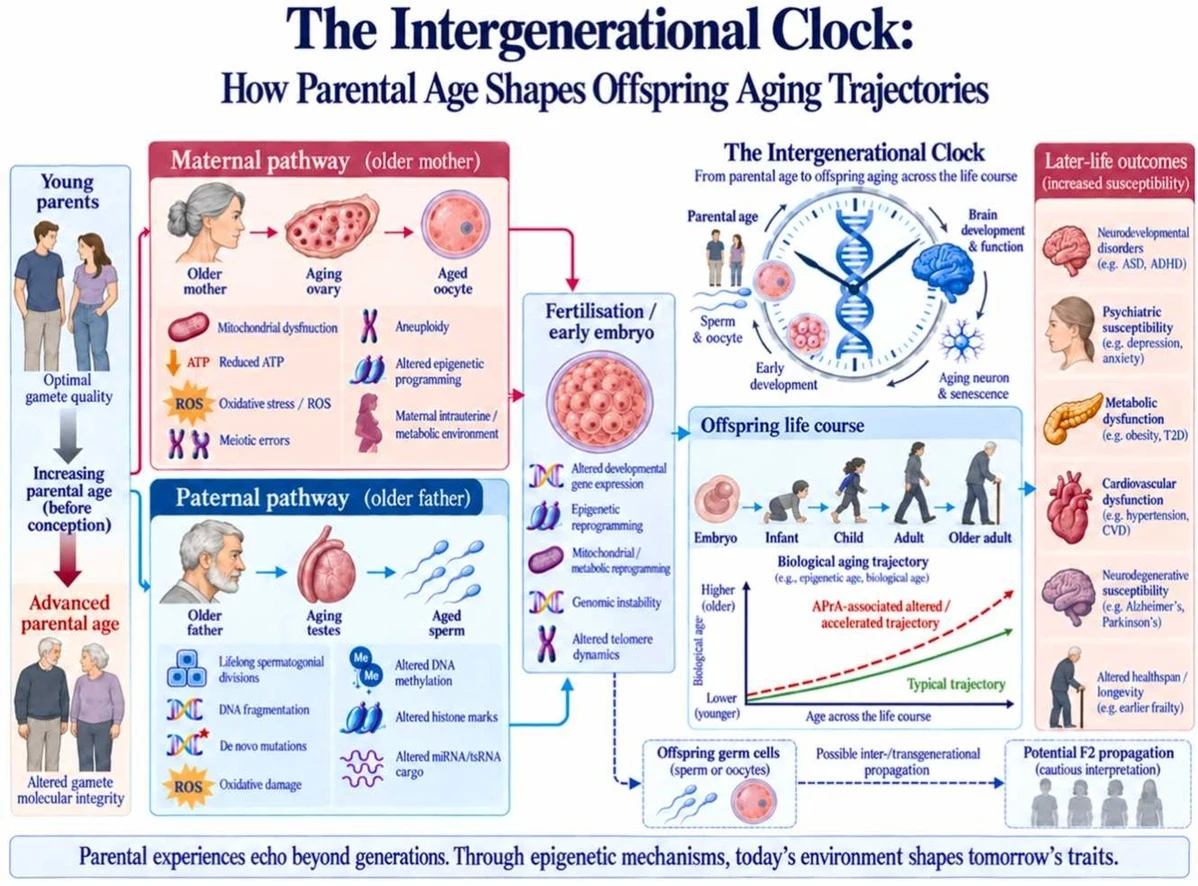
BACKGROUND: As delayed parenthood becomes a global demographic norm, understanding the biological consequences of advanced parental age or APrA (≥35 years in mothers; ≥40 years in fathers) is a critical geroscience priority. This shift represents a significant public health challenge, as parental senescence dictates implications far beyond immediate fertility. APrA is a key determinant of offspring healthspan, linked to increased risks of congenital anomalies, premature mortality, neurodevelopmental and metabolic dysfunction, as well as neurodegenerative diseases. This inherited biological legacy supports an "intergenerational clock" linking reproductive timing to the aging trajectories of subsequent generations. SCOPE: This review synthesizes molecular mechanisms connecting parental senescence to reproductive success and offspring longevity. It examines the divergence between maternal factors, such as declining oocyte quality, and paternal factors, including sperm DNA fragmentation. Crucially, it integrates cross-species evidence ranging from Drosophila and mammalian models to human cohorts demonstrating how APrA progeny exhibit distinct behavioral phenotypes, including social deficits and anxiety, alongside compromised metabolic vitality. MAJOR CONCLUSIONS: Age-related modifications in DNA methylation, histone profiles, and non-coding RNAs serve as primary mediators, influencing gene regulation during early embryogenesis. These epigenetic processes interact with parental lifestyle and environment to alter germ cell programming. Propagated through intergenerational inheritance, these signatures increase susceptibility to neuropsychiatric and neurodegenerative disorders. Ultimately, this reframes aging as a continuous intergenerational process rather than an isolated individual trajectory. GENERAL SIGNIFICANCE: Bridging reproductive biology and geroscience, this framework decodes how parental age shapes offspring biological legacy - essential for refining reproductive counseling and informing public health strategies.
- Advanced parental age
- DNA damage response
- DNA methylation
- Epigenetic regulation of gene expression
- Anxiety
- Metabolic dysfunction
The paper
Indian Institute of Technology
Neuroscience and Biobehavioral Reviews, 13 Oct 2026