A multi-centre study on cervical cancer screening reveals population-related impact on cervical intraepithelial neoplasia rate
Multicentre
Abstract
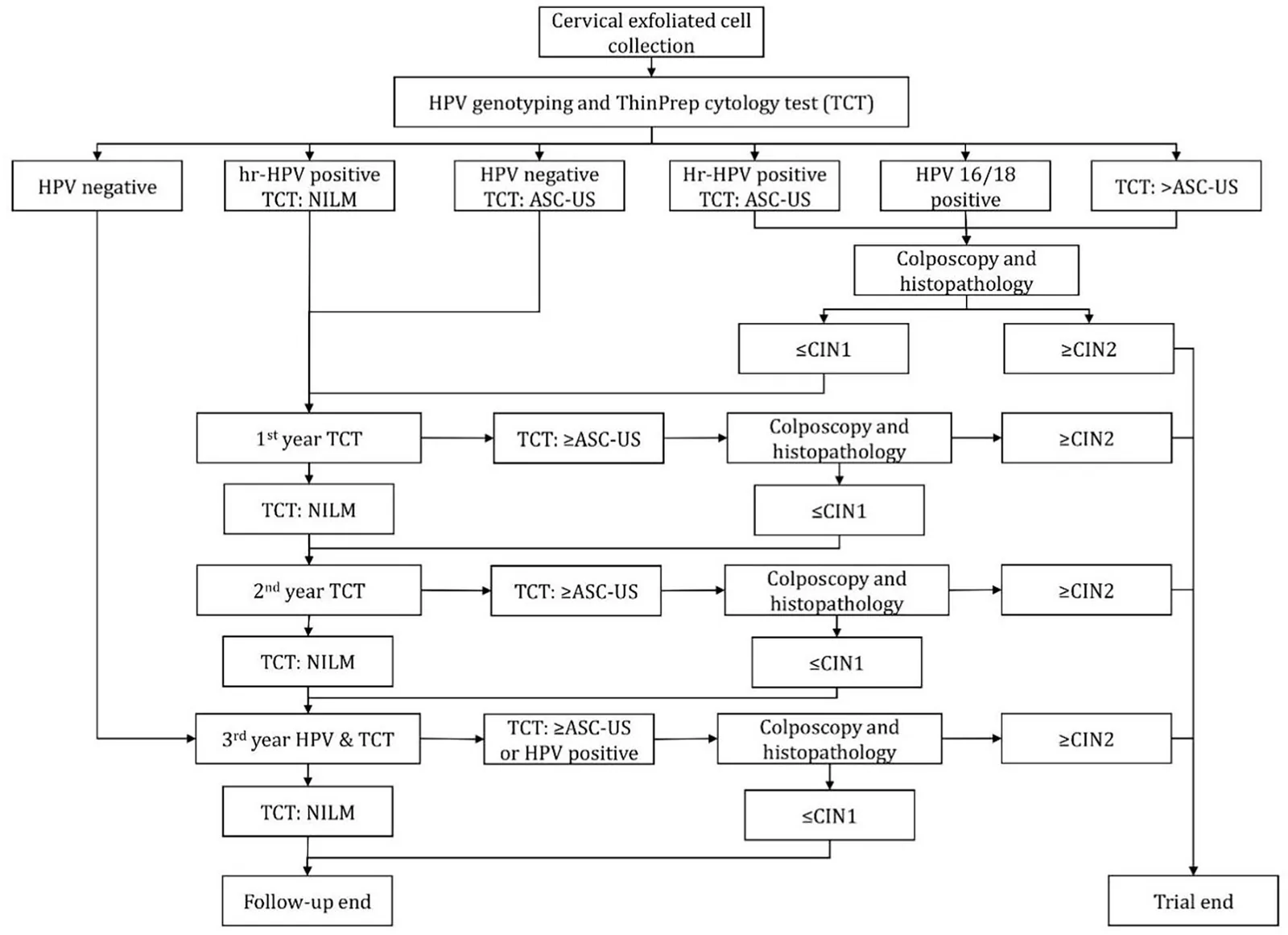
OBJECTIVE: To conduct a three-year cervical cancer screen in Zhejiang, Sichuan, Beijing, and Inner Mongolia and analyse clinical and population data to identify possible improvements to the screening protocol. METHODS: A standard protocol including human papillomavirus (HPV) detection, cytology test, colposcopy, and histopathology inspection was adapted for the screening. Additional HPV genotyping was performed for participants in Sichuan, Beijing, and Inner Mongolia. RESULTS: 12,086 women were included in this study, and 178 cases of cervical intraepithelial neoplasia (CIN) grade 2 or worse (CIN2+) were identified. Detailed analyses on features of age, region, ethnicity, and origin showed a notable correlation between age strata and high-grade CIN rates. Moreover, apart from HPV16/18, other HPV types such as HPV33, HPV52, and HPV58 were found to be enriched in high-grade CIN cases, as was repeat positivity. CONCLUSIONS: Our results suggest that age, HPV16, and ThinPrep cytologic test (TCT) are prominent exploratory predictors for CIN2+ detection, and HPV33, 52, and 58 may pose higher risks than other non-HPV16/18 types. Future studies incorporating prospective effectiveness and health-economic evaluation are required to validate the clinical utility of these predictors.
From the paper
- Participants
A total of 52 patients with CIN2+ were diagnosed in the last year; of these, 20, accounting for 23.53% of all CIN2+ cases identified during follow-up and 38.46% of those identified in the last year …
Results, 3.3 High-grade lesions found in the follow-up period
- Limitation
First, extended HPV genotyping was not uniformly performed for all participants.
Quoted word for word from the full text on frontiersin.org.
- Cervical cancer screening
- Cervical cancer
- Cervical intraepithelial neoplasia
- High-grade cervical intraepithelial neoplasia
- HPV detection
- Humans
The paper
Peking University People's Hospital
Frontiers in Cellular and Infection Microbiology, 28 Sep 2026