Older men showed less muscle growth and smaller protein shifts
After 10–12 weeks of resistance training, younger men gained 2.73 kilograms of lean body mass, compared with 1.18 kilograms in older men.
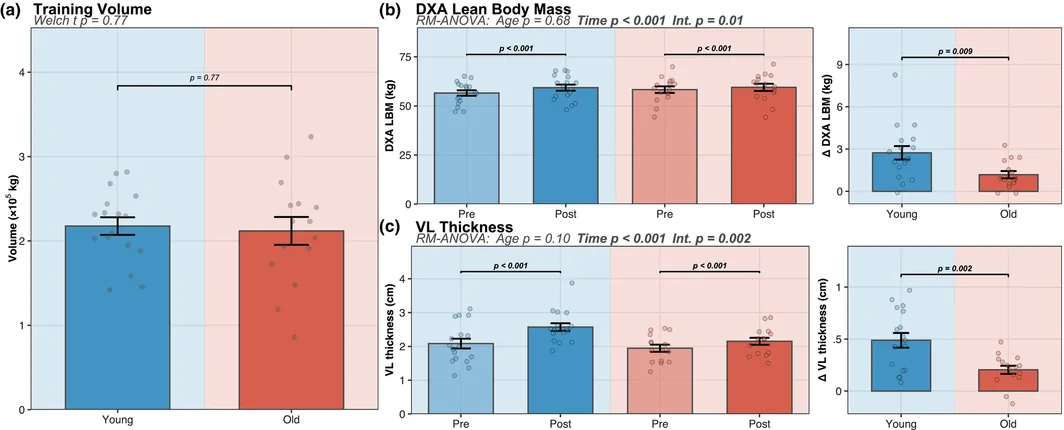
Seventeen younger and 15 older untrained men, averaging 21.9 and 57.5 years respectively, completed a 10–12-week resistance-training trial. Researchers measured 2,106 proteins in thigh muscle before and after training.
Both groups did similar amounts of training. Younger men gained more lean body mass and thigh-muscle thickness: thickness rose by 0.49 centimetres, compared with 0.20 centimetres in older men. The analysis detected statistically significant changes in 135 muscle proteins in younger men, but none in older men. That did not mean older muscle failed to respond: 81.5% of those 135 proteins shifted in the same direction in older men. The researchers concluded that the smaller muscle-growth response coincided with a smaller protein response, rather than a fundamentally different pattern of adaptation.
Why it matters
The biological basis of weaker muscle growth after resistance training with aging remains unclear. Measuring muscle proteins offers a way to investigate this age-related change.
Caveats
This trial compared age groups but did not establish whether the protein changes caused the differences in muscle growth. It studied only untrained men.
From the paper
- Limitation
First, the analysis is secondary, drawing from parent RT investigations with shared training protocols but different nutritional supplementation paradigms (peanut protein and beetroot juice), and participant-level random intercepts accounted for within-subject correlation.
Quoted word for word from the full text on physoc.onlinelibrary.wiley.com.
- Resistance training
- Lean body mass
- Older-adult protein responses to resistance training
- Skeletal muscle soluble proteome
- Turquoise co-expression module
- Humans
The paper
Auburn University
Physiological Reports, 1 Oct 2026, Open access