Smoking links to dementia risk mainly in APOE ε4 noncarriers
Across 207,887 participants in a meta-analysis, current smoking was associated with all-cause dementia risk exclusively among APOE ε4 noncarriers.
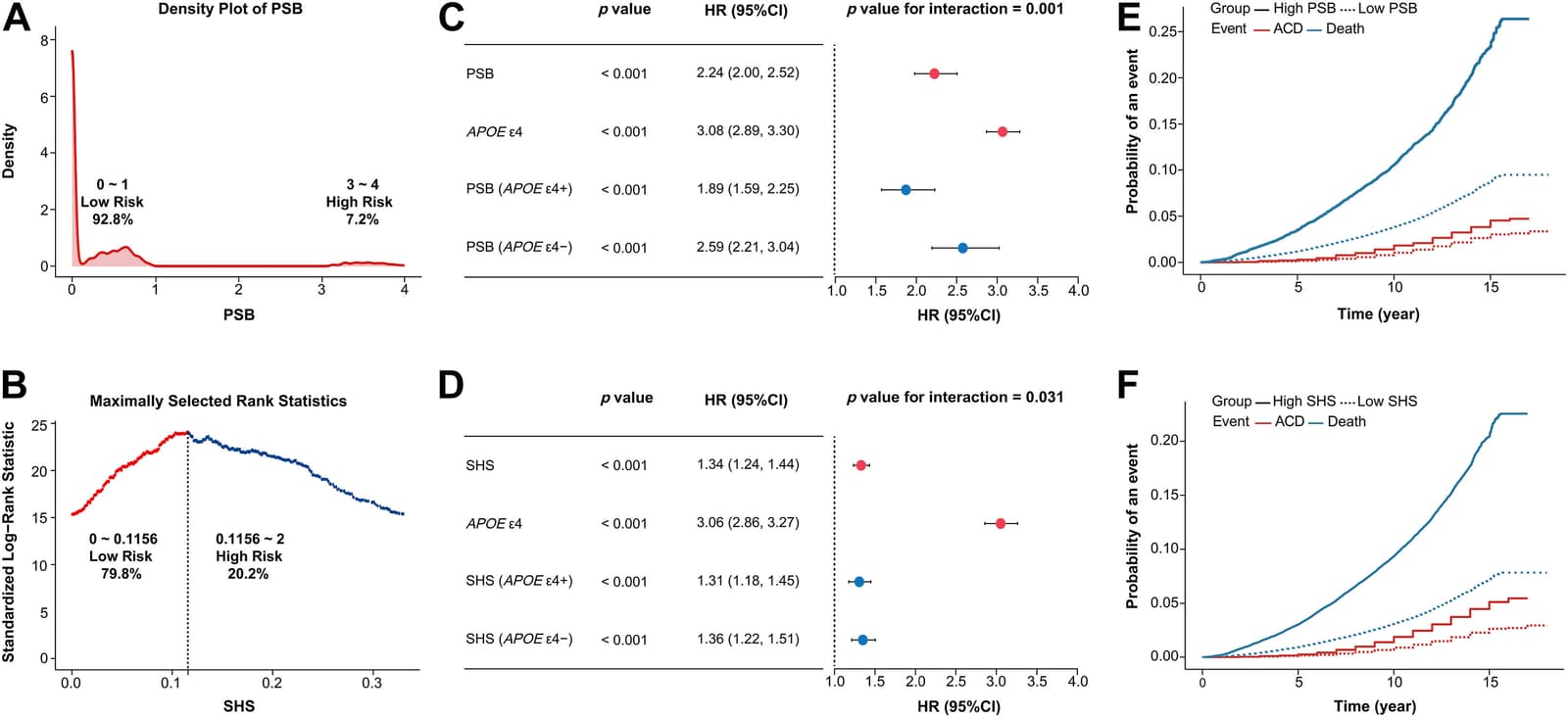
In a cohort of 173,366 UK Biobank participants without dementia followed for a median of 13 years, researchers evaluated how smoking burden and smoking history interacted with APOE ε4 carrier status. Using death-competing risk models, they found both smoking indices were associated with all-cause dementia risk, with significant multiplicative interactions by APOE ε4 carrier status (p < .001 for panoramic smoking burden and p = .031 for smoking history score). The associations between smoking and dementia were more pronounced in ε4 noncarriers. The authors validated this interaction in a meta-analysis of 207,887 participants, finding that APOE ε4 status significantly modulated the relationship (p = .011). Current smoking was tied to dementia risk exclusively among ε4 noncarriers (p < .001). Proteomic and mediation analyses identified inflammation, angiogenesis modulation, and endopeptidase activity regulation as potential mediating mechanisms.
Why it matters
The findings clarify how genetic risk and modifiable lifestyle exposures interact to influence late-life cognitive decline. Accounting for these gene-by-environment dynamics could improve individual dementia risk prediction models in aging populations.
Caveats
The findings are based on observational data and cannot prove a direct causal relationship. Additionally, the identified biological mechanisms rely on proteomic correlations and statistical mediation rather than direct experimental validation.
The paper
Smoking Interacts With APOE ε4 to Influence Dementia: Evidence From the UK Biobank and Validation by Meta-Analysis of Longitudinal Studies
Cong YL, Wang YC, Huang LY et al.
Biological Psychiatry Global Open Science · 30 Jul 2026