Aging and Alzheimer's alter separate functional brain pathways
Two human cohorts of 973 and 129 individuals revealed that aging and Alzheimer's disease disrupt separate, orthogonal functional communication axes across the brain.
Nature Neuroscience
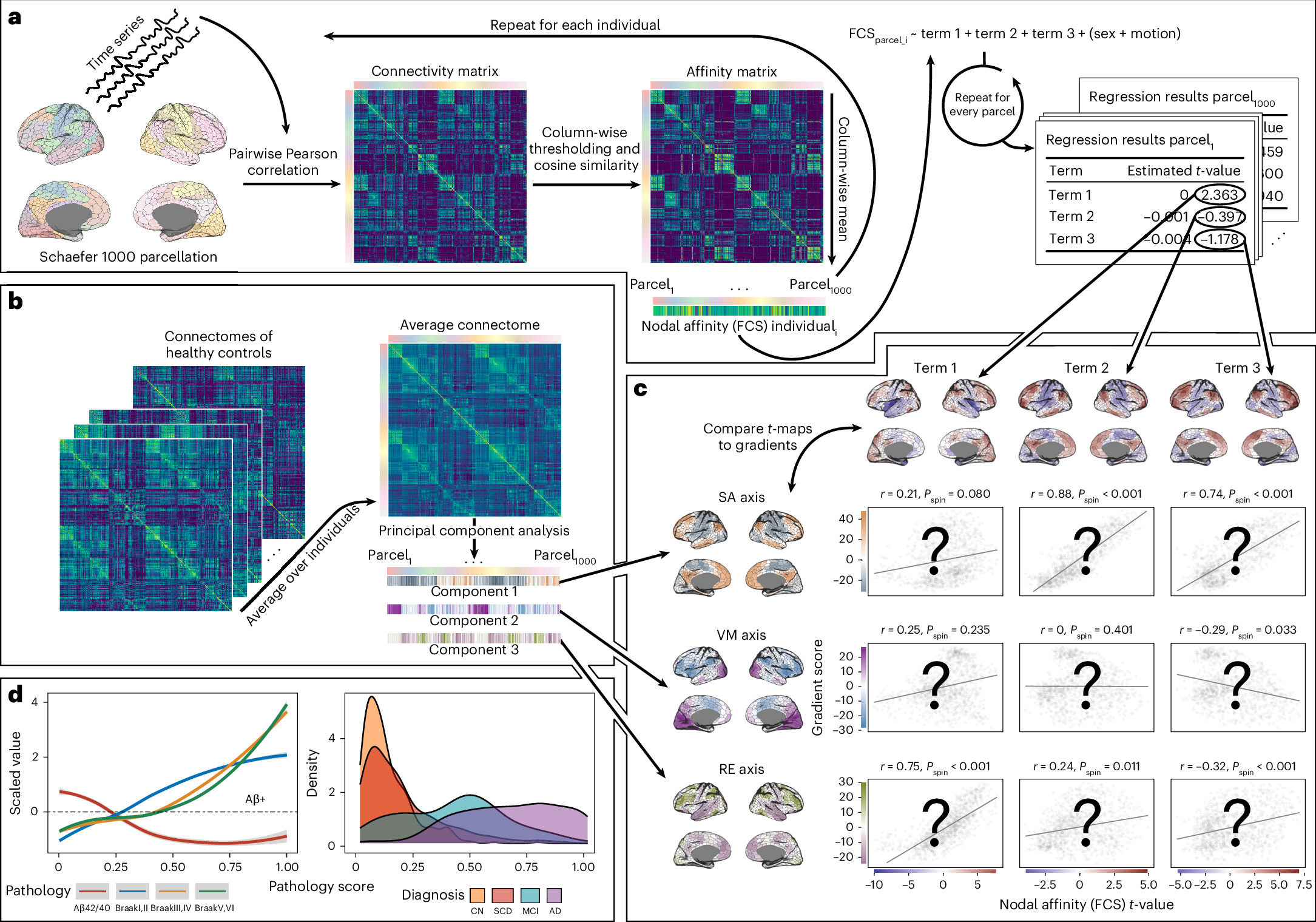
In two independent human cohorts (BioFINDER-2, N = 973; Alzheimer's Disease Neuroimaging Initiative, N = 129), researchers analyzed whole-cortex functional connectivity changes across the adult lifespan and in Alzheimer's disease. The team found that functional connectivity alterations linked to aging and Alzheimer's disease align with separate fundamental axes of hierarchical brain communication. Early accumulation of Alzheimer's pathology and subsequent cognitive decline both link to functional changes along the sensory-association axis. In contrast, age-related functional changes occur along the representation-executive axis consistently throughout the adult lifespan. These patterns demonstrate that Alzheimer's disease and typical aging alter major but orthogonal functional pathways in the brain rather than sharing a single continuum of network breakdown.
Why it matters
The findings help clarify the biological distinction between normal brain aging and neurodegenerative disease by showing their functional impacts follow separate organizational axes. This framework provides a whole-brain model for interpreting how brain communication shifts across the adult lifespan.
Caveats
The findings rely on observational functional imaging data across two specific cohorts. The study also does not establish whether these functional connectivity changes directly cause cognitive decline or arise secondary to other neuropathological events.
The paper
Different functional connectivity gradients reflect aging and Alzheimer's disease
Show 16 more authors
Léa Chauveau, Theodore Daniel Satterthwaite, Laura E.M. Wisse, Nicola Spotorno, Hamid Behjat, Amir Dehsarvi, Danielle van Westen, Toomas Erik Anijärv, the Frontotemporal Lobar Degeneration Neuroimaging Initiative, Susan M. Landau, Sebastian Palmqvist, Shorena Janelidze, Erik Stomrud, Rik Ossenkoppele, Niklas Mattsson, Oskar Hansson,Lund University
Nature Neuroscience · 1 Oct 2026