Intrinsic capacity predicts mortality better than frailty index
Higher intrinsic capacity lowered mortality risk (HR = 0.84 against 1.25 per 0.1 frailty increase) and remained predictive after adjusting for frailty index.
Frontiers in Public Health
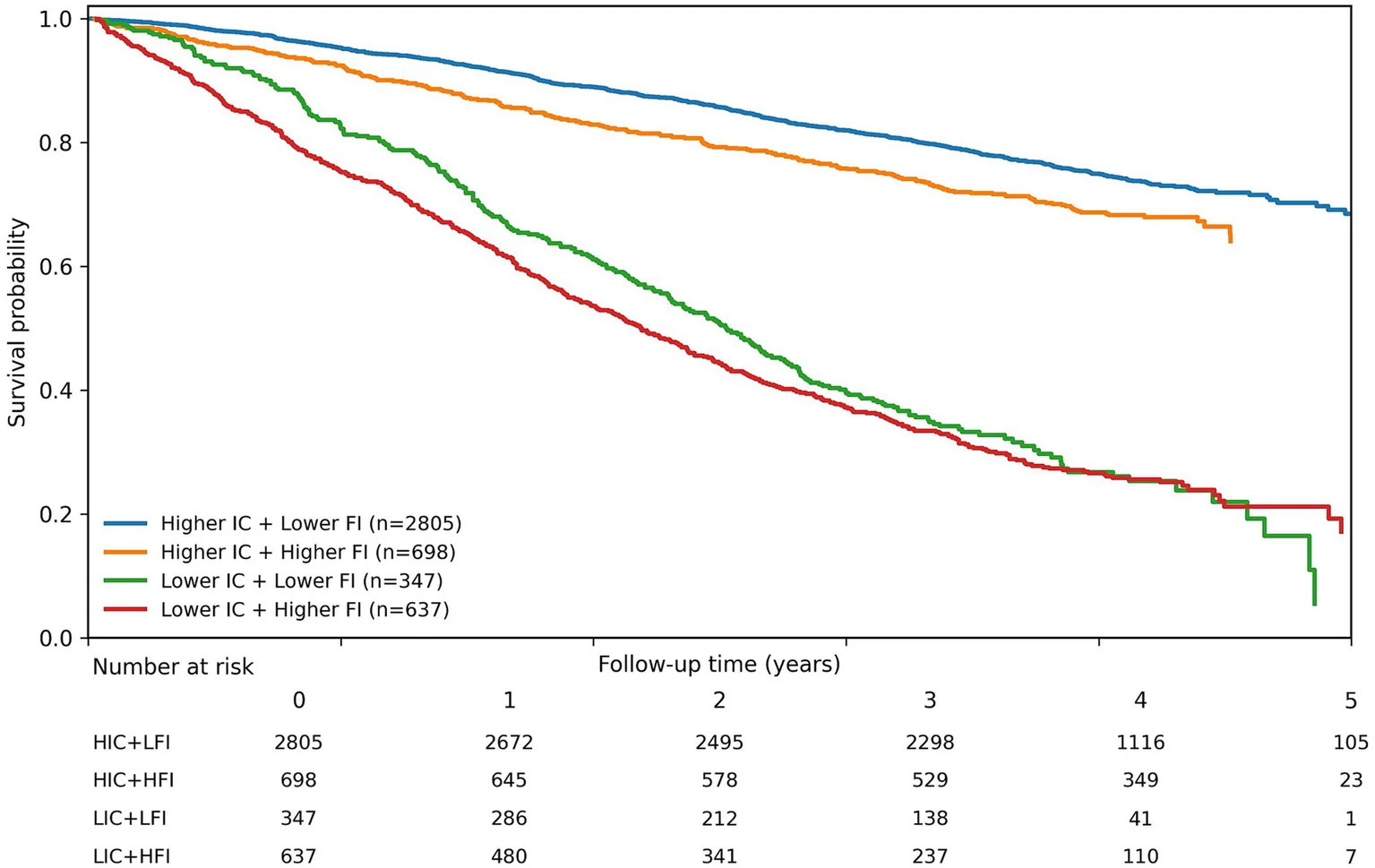
In a prospective cohort of 7,168 Chinese adults aged 60 and older from the Chinese Longitudinal Healthy Longevity Survey, researchers evaluated how intrinsic capacity and frailty index relate to health outcomes over four years. Intrinsic capacity was scored from 0 to 10 across five physical and mental domains, while frailty was measured using a 37-deficit accumulation index. During follow-up, 474 participants developed incident disability and 2,225 died. Higher baseline intrinsic capacity tracked lower odds of incident disability (OR = 0.79) and lower all-cause mortality (HR = 0.84). Conversely, higher frailty index scores tracked higher disability odds (OR = 1.93 per 0.1 increase) and mortality (HR = 1.25). When modeled together, both measures remained associated with disability, but only intrinsic capacity remained significantly associated with mortality (HR = 0.82). Participants combining low capacity with high frailty had the highest risks for both outcomes.
Why it matters
Intrinsic capacity focuses on positive functional reserves rather than accumulated deficits, offering a distinct framework for evaluating biological health in aging. Demonstrating that intrinsic capacity maintains stronger links to survival than deficit accumulation highlights the importance of preserving functional capacities in older populations.
Caveats
The observational design cannot establish causal relationships between these indices and subsequent health outcomes. Additionally, the disability analysis excluded participants who died prior to the 2018 follow-up, which may introduce survivor bias.
The paper
Chinese People's Liberation Army
Frontiers in Public Health · 16 Sep 2026