Chronic stress accelerates Alzheimer pathology in mice by hyperactivating mTORC1
Inhibiting mTORC1 restored autophagy, reduced amyloid accumulation, and corrected circuit desynchronization and behavioral deficits in stressed Alzheimer model mice.
CNS Neuroscience & Therapeutics
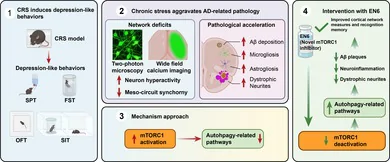
In 5xFAD mice, researchers investigated how chronic restraint stress accelerates Alzheimer's disease progression. Chronic stress impaired cortical slow-wave oscillations, induced prefrontal single-neuron hyperactivity, and aggravated cognitive decline. Stressed mice also showed increased amyloid-beta deposition, dystrophic neurites, and reactive gliosis. Molecular profiling revealed that chronic stress suppressed autophagic pathways via selective hyperactivation of mTORC1 signaling rather than AMPK pathways. This mTORC1 activation and autophagy dysfunction preceded visible amyloid accumulation. Chemically activating mTOR worsened autophagic impairment and elevated amyloid-beta 42 levels. Conversely, pharmacological inhibition of mTORC1 using EN6 restored autophagic function, decreased BACE1 abundance and amyloid burden, calmed neuroinflammation, and rescued both network synchronization and cognitive deficits.
Why it matters
The study reveals a mechanistic route through which environmental stress exacerbates protein aggregation and circuit breakdown via the mTORC1-autophagy axis. Modulating this nutrient-sensing pathway offers a potential strategy to counter stress-accelerated neurodegeneration in aging brains.
Caveats
All findings were generated in a 5xFAD mouse model using a chronic restraint stress protocol. Further research is necessary to confirm whether these circuit and autophagic mechanisms operate similarly in human patients.
The paper
Show 7 more authors
Guodong Wang, Wen Lu, Xiaoping Chen, Xingxing Ma, Kehan Chen, Liang Peng, Yinghui Wu,Guangxi Medical University
CNS Neuroscience & Therapeutics · 29 Sep 2026 · CC BY