Vascular and metabolic traits linked to angle-closure glaucoma
Across 499,102 adults followed for 15.7 years, 26 factors including diabetes and elevated pulse pressure independently associated with probable primary angle-closure glaucoma.
Asia-Pacific Journal of Ophthalmology
In a prospective study of 499,102 adults aged 30 to 79 years in the China Kadoorie Biobank, researchers tracked 117 potential risk factors across a median follow-up of 15.7 years. Over that period, 3,266 incident cases of probable primary angle-closure glaucoma were ascertained.
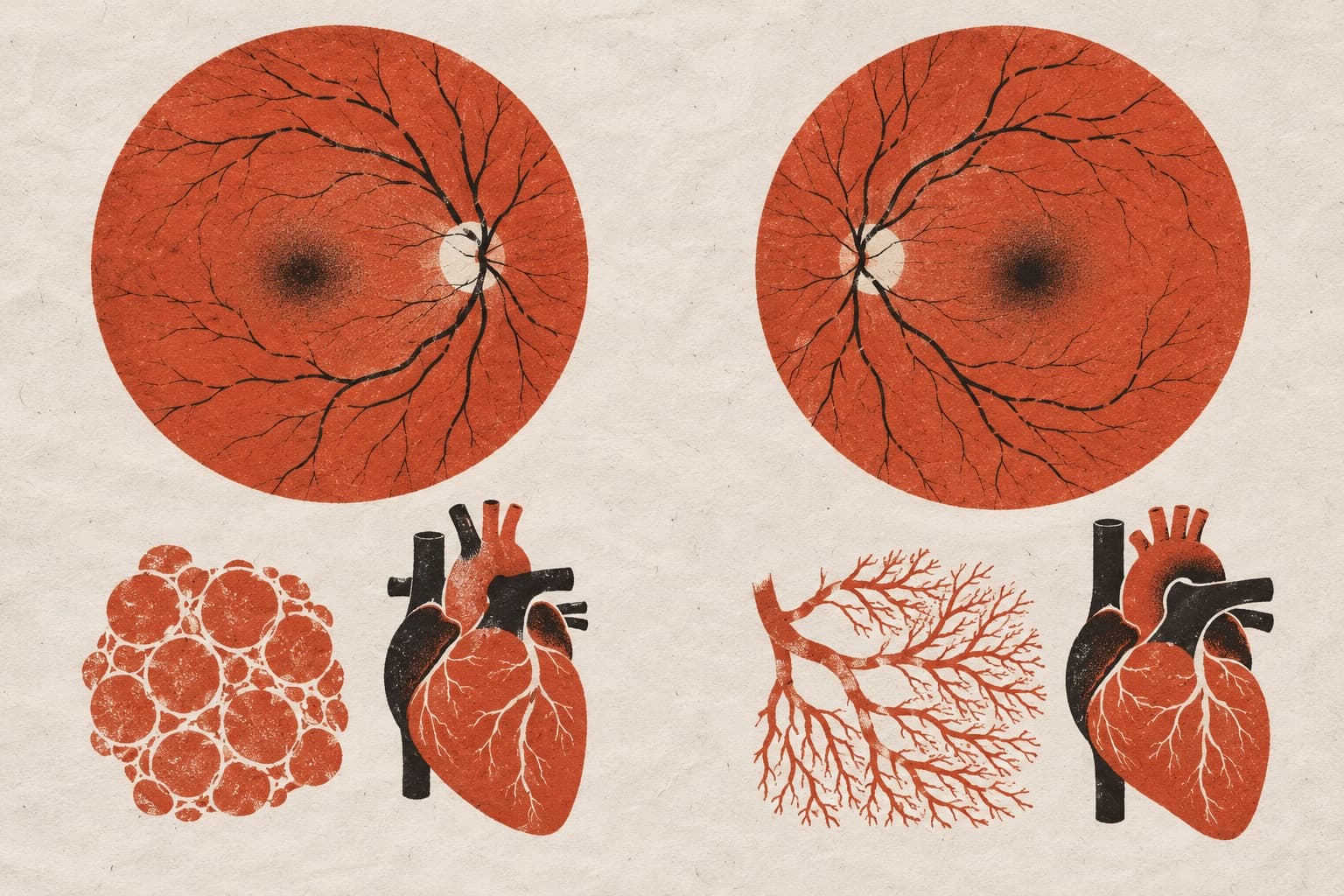
Using Elastic-Net, XGBoost, and Cox regression analyses with correction for multiple testing, the researchers identified 26 factors independently associated with probable disease. Age, female sex, and postmenopausal status showed the strongest positive associations. Several systemic indicators of metabolic and vascular aging—including diabetes, higher random plasma glucose, larger waist circumference, and elevated pulse pressure—were independently tied to higher risk, whereas body mass index showed an inverse association.
Why it matters
The findings suggest that primary angle-closure glaucoma is not merely an anatomical eye disorder, but may also be driven by broader systemic metabolic and vascular aging processes.
Caveats
The observational design cannot establish causality, and the study tracked probable rather than definitively confirmed diagnoses.
The paper
Show 19 more authors
Canqing Yu, Pei Pei, Ling Yang, Yiping Chen, Enzhong Jin, Ting Shen, Jie Yu, Bin Wang, Zhi Chen, Ruoyan Wei, Jian Wang, Xiaoming Yang, Junshi Chen, Zhengming Chen, Xingtao Zhou, Yongyue Wei, Jun Lv, Liming Li, Huaidong Du,Peking University
Asia-Pacific Journal of Ophthalmology · 26 Sep 2026