Deleting liver growth hormone receptors accelerates aging phenotypes and shortens lifespan in mice
The loss of hepatic growth hormone signaling disrupts lipid metabolism and causes mitochondrial damage that can be counteracted by inhibiting PDK4.
Aging Cell
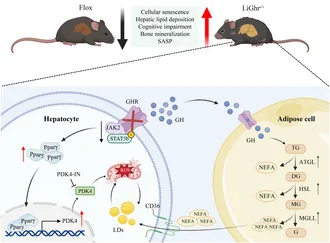
In a study of mice, researchers found that deleting the growth hormone receptor specifically in hepatocytes accelerated aging-related decline. The genetically modified mice showed shortened lifespans, increased cellular senescence, cognitive decline, reduced bone mineralization, and worse inflammaging. They also showed impaired resilience to metabolic stress. Loss of liver growth hormone receptors raised circulating growth hormone levels, driving adipose tissue lipolysis and CD36-dependent liver fat accumulation. This deficiency worsened liver pathologies in both naturally aged mice and mice fed a high-fat diet. Mechanistically, hepatic receptor loss impaired STAT5b phosphorylation and elevated PPARγ expression, which upregulated Pdk4 and Cd36 transcription to trigger mitochondrial damage and lipid buildup. Pharmacologically inhibiting PDK4 in vivo alleviated these age-related pathologies.
Why it matters
The findings identify hepatic growth hormone receptor signaling as a key regulator of systemic aging and highlight PDK4 as a potential therapeutic target for age-related liver disorders.
Caveats
The study was conducted exclusively in mouse models, so further research is needed to determine whether these mechanisms apply to humans.
The paper
Dalian Medical University
Aging Cell · 26 Sep 2026 · CC BY