Ghrelin alleviates aging-related cognitive decline in mice
The peptide suppressed inflammation and microglial senescence in mouse models, acting through an autophagy-related signaling pathway.
Aging Cell
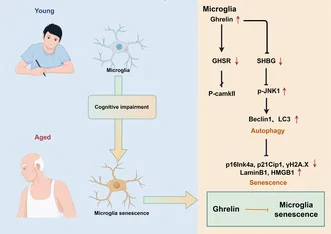
In older and D-galactose-induced mouse models, ghrelin treatment improved cognitive function, attenuated microglial senescence, and suppressed inflammation. The study followed human cohort analyses that identified ghrelin as the factor most strongly associated with cognitive impairment. Both aged and D-galactose mouse models initially displayed cognitive deficits, microglial senescence, inflammation, and elevated ghrelin levels. In cultured microglia, transcriptomic profiling showed enriched autophagy pathways after ghrelin exposure, accompanied by increased Beclin1 and LC3 and decreased p62. Further cell experiments indicated that sex hormone-binding globulin acts as a potential mediator of ghrelin signaling, with its overexpression or JNK1 inhibition blunting the anti-senescent and autophagy-related responses.
Why it matters
The results suggest that metabolic regulators and microglial autophagy signaling may play a role in brain aging and neuroinflammation.
Caveats
The therapeutic effects and signaling mechanisms were investigated in mice and cell cultures, while human cohort data were purely observational. Additionally, high doses of ghrelin induced receptor desensitization in the animal models.