Leveraging machine learning algorithms to assess the impact of cervical cancer early detection on patients' survival
Declared no competing interests
Abstract
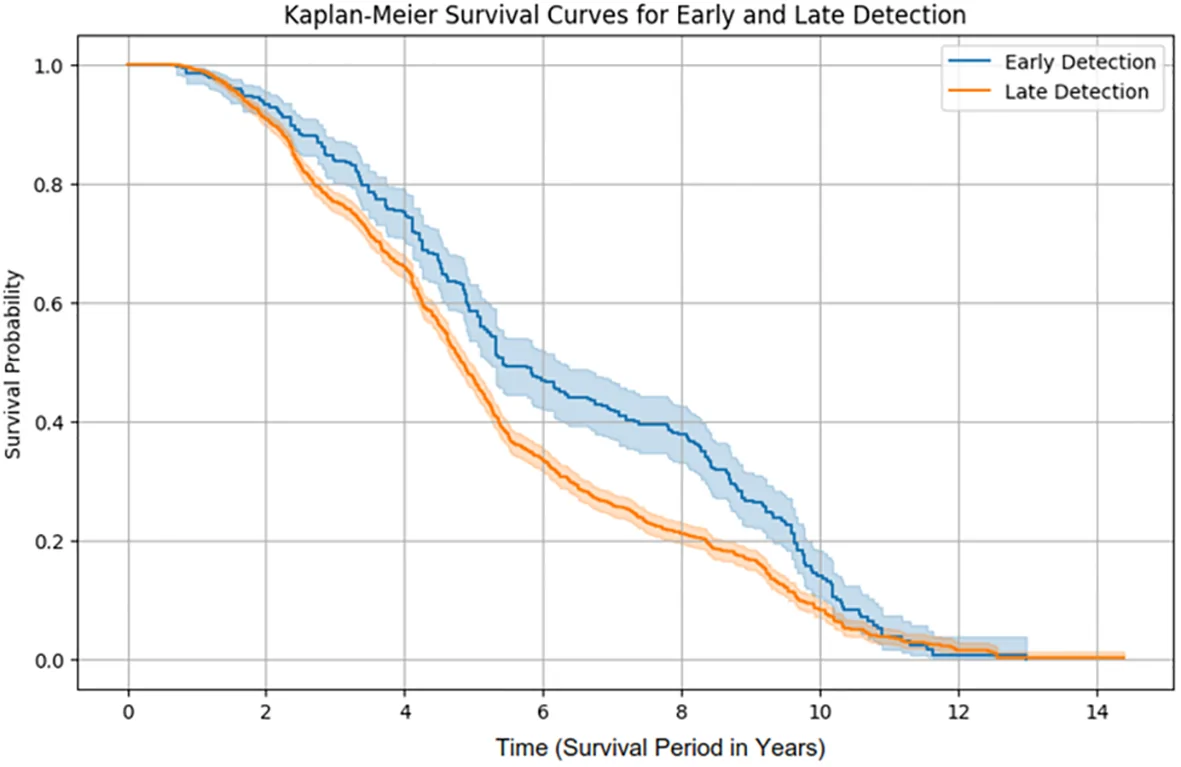
BACKGROUND: Cervical cancer morbidity and mortality remain a significant global health challenge worldwide, with an age-standardized incidence rate (ASR) of 7.3/100,000 in 2022. Low and Middle-Income Countries (LMICs), especially sub-Saharan Africa, have the highest incidence and mortality of cervical cancer, with 70% to 90% of cervical cancer cases and deaths, respectively. Despite Rwanda's considerable efforts, cervical cancer remained the second most prevalent cancer among Rwandan women in 2023. Although numerous studies have explored the relationship between early detection and better outcomes, there is a lack of comprehensive research assessing the overall impact of early detection on patient survival in Rwanda. This study sought to explore the impact of early detection on survival outcomes, explore the use of machine learning (ML) techniques for survival prediction in cervical cancer patients, to provide a thorough understanding of the impact of cervical cancer early detection on patient survival. METHODS: This retrospective cohort study analyzed data from the Rwanda National Cancer Registry (2016-2023). Kaplan-Meier survival analysis, Log-rank Test, and Cox proportional hazards models were employed to evaluate survival rates and risk factors. Gradient Boosting, Logistic Regression, and Survival Support Vector Machines (SSVM) models were developed, tested, and validated using 5-fold stratified cross-validation for survival prediction. Data cleaning retained 2,476 records with complete clinical information. RESULTS: Early detection reduced the hazard of death by 39% compared to late detection. The Gradient Boosting ML Model demonstrated superior performance with an accuracy of 82.2%, sensitivity of 99.7%, and the lowest Brier score of 0.1408. 5-fold cross-validation confirmed model stability (AUC 0.550 ± 0.038 for Gradient Boosting. Key predictors of poor survival included older age at diagnosis and HIV positivity. CONCLUSION: Early detection significantly improves survival outcomes for cervical cancer patients. HIV positivity and age at diagnosis returned as key influencers for the survival outcome. ML models offer robust predictive capabilities, enabling resource optimization and personalized care in LMICs. Findings emphasize the importance of scaling early detection initiatives and leveraging ML for informed decision-making in cervical cancer management.
From the paper
- Participants
Among the 431 deceased patients, a majority (59%) were diagnosed at a late stage, while only 7% were diagnosed early.
Results, Presentation of study population and their characteristics
- Result
HIV Status: Being HIV-positive was associated with a significantly higher risk of death (HR = 2.12; 95% CI: 1.50–3.00; p< 0.001).
- Limitation
A major constraint was the high proportion of records with unknown detection stage (42.5%) and HIV status (67.2%), consistent with documented challenges of data completeness in routine cancer registry reporting in resource-limited settings.
Quoted word for word from the full text on PubMed Central.
The paper
University of Rwanda
Frontiers in Oncology, 1 Sep 2026