Rapamycin increases brain blood flow in Alzheimer's gene carriers
After four weeks of daily rapamycin, brain blood flow rose more than 15% from baseline across multiple regions in carriers; non-carriers showed no significant change.
Non-randomized trial
Limit: Blood pressure changes could contribute to increased brain blood flow; post-treatment pressure was not measured
Edited by Boris Djordjevic · AgingResearch.News
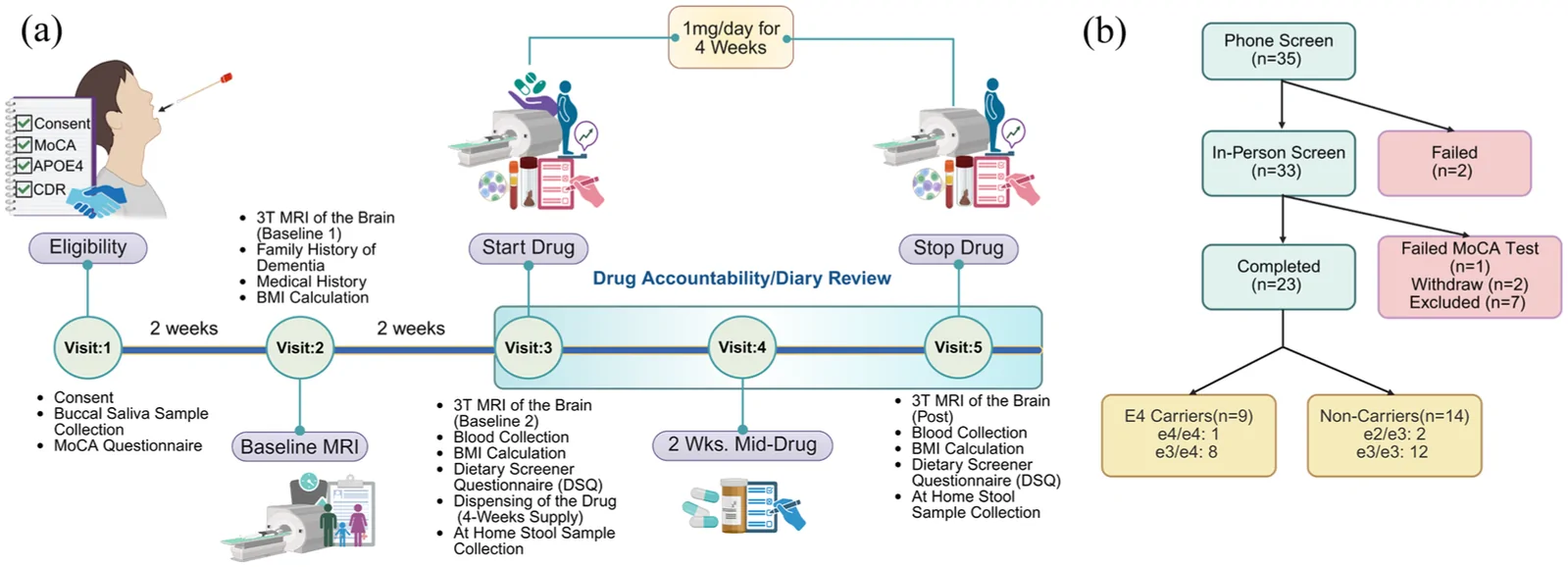
In a single-arm pilot trial, 23 cognitively normal adults aged 45 to 65 years, including nine carriers of the apolipoprotein E4 (APOE4) gene variant and 14 non-carriers, took one milligram of rapamycin daily for four weeks. The trial evaluated blood flow in the brain, along with blood markers of metabolism, inflammation, and Alzheimer's disease.
In APOE4 carriers, brain blood flow increased by more than 15% across multiple brain regions. Non-carriers showed no significant change in brain blood flow. Blood markers of metabolism and inflammation also changed. One inflammation-related protein decreased in carriers, while another increased in both groups. Levels of Alzheimer's disease biomarkers showed no significant changes. The authors reported that the treatment had minimal adverse effects.
Why it matters
APOE4 carriers often develop problems with blood vessel function in the brain decades before Alzheimer's disease symptoms appear. The authors suggest that addressing these early problems may help delay or slow the disease's progression.
Caveats
The trial had no control group or randomization, so changes over the four-week treatment cannot be definitively attributed to rapamycin alone. The findings come from just 23 cognitively normal adults aged 45 to 65, including only nine APOE4 carriers, and may not apply to older populations or individuals with cognitive impairment.
From the paper
- Participants
Ultimately, 23 participants completed the 4-week intervention between March 2, 2023 and July 19, 2024.
- Who took part
Cognitively normal adults aged 45 to 65 years were recruited from Columbia, Missouri; full eligibility criteria are listed in.
- Analyzed for cerebral blood flow
Nine were E4(+; 1 e4/e4, 8 e3/e4), and 14 were E4−; 12 e3/e3, 2 e2/e3).
- Primary outcome
After 4 weeks of rapamycin treatment, CBF was increased in the overall study sample (3.08; 95% CI: 0.16, 6.00, p = 0.04), particularly E4(+) participants, who showed a significant increase in CBF (4.68; 95% CI: 0.003, 9.36, p = 0.05).
- Harms
Two participants experienced minor side effects, and all adverse events were graded according to the Common Terminology Criteria for Adverse Events (CTCAE; Supplemental Table 6).
- Limitation
First, the relatively small sample size limited statistical power and precluded meaningful sex-stratified analyses, which will be an important priority in future investigations.
- Cerebral blood flow
No overall significant group-averaged CBF changes were observed in the E4(−) group.
- Inflammation
shows that the E4(+) group exhibited significant post-treatment reductions in monocyte chemoattractant protein-1 (MCP-1), a key mediator of inflammation and tissue injury (−0.155; 95% CI: −0.307, −0.003, p = 0.046).
Quoted word for word from the full text on PubMed Central.
The paper
University of Missouri
Journal of Cerebral Blood Flow and Metabolism, Sep 10, 2026, Open access