Brain blood flow may mark resilience in people at Alzheimer’s risk
An observational study of 148 older adults without cognitive impairment linked higher blood flow to better thinking only in a subgroup carrying an Alzheimer’s-associated gene variant.
148 participants
Limit: A single blood-test cutoff could mix Alzheimer's stages and hide associations with worse thinking
Edited by Boris Djordjevic · AgingResearch.News
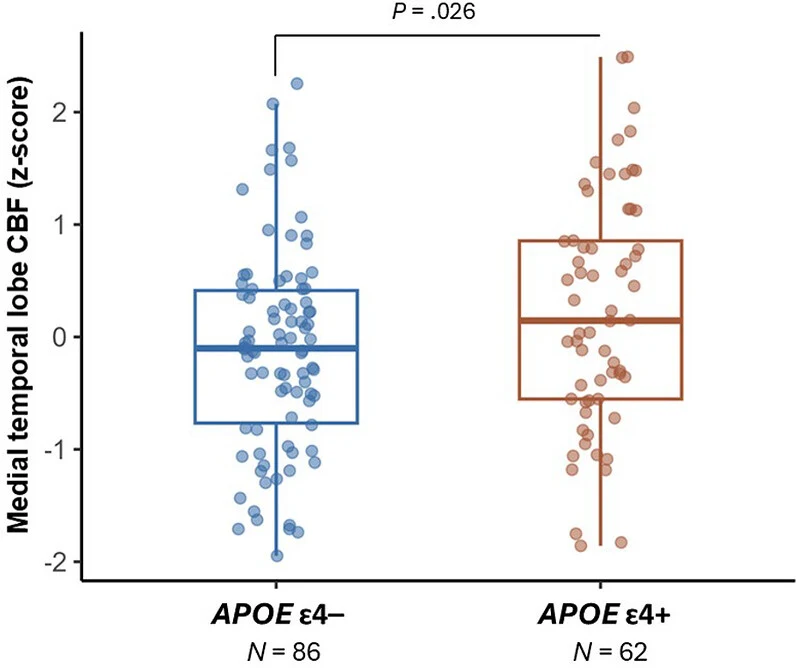
In an observational study, 148 older adults without cognitive impairment underwent brain scans to measure blood flow in the medial temporal lobe, a brain region involved in memory. Researchers assessed memory and executive function, the skills used to plan and manage tasks. They also assessed a blood marker of Alzheimer’s-related changes in 126 participants.
Carriers of APOE ε4, a gene variant linked to Alzheimer’s risk, had higher blood flow in this region than noncarriers. Higher blood flow was associated with better executive function only among carriers who tested negative for the blood marker. The researchers suggested that higher blood flow may mark resilience in carriers without detectable Alzheimer’s-related changes.
Why it matters
The work bears on whether elevated brain blood flow in older adults at genetic risk for Alzheimer’s reflects resilience or dysfunction.
Caveats
This observational study cannot show that higher blood flow caused better cognitive performance. Blood-marker results were available for only 126 participants, and the findings concern older adults without cognitive impairment.
From the paper
- Participants
The present study excluded individuals who met the Jak-Bondi criteria for possible MCI,33 resulting in a final sample of 148 cognitively unimpaired participants with valid APOE genotyping and pseudo-continuous arterial spin labeling (pCASL) MRI scans.
- Result
… there was no significant MTL CBF × APOE ɛ4 interaction and there is no significant association between MTL CBF and executive function in either APOE ɛ4 carriers (b = -0.020, SE = 0.209, 95% CI [-0.447, 0.407], p = 0.92) or noncarriers (b = 0.063, SE = 0.182, 95% CI [-0.309, 0.435], p = 0.73).
Quoted word for word from the full text on alz-journals.onlinelibrary.wiley.com.
- Memory
- Executive function
- Alzheimer's disease
- Medial temporal lobe cerebral blood flow
- Medial temporal lobe cortical volume
- Humans
The paper
Cerebral blood flow as a biomarker of resilience in cognitively unimpaired APOE ɛ4 carriers
University of Southern California
Alzheimer's & Dementia, Oct 2026, Open access