Mitochondria help keep lysosomes acidic in human cells
Experiments in lab-grown human cells found that restoring contact between energy-producing and recycling compartments reversed the loss of acidity inside lysosomes.
Edited by Boris Djordjevic · AgingResearch.News
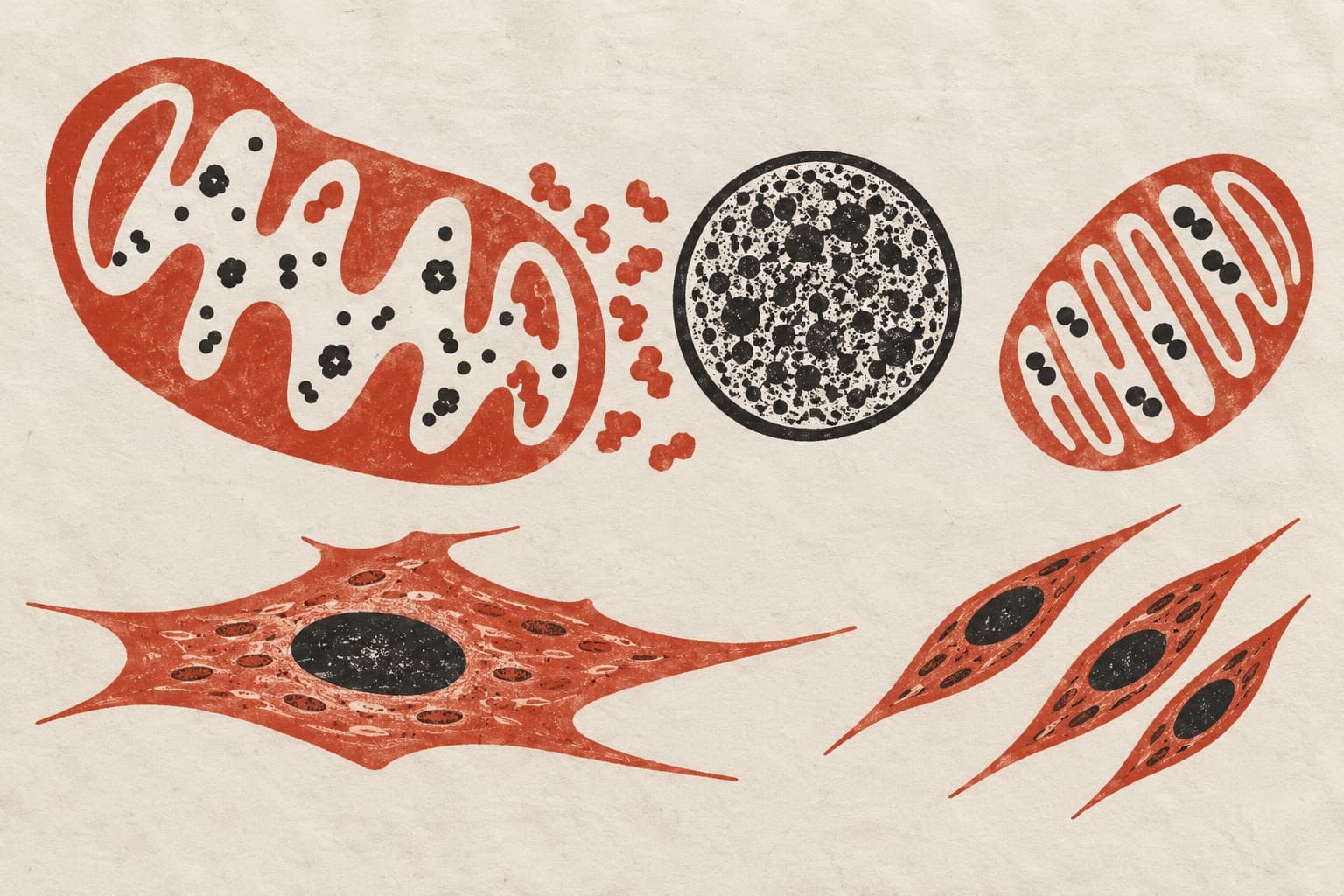
In experiments with yeast and human cells grown in the lab, researchers studied how mitochondria, the cell’s energy-producing compartments, helped keep cellular recycling compartments acidic. These recycling compartments are called vacuoles in yeast and lysosomes in human cells. The human experiments included fibroblasts, connective-tissue cells, made senescent—a lasting nondividing state—by radiation and examined 10 days later.
At sites where the compartments’ membranes touched, recycling compartments took up hydrogen ions pumped out by mitochondria. These ions create acidity. Aging in yeast and senescence in human cells disrupted these contacts, reducing acidity. An engineered linker connecting the compartments restored acidity. In senescent human cells, preserving lysosome acidity also restored autophagic flux, the flow of cellular material through a breakdown-and-recycling process.
Why it matters
Loss of acidity in cellular recycling compartments is a hallmark of aging and age-related disease. The work addresses how cells lose conditions essential for breaking down their contents as they age.
Caveats
These were laboratory cell experiments, including radiation-induced senescence in human fibroblasts, not studies of aging or lifespan in people.
The paper
Mitochondria-lysosome coupling contributes to lysosome acidification and aging
Buck Institute for Research on Aging
Molecular Cell, May 29, 2026, Open access


Comments
Be the first to comment.